
Begin of page section:
Page sections:

  • Go to contents (Accesskey 1)
  • Go to position marker (Accesskey 2)
  • Go to main navigation (Accesskey 3)
  • Go to sub navigation (Accesskey 4)
  • Go to additional information (Accesskey 5)
  • Go to page settings (user/language) (Accesskey 8)
  • Go to search (Accesskey 9)

End of this page section. Go to overview of page sections

Begin of page section:
Page settings:

English en
Deutsch de
Search
Login

End of this page section. Go to overview of page sections

Begin of page section:
Search:

Search for details about Uni Graz
Close

End of this page section. Go to overview of page sections


Search

Begin of page section:
Main navigation:

Page navigation:

  • University

    University
    • About the University
    • Organisation
    • Faculties
    • Library
    • Working at University of Graz
    • Campus
    Developing solutions for the world of tomorrow - that is our mission. Our students and our researchers take on the great challenges of society and carry the knowledge out.
  • Research Profile

    Research Profile
    • Our Expertise
    • Research Questions
    • Research Portal
    • Promoting Research
    • Research Transfer
    • Ethics in Research
    Scientific excellence and the courage to break new ground. Research at the University of Graz creates the foundations for making the future worth living.
  • Studies

    Studies
    • Prospective Students
    • Students
  • Community

    Community
    • International
    • Location
    • Research and Business
    • Alumni
    The University of Graz is a hub for international research and brings together scientists and business experts. Moreover, it fosters the exchange and cooperation in study and teaching.
  • Spotlight
Topics
  • Our digital Advent calendar
  • Sustainable University
  • Researchers answer
  • Work for us
Close menu

End of this page section. Go to overview of page sections

Begin of page section:
You are here:

University of Graz News How do we turn taxes into profit?

End of this page section. Go to overview of page sections

Friday, 24 May 2019

How do we turn taxes into profit?

A carbon tax is an effective instrument to reduce greenhouse gas emissions. Photo: iStock.com/Olivier Le Moal ©Olivier Le Moal

A carbon tax is an effective instrument to reduce greenhouse gas emissions. Photo: iStock.com/Olivier Le Moal

The Environmental Law Forum at the University of Graz is analysing ways to implement an environmentally friendly, socially and economically viable fiscal reform

Many experts conclude that carbon taxes and other taxes related to the environment are particularly powerful and cost-effective instruments for fulfilling the Paris Agreement climate objectives and the UN’s Sustainable Development Goals (SDGs). The general public, on the other hand, is less than enthusiastic about the idea of paying more taxes. “If it’s done in an intelligent way, a carbon tax can stimulate positive trends both in terms of social justice as well as economic prosperity”, notes the economist Karl Steininger. The Environmental Law Forum, which takes place at the University of Graz on 29 May 2019, will present examples of international best practices and paths towards an environmentally friendly, socially and economically viable fiscal reform, which can also be chosen in Austria.

As the name suggests, a carbon tax is an environmental tax on carbon dioxide and other greenhouse gases. As a result, goods which entail higher levels of emissions are more expensive. This price signal is designed as an incentive for companies and consumers to switch to more sustainable alternatives. Until now, politicians in Austria have been opposed to the introduction of a carbon tax. An argument: The public cannot be expected to pay additional taxes. Karl Steininger from the Wegener Center for Climate and Global Change at the University of Graz argues that a carbon tax doesn’t need to be a burden for households and the economy, citing examples from other countries.

The climate economist mentions Switzerland as a role model. “They introduced a carbon tax there in 2007, and the revenues are redistributed among the population, per capita, as a climate bonus. Employers receive part of it, which lowers their incidental wage costs. The rest of the funds are paid out to citizens through their social insurance provider”. Although consumers initially pay more for emission-intensive goods, at least they are refunded part of these costs. The amount of the climate bonus is the same for everyone. Those whose carbon expenses are less than the amount of the bonus actually make a profit.
Steininger uses this example to dismantle a stereotype: It is not necessarily those with a lower socioeconomic status who are punished by carbon taxes. “Our studies have shown that CO2 consumption per capita increases with income. Hence poorer households in Switzerland often receive more than they pay in”.

Another example of how effective a carbon tax can be without curtailing economic growth comes from a Scandinavian country. “Since the introduction of a carbon tax in 1991, Sweden has reduced its emissions, measured in CO2 equivalents, by 26 percent. At the same time, its economy has grown more than Austria’s, and it has been in the direction of a sustainable structure. Here in Austria, however, our emissions have increased”, says Steininger. At the same time, the researcher notes that the laws of economics cannot be ignored. “To remain internationally competitive, Sweden’s export-oriented and emission-intensive economy is exempt from the carbon tax”.

This is just one of many international experiences that will be shared at the Environmental Law Forum on 29 May 2019 at the University of Graz. The event is under the scientific direction of climate researcher Gottfried Kirchengast, environmental lawyers Gerhard Schnedl and Eva Schulev-Steindl as well as Karl Steininger. They are also addressing the question of how a carbon tax could benefit Austria.
“Austria has overlooked this option in the recent tax reform”, regrets Steininger. “Although the tax on petroleum is relatively high here, it still can’t cover all the costs that arise in connection with transport: everything from maintaining roads to health and the environment”. This is why Steininger feels an additional carbon tax is necessary. It would also make sense for heating, farming and waste management.

“A price regulation would provide key players with more leeway than demands and bans would. It would allow companies and individuals to make the adjustments they can implement most easily, depending on their situation”, says Steininger, which is why he argues in favour of environmental taxes. It is important to always see things from a holistic perspective. “The taxes have to be introduced in a way that all 17 SDGs, including those of a social and economic nature, can be achieved”.
>> Environmental law forum

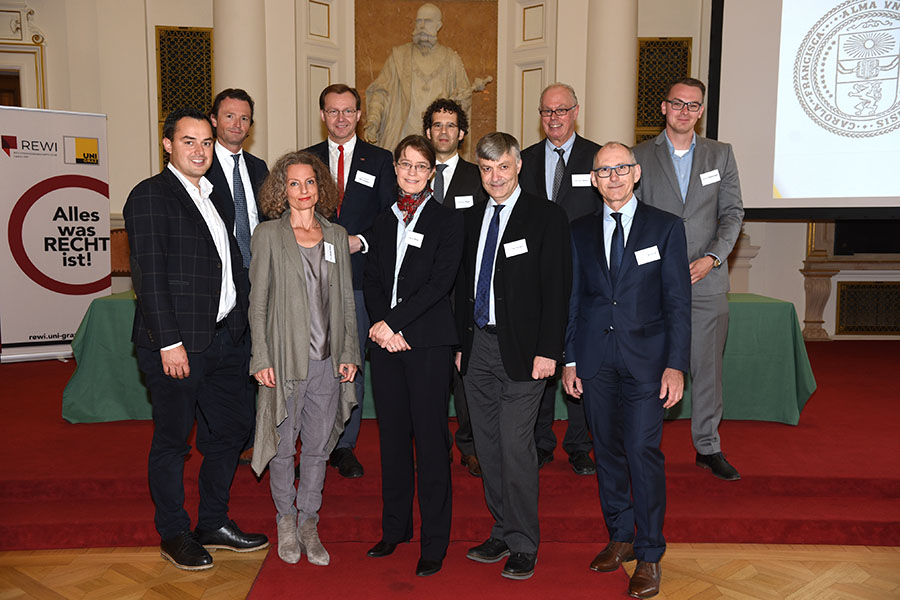
Environmental Law Forum 2019 (f.l.): a person who does not want to be mentioned, Johannes Zollner, Tina Ehrke-Rabel, Gottfried Kirchengast, Karen Pittel, Florens Flues, Karl Steininger, Richard Sturn, Gerhard Schnedl, Robin Damberger. Photo: Uni Graz/Pichler
Environmental Law Forum 2019 (f.l.): person does not want to be mentioned, Johannes Zollner, Tina Ehrke-Rabel, Gottfried Kirchengast, Karen Pittel, Florens Flues, Karl Steininger, Richard Sturn, Gerhard Schnedl, Robin Damberger. Photo: Uni Graz/Pichler
created by Gudrun Pichler

Related news

Semester abroad without barriers: University of Graz wins award for promoting inclusion

The University of Graz has been awarded the Internationalization Award for its new inclusion initiative. Students with fewer opportunities now also receive financial support for their semester abroad outside Europe.

Fair distribution: Researchers determine just greenhouse gas budgets for all EU regions

Ten years ago, on 12 December 2015, the Paris Climate Agreement was signed at the UN Climate Conference. In order to limit global warming to well below two degrees, only a certain amount of CO2 may be emitted worldwide. While the focus was originally on national emission targets, more than 200 subnational regions and almost 300 cities have now adopted their own targets. But how many emissions are they fairly entitled to? Researchers at the University of Graz have now developed transparent criteria for fair distribution at the subnational level for the first time and determined corresponding greenhouse gas budgets for all European regions. The paper was published today in the scientific journal Nature Communications.

Chemical Christmas show at the University of Graz: An explosive evening at the Schauspielh

At the beginning of December, the University of Graz transformed the theater into a laboratory: as part of “Chemical Life,” teacher training students staged a chemical Christmas show for Styrian school classes—complete with ethanol rockets, nitrogen snow, and glowing effects. An evening designed to inspire interest in studying chemistry.

Train by train: Koralm railway accelerates exchange between the Universities

Lectures at the University of Klagenfurt in the morning, seminars at the University of Graz in the afternoon: Austria's longest tunnel and a journey time of around 45 minutes make it easy. The Koralm railway increases the speed of networking between the two university locations. The collaboration builds on existing cooperation - for example in the areas of teacher training, Slavic studies and as employers, the universities are well coordinated.

Begin of page section:
Additional information:

University of Graz
Universitaetsplatz 3
8010 Graz
Austria
  • Contact
  • Web Editors
  • Moodle
  • UNIGRAZonline
  • Imprint
  • Data Protection Declaration
  • Accessibility Declaration
Weatherstation
Uni Graz

End of this page section. Go to overview of page sections

End of this page section. Go to overview of page sections

Begin of page section:

End of this page section. Go to overview of page sections