



Begin of page section:
Page sections:

  • Go to contents (Accesskey 1)
  • Go to position marker (Accesskey 2)
  • Go to main navigation (Accesskey 3)
  • Go to sub navigation (Accesskey 4)
  • Go to additional information (Accesskey 5)
  • Go to page settings (user/language) (Accesskey 8)
  • Go to search (Accesskey 9)

End of this page section. Go to overview of page sections

Begin of page section:
Page settings:

English en
Deutsch de
Search
Login

End of this page section. Go to overview of page sections

Begin of page section:
Search:

Search for details about Uni Graz
Close

End of this page section. Go to overview of page sections


Search

Begin of page section:
Main navigation:

Page navigation:

  • University

    University
    • About the University
    • Organisation
    • Faculties
    • Library
    • Working at University of Graz
    • Campus
    Developing solutions for the world of tomorrow - that is our mission. Our students and our researchers take on the great challenges of society and carry the knowledge out.
  • Research Profile

    Research Profile
    • Our Expertise
    • Research Questions
    • Research Portal
    • Promoting Research
    • Research Transfer
    • Ethics in Research
    • Commission for Scientific Integrity
    Scientific excellence and the courage to break new ground. Research at the University of Graz creates the foundations for making the future worth living.
  • Studies

    Studies
    • Prospective Students
    • Students
    • Registration for Study Programme (Winter semester 2026/27)
  • Community

    Community
    • International
    • Location
    • Research and Business
    • Alumni
    The University of Graz is a hub for international research and brings together scientists and business experts. Moreover, it fosters the exchange and cooperation in study and teaching.
Topics
  • Sustainable University
  • Researchers answer
  • Work for us
Close menu

End of this page section. Go to overview of page sections

Begin of page section:
You are here:

University of Graz News Train together

End of this page section. Go to overview of page sections

Tuesday, 28 April 2020

Train together

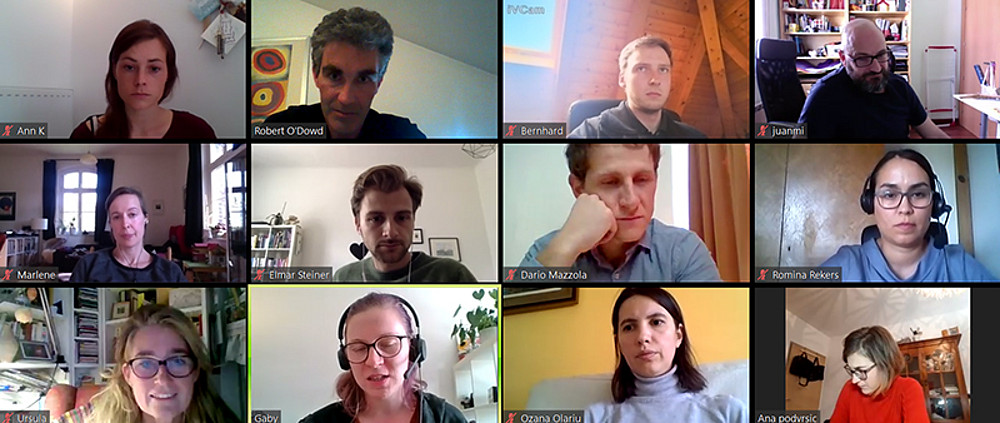
Training together: the "Teaching in English" training courses haven been opened to teaching staff of Arqus partner universities - with great success. Photo: Uni Graz/Goldgruber.

Training together: the "Teaching in English" training courses haven been opened to teaching staff of Arqus partner universities - with great success. Photo: Uni Graz/Goldgruber.

Teaching in English training open to teaching staff of Arqus partner universities

In times of the corona-induced lockdown, lecturers at all European universities are mainly involved in online teaching. The 26 participants in the latest edition of the "Teaching in English" course at the University of Graz have shown that, in addition to this intensive form of teaching, there can be enough time for further training. Between 8 and 21 April 2020, they followed the online training from their home offices in Graz, Bergen, Granada and Leipzig by, thus, representing four of the seven Arqus partner universities. Ten lecturers of the teaching staff of the University of Graz as hosting institution of this online training attended the Certificate Course (8) and the Refresher Course (2).

„In the current situation, the Arqus European University Alliance remains committed to promoting a multicultural, multilingual and inclusive Europe which is open to the world. Therefore, we had opened this training to our Arqus partners as part of the Action Line 4 ‘Multilingual and Multicultural University’”, explains Daniela Unger-Ullmann, responsible for Action Line 4 at Graz University and head of treffpunkt sprachen. The "Teaching in English" courses are organised by the Human Resources Development of the University of Graz together with the Office of International Relations and treffpunkt sprachen - Centre for Language, Plurilingualism and Didactics.

The free training is part of the initiative to increase the number of courses offered in English at the University of Graz and aims to support teachers in implementing English-language teaching. The Refresher course was intended for university teachers who were already familiar with the basics of English Medium Instruction (EMI). Participants learnt how to keep their students interested and motivated by making online teaching interactive, entertaining, supportive and with lots of opportunities for students to participate actively.

The Certificate “Teaching in English” course was intended for university teachers who were interested in learning how to teach their subjects through English. The first objective of the course was to familiarize participants with a variety of teaching strategies and scaffolding techniques suitable for teaching through English in university classrooms. The second objective was to reflect on the different issues and challenges related to teaching groups of international learners. All participants received a certificate at the end of the courses. They were full of praise for the smooth organisation, the complex content and the inspiring lecturer Robert O'Dowd from the University of León, Spain.

With the aim that this article also increases competence in the English language, the original feedback provided (with the consent of the participants) is reproduced here in extracts:

“It’s been a long time since I enjoyed a course like this one that much! It’s not only that Robert has been really an amazing teacher, it is also the usefulness of contents and tools and how he has shown us. I’ve learned a lot and I’ve seen a lot of possibilities to use them in my classes.”

“I really enjoyed the course and believe that, given the circumstances, you organized everything in the best possible way – including the celebration.”

"I indeed enjoyed much the course and learnt plenty of useful things. I am very glad that I had participated and would like to thank you again for giving me the opportunity to join the workshop.”

“Arqus is a great collaboration network. I'd like to participate more often.”

“It was already my second course with Robert as instructor, he is doing this in an excellent way and he should feel celebrated, as well.”

“I very much enjoyed the course and I am already putting it into practice. “


About Arqus:

Together with the universities of Granada (Spain), Bergen (Norway), Leipzig (Germany), Lyon (France), Padua (Italy) and Vilnius (Lithuania), the University of Graz has established the European University Alliance "Arqus" in order to foster its cooperation in research, teaching, administration and social commitment and, thus, to contribute to the excellence and attractiveness of the European higher education area. The seven partner universities bring together nearly 310.000 students and 40.000 staff members. Each university has not only a leading role in European projects and internationalisation processes, but also an important part in the regional development at the respective locations.

created by Gerhild Leljak & Anja Hoffmann

Related news

Complying with the norm: Why Do Standards Shape Our Lives, Elisabeth Staudegger?

Standards determine whether a sheet of paper fits in a printer or whether a charging plug can power multiple devices. These standards shape our everyday lives. But who actually sets these standards? Where are the weaknesses, and how could science help to improve them? Elisabeth Staudegger, Head of the ‘Law and IT’ Department at the Institute for Legal Foundations at the University of Graz, host the Academic Standards Day on 16 June. Here she relays how sciences can contribute to the topic of standardisation and reveals her personal favourite standard.

More body awareness than a culture war

In Italy, sex education lessons will in future only be permitted with parental consent, and will be banned entirely in nurseries and primary schools. At the same time, Pride Month highlights why knowledge about the body, relationships, boundaries and diversity is important for young people. A study by the University of Graz shows how important knowledge about the body, contraception, relationship skills and protection against violence is

Will Austria win the World Cup? Mathematician reveals calculation method

Michael Fischer uses the football tournament as a practical example for highschool lessons.

Survival strategies: How plants respond to drought

According to Geosphere Austria, this spring was the driest in Austria since records began around 170 years ago. The low rainfall put particular pressure on the agricultural sector. And climate change is set to make the situation even worse in the coming decades. We asked Johannes Liesche, a professor at the Department of Biology at the University of Graz, how plants react to water shortages and how they survive periods of drought.

Begin of page section:
Additional information:

University of Graz
Universitaetsplatz 3
8010 Graz
Austria
  • Contact
  • Web Editors
  • Moodle
  • UNIGRAZonline
  • Imprint
  • Data Protection Declaration
  • Accessibility Declaration
Weatherstation
Uni Graz

End of this page section. Go to overview of page sections

End of this page section. Go to overview of page sections

Begin of page section:

End of this page section. Go to overview of page sections

