Begin of page section:
Page sections:

  • Go to contents (Accesskey 1)
  • Go to position marker (Accesskey 2)
  • Go to main navigation (Accesskey 3)
  • Go to sub navigation (Accesskey 4)
  • Go to additional information (Accesskey 5)
  • Go to page settings (user/language) (Accesskey 8)
  • Go to search (Accesskey 9)

End of this page section. Go to overview of page sections

Begin of page section:
Page settings:

English en
Deutsch de
Search
Login

End of this page section. Go to overview of page sections

Begin of page section:
Search:

Search for details about Uni Graz
Close

End of this page section. Go to overview of page sections


Search

Begin of page section:
Main navigation:

Page navigation:

  • University

    University
    • About the University
    • Organisation
    • Faculties
    • Library
    • Working at University of Graz
    • Campus
    Developing solutions for the world of tomorrow - that is our mission. Our students and our researchers take on the great challenges of society and carry the knowledge out.
  • Research Profile

    Research Profile
    • Our Expertise
    • Research Questions
    • Research Portal
    • Promoting Research
    • Research Transfer
    • Ethics in Research
    • Commission for Scientific Integrity
    Scientific excellence and the courage to break new ground. Research at the University of Graz creates the foundations for making the future worth living.
  • Studies

    Studies
    • Prospective Students
    • Students
  • Community

    Community
    • International
    • Location
    • Research and Business
    • Alumni
    The University of Graz is a hub for international research and brings together scientists and business experts. Moreover, it fosters the exchange and cooperation in study and teaching.
  • Spotlight
Topics
  • Sustainable University
  • Researchers answer
  • Work for us
Close menu

End of this page section. Go to overview of page sections

Begin of page section:
You are here:

University of Graz News Microcredit and moral economy: Tanja Skambraks explores the innovative Middle Ages

End of this page section. Go to overview of page sections

Tuesday, 02 July 2024

Microcredit and moral economy: Tanja Skambraks explores the innovative Middle Ages

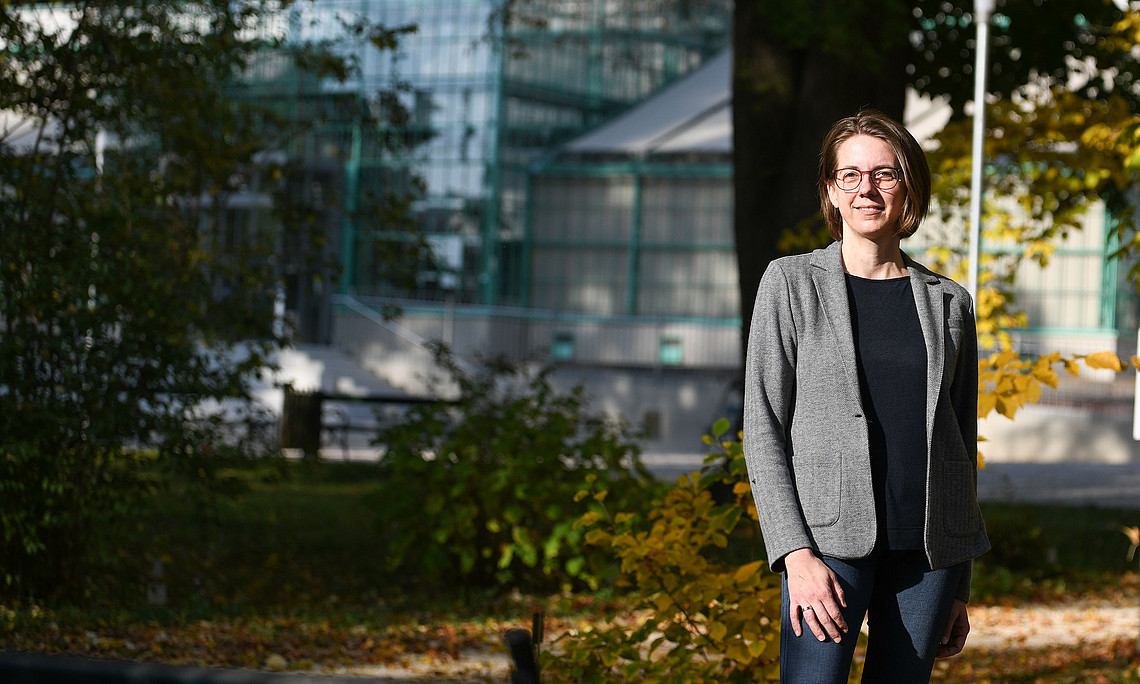
Tanja Skambraks in the inner courtyard of the main building of the University of Graz ©Uni Graz/Tzivanopoulos

Tanja Skambraks, Professor of Medieval History, is strengthening a core topic of the Faculty of Humanities with her research into social and economic historical developments in the Mediterranean region. Photo: Uni Graz/Tzivanopoulos

Castles, monasteries, knights' games - tourism owes a number of attractions to the Middle Ages. An aura of mystery surrounds this era, which stretches from the 6th to the 15th century. It was later described as "dark" by Renaissance scholars. However, this assessment is by no means accurate. "From the 13th century in particular, the Middle Ages were a very innovative time," says Tanja Skambraks. She researches economic and social history topics, such as welfare for the poor, the credit system and moral values in the economy. She has been Professor of Medieval History at the University of Graz since September 2023.

Fighting poverty through microcredits - this is the concept for which Muhammad Yunus, an economist from Bangladesh, was awarded the Nobel Peace Prize in 2006. Who would have thought that this idea was already being implemented in the 13th century? "In the late Middle Ages, 50 to 80 percent of people in cities lived in very precarious conditions - at least some of the time," says Tanja Skambraks. "To counteract poverty and keep the economy going at the same time, Italian city governments granted microloans to the working population to bridge financial bottlenecks." With such a credit a shoemaker, for example, could buy the leather he needed to make shoes.

"Monti di Pietà" - mountains of mercy - was the name of these institutions, which granted small loans to the poor in return for a pledge and low interest. "The first pawnshop of this kind was founded in Perugia in 1462. Around 200 more were established over the next hundred years. In contrast to private money lenders, who demanded interest rates of 20 to 30 percent, the Monti di Pietà only charged four to ten percent," reports Skambraks.

Economy with values
The Franciscans played a key role in the founding of these pawnbroking institutions. With their sermons and writings, the mendicant friars contributed significantly to the development of a Christian economic ethic, shaped by the ideas of charity and the common good.

Today, the term "social economy" is used to describe companies and institutions that are oriented towards democratic principles, solidarity and the common good rather than profit maximisation. The Christian-influenced moral economy of the late Middle Ages does not seem so far from this. In addition to piety, a handbook for merchants describes good practices such as being economical with profits, making contact with the natives of foreign countries, learning their language and dressing appropriately according to their customs. "Letters also show that merchants attached great importance to gaining a reputation as good Christians," says Skambraks. With her research, the historian is opening up new, fascinating insights into medieval societies that are often not so alien to our own.

Skambraks studied medieval history, English and communications in Dresden. She then completed her doctorate at the University of Mannheim, where she also habilitated. At the University of Graz, her research on social and economic historical developments in the Mediterranean region is now strengthening a core topic of the Faculty of Humanities.

Core topic "Trans-Mediterranean Relations"

Publication
Tanja Skambraks: Karitativer Kredit. Die Monti di Pietà, franziskanische Wirtschaftsethik und städtische Sozialpolitik in Italien (15. und 16. Jahrhundert), Franz Steiner 2023

created by Gudrun Pichler

Related news

Around the world in eight stops: the Long Night of Research at the University of Graz

On 24 April from 5 pm, you can take a short trip around the globe at the University of Graz, discovering pecularities of foreign countries or new local features in the entrance hall of the University Library. The itinerary takes you through introduced animal species, political attitudes and the omnipotence of algorithms. There will also be a programme in the historic reading hall, as well as at the UniGraz@Museum and the University Archive.

Studying at the University of Graz: How to enrol

Ready for a new chapter in your life with the start of your studies at the University of Graz in the winter semester 2026/27? Here you will find information on deadlines, admission procedures, registration, and everything else you need to successfully start your studies in the fall.

Interpreting data: Why studies sometimes get it wrong

Hilmar Brohmer and Ziva Korda from the Institute of Psychology, together with 500 international colleagues, have re-evaluated a hundred scientific publications and have often come to different conclusions.

Crystal-clear: AI method revolutionises solar observation

The Sun makes life on Earth possible. However, its magnetic fields can also cause massive disruption. This makes it all the more important to gain a better understanding of the processes taking place on our nearest star. A research team from the University of Graz and the High Altitude Observatory in Boulder (USA) has succeeded in doing just that. The astrophysicists have developed an AI-supported method that makes even the smallest structures on the Sun visible. The scientists are convinced that this will bring about a lasting change in solar observation and that the new method can be used for the planned European Solar Telescope.

Begin of page section:
Additional information:

University of Graz
Universitaetsplatz 3
8010 Graz
Austria
  • Contact
  • Web Editors
  • Moodle
  • UNIGRAZonline
  • Imprint
  • Data Protection Declaration
  • Accessibility Declaration
Weatherstation
Uni Graz

End of this page section. Go to overview of page sections

End of this page section. Go to overview of page sections

Begin of page section:

End of this page section. Go to overview of page sections