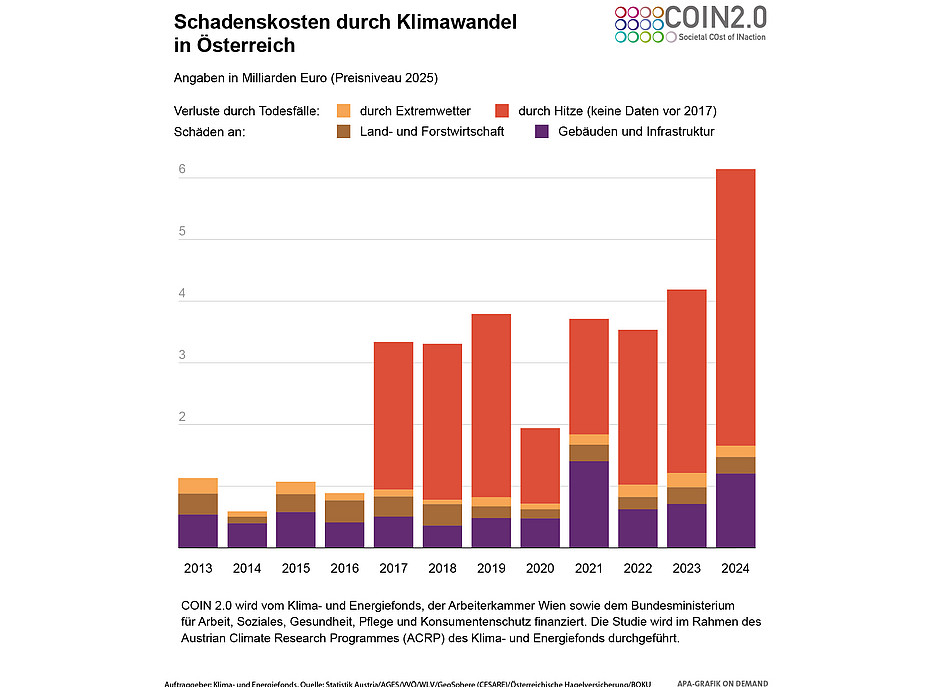



Between 2017 and 2024, climate- and weather-related events caused direct damage and losses in Austria averaging 3.7 billion euros per year. Despite numerous adaptation measures having been put in place, recent years (particularly 2021, 2023 and 2024) have seen a cluster of years with particularly high levels of damage – this year’s summer drought is therefore not a one-off anomaly, but rather a continuation of the trend.
This is the conclusion reached by a comprehensive analysis of the COIN 2.0 study, which is currently being carried out under the leadership of the University of Graz by an interdisciplinary team comprising more than 50 experts from 12 research institutions. The aim of the study is to provide a comprehensive overview of the economic and social costs of the consequences of climate change in Austria and their distribution across different sectors and population groups.
With the first year of the study now complete, findings are available on the damage and losses that have already occurred; these were analysed by the Federal Environment Agency with the support of the Wegener Centre at the University of Graz and the Austrian Institute of Economic Research. In the second year of the study, the costs of damage in the future (2050 and 2080) will be estimated, and the effectiveness and limitations of adaptation measures in reducing the costs of climate change, as well as the burdens on different groups and the labour market, will be examined.
Improved data shows: 2026 is not an exceptional year
Between 2017 and 2024, Austria incurred an average of €1 billion per year in direct climate- and weather-related damage to property and crop losses. When losses due to fatalities are also taken into account, the costs amount to an average of 3.7 billion euros per year. These so-called ‘costs of inaction’ include direct damage to buildings and infrastructure, to protective structures (torrential stream and avalanche defences), in agriculture and forestry, and losses due to deaths related to heat (excess mortality) as well as other extreme weather events such as floods, landslides, thunderstorms and gales. The impacts of gradual climatic changes and losses in ecosystem services are not included in these figures. In addition to unrecorded direct damage, negative economic knock-on effects have not yet been taken into account, e.g. due to a lack of snow in winter tourism or heat-related losses in labour productivity. Depending on the sector, these in turn cause economic multiplier effects; for example, in tourism, a decline in overnight stays leads to a corresponding fall in demand in the local hospitality sector and for leisure equipment.
Climate- and weather-related losses are on the rise
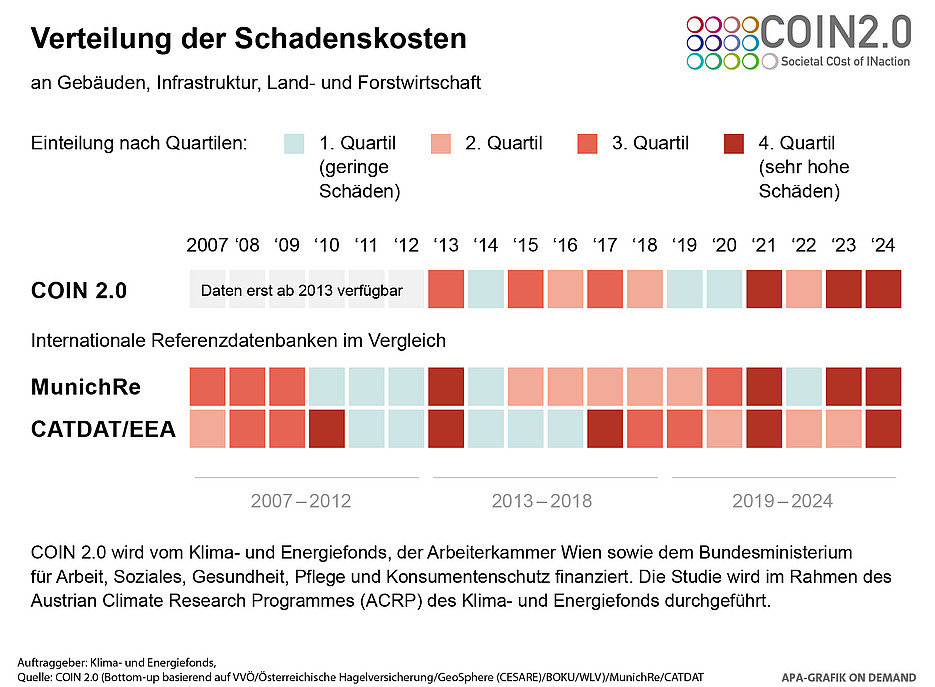
Losses attributable to climate change have increased since the previous study, COIN 1 (2015). The most recent years in particular (2021, 2023, 2024) were especially loss-intensive – despite the adaptation measures that had been put in place.
The comprehensive review of all nationally available data sources, carried out for the first time in COIN 2.0, shows similar totals and patterns to those in internationally recognised reference databases (Munich Re and CATDAT/EEA, with direct losses of €0.9 billion and €0.8 billion respectively for the same reference period). Compared with these loss figures, however, the national estimates are more comprehensive, allow for a comparison between different loss categories and are, for the most part, publicly accessible via the national loss database CESARE.
Despite significant annual fluctuations, the analysis shows that average annual losses have recently risen in the available data. This increase is statistically significant in both the data collected in COIN 2.0 and that from Munich Re.
Better loss data is a prerequisite for planning climate change adaptation and disaster risk reduction in an even more targeted manner. The data situation has improved compared with COIN 1 (2015), but significant data gaps still remain. A standardised, centralised and even more comprehensive data collection system with rapid availability would therefore be an important next step.
>> Documents & charts for download
Contact
Study coordinator: Birgit Bednar-Friedl, Wegener Center, University of Graz, birgit.friedl(at)uni-graz.at, Tel. +43 (0)316 380 7107
Head of the Damage Cost Survey: Markus Leitner, Federal Environment Agency, markus.leitner(at)umweltbundesamt.at, Tel. +43 (0)664 2626 345
Katja Hoyer, Press Officer, Climate and Energy Fund: katja.hoyer(at)klimafonds.gv.at, Tel. +43 (0)1 5850390 23
Ingeborg Zechmann, Press Officer, Federal Environment Agency: presse(at)umweltbundesamt.at, Tel. +43 (0)664 611 90 94
Veronika Rogenhofer, Public Relations Co-ordinator, Wegener Center: veronika.rogenhofer(at)uni-graz.at, Tel. +43 (0)316 380 8416