Begin of page section:
Page sections:

  • Go to contents (Accesskey 1)
  • Go to position marker (Accesskey 2)
  • Go to main navigation (Accesskey 3)
  • Go to sub navigation (Accesskey 4)
  • Go to additional information (Accesskey 5)
  • Go to page settings (user/language) (Accesskey 8)
  • Go to search (Accesskey 9)

End of this page section. Go to overview of page sections

Begin of page section:
Page settings:

English en
Deutsch de
Search
Login

End of this page section. Go to overview of page sections

Begin of page section:
Search:

Search for details about Uni Graz
Close

End of this page section. Go to overview of page sections


Search

Begin of page section:
Main navigation:

Page navigation:

  • University

    University
    • About the University
    • Organisation
    • Faculties
    • Library
    • Working at University of Graz
    • Campus
    Developing solutions for the world of tomorrow - that is our mission. Our students and our researchers take on the great challenges of society and carry the knowledge out.
  • Research Profile

    Research Profile
    • Our Expertise
    • Research Questions
    • Research Portal
    • Promoting Research
    • Research Transfer
    • Ethics in Research
    Scientific excellence and the courage to break new ground. Research at the University of Graz creates the foundations for making the future worth living.
  • Studies

    Studies
    • Prospective Students
    • Students
  • Community

    Community
    • International
    • Location
    • Research and Business
    • Alumni
    The University of Graz is a hub for international research and brings together scientists and business experts. Moreover, it fosters the exchange and cooperation in study and teaching.
  • Spotlight
Topics
  • Our digital Advent calendar
  • Sustainable University
  • Researchers answer
  • Work for us
Close menu

End of this page section. Go to overview of page sections

Begin of page section:
You are here:

University of Graz News Sustainability Award 2024 for two projects of the University of Graz

End of this page section. Go to overview of page sections

Wednesday, 27 November 2024

Sustainability Award 2024 for two projects of the University of Graz

Light bulb in which a green plant grows - subject of the Sustainability Award 2024 ©Anatol Stelzhammer

Photo: Anatol Stelzhammer

How do major international conferences reduce their carbon footprint? And what can maths lessons contribute to education for sustainable development? Two questions that were answered at the University of Graz. The corresponding projects were awarded the Sustainability Award 2024 in silver on 26 November in Vienna. This award for Austria's universities and colleges is presented by the Ministry of Science and the Ministry of Climate Protection.

The University of Graz has been dedicated to sustainable development for many years - in research and teaching as well as in operational management. "In line with our motto 'We work for tomorrow', we are working towards a future worth living. The two projects at our university that were honoured with this year's Sustainability Award show once again how committed and creative members of the University of Graz are to the sustainable transformation of our society," emphasises Rector Peter Riedler.

Climate-friendly conferences
A conference that takes place at several locations around the world at the same time and connects all participants around the globe: in 2018, Richard Parncutt, then Director of the Centre for Systematic Musicology, implemented his concept of a semi-virtual multi-hub conference for the first time. Around 600 researchers took part in the "15th International Conference for Music Perception and Cognition" and "10th Conference of the European Society for the Cognitive Science of Music" in Graz, Sydney/Australia, Montreal/Canada and La Plata/Argentina. Despite time differences, all hubs were able to communicate with each other for at least four hours a day. "The event serves as a model for climate-friendly planning of major international conferences by reducing CO2 emissions that would otherwise be caused by intercontinental flights. In addition, the format also enables interested parties from emerging countries to participate in the exchange of new scientific findings by eliminating high travel costs," says Parncutt, summarising the biggest plus points. Publications on the detailed implementation, experiences and suggestions for improvement should provide inspiration for further conferences of this kind.

Lessons that do the maths
Mathematical modelling helps us to better understand the world and learn how to solve problems, and not just in arithmetic. This also applies to current social challenges. Michael Fischer from the Didactics Centre for Natural Sciences and Mathematics shows what the subject can contribute to education for sustainable development in schools. "Based on current scientific publications, we have developed teaching materials on topics such as sustainability, wealth distribution, inflation, phasing out coal, weather forecasting and climate modelling," he reports. There were also concepts for project lessons in the classroom that link tasks in the field of mathematical modelling with the 17 Sustainable Development Goals. "Through science-based, interesting lessons, we want to raise awareness and promote pupils' sustainability skills so that they can contribute to the transformation of society," explains Fischer. The project, which is based at the University of Graz, brings together experts, teachers and students from various institutions, including the University of Agricultural and Environmental Policy, BOKU, the University of Teacher Education Upper Austria, the University of Vienna and the Vienna Chamber of Labour.

More information on the Sustainability Award of Austria's universities and colleges
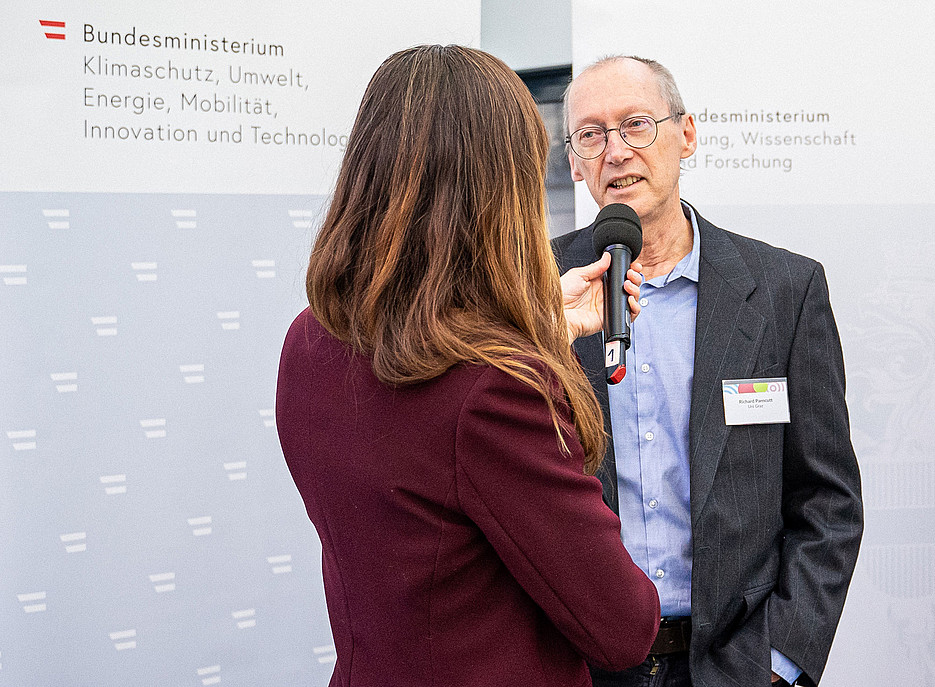
Richard Parncutt is interviewed by a lady. ©Sacha Gillen/Forum Umweltbildung
©Sacha Gillen/Forum Umweltbildung
Richard Parncutt was awarded silver in the "Anchoring" category for his concept of a semi-virtual multi-hub conference. Photo: Sacha Gillen/Forum Umweltbildung
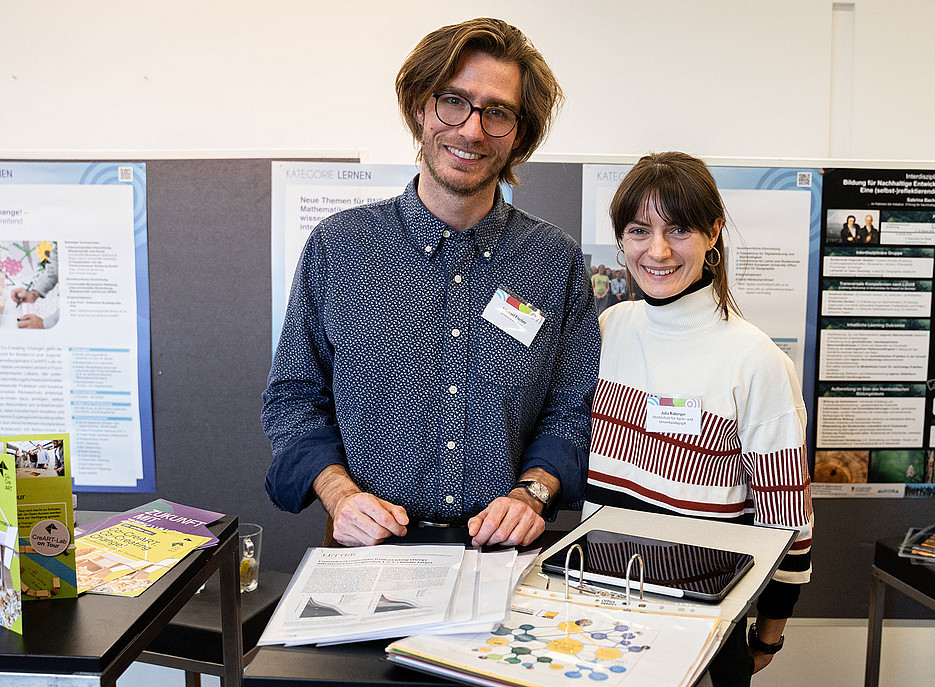
Michael Fischer and a colleague present materials from the project on a table ©Sacha Gillen/Forum Umweltbildung
©Sacha Gillen/Forum Umweltbildung
The project "New topics for ESD and maths lessons" submitted by Michael Fischer received silver in the "Learning" category. Photo: Sacha Gillen/Forum Umweltbildung
created by Gudrun Pichler

Related news

Chemical Christmas show at the University of Graz: An explosive evening at the Schauspielh

At the beginning of December, the University of Graz transformed the theater into a laboratory: as part of “Chemical Life,” teacher training students staged a chemical Christmas show for Styrian school classes—complete with ethanol rockets, nitrogen snow, and glowing effects. An evening designed to inspire interest in studying chemistry.

Train by train: Koralm railway accelerates exchange between the Universities

Lectures at the University of Klagenfurt in the morning, seminars at the University of Graz in the afternoon: Austria's longest tunnel and a journey time of around 45 minutes make it easy. The Koralm railway increases the speed of networking between the two university locations. The collaboration builds on existing cooperation - for example in the areas of teacher training, Slavic studies and as employers, the universities are well coordinated.

On the trail of the Big Bang: University of Graz receives 1.5 million euros for doctoral programmes

The Austrian Science Fund FWF has selected the Doctoral Programme in Theoretical Particle Physics at the University of Graz for funding from the Doc.funds. Six young scientists will be funded for 3.5 years. They will gain fundamentally new insights into the origins of the world.

From trans women and knee prostheses: sports science prizes awarded

Walking better with a prosthesis, successfully getting rid of excess weight, training more effectively, more fairness for trans people in sport: these were the topics addressed by the students at the University of Graz who were awarded the sports science prizes for their Master's theses on 3 December 2025.

Begin of page section:
Additional information:

University of Graz
Universitaetsplatz 3
8010 Graz
Austria
  • Contact
  • Web Editors
  • Moodle
  • UNIGRAZonline
  • Imprint
  • Data Protection Declaration
  • Accessibility Declaration
Weatherstation
Uni Graz

End of this page section. Go to overview of page sections

End of this page section. Go to overview of page sections

Begin of page section:

End of this page section. Go to overview of page sections