



Begin of page section:
Page sections:

  • Go to contents (Accesskey 1)
  • Go to position marker (Accesskey 2)
  • Go to main navigation (Accesskey 3)
  • Go to sub navigation (Accesskey 4)
  • Go to additional information (Accesskey 5)
  • Go to page settings (user/language) (Accesskey 8)
  • Go to search (Accesskey 9)

End of this page section. Go to overview of page sections

Begin of page section:
Page settings:

English en
Deutsch de
Search
Login

End of this page section. Go to overview of page sections

Begin of page section:
Search:

Search for details about Uni Graz
Close

End of this page section. Go to overview of page sections


Search

Begin of page section:
Main navigation:

Page navigation:

  • University

    University
    • About the University
    • Organisation
    • Faculties
    • Library
    • Working at University of Graz
    • Campus
    Developing solutions for the world of tomorrow - that is our mission. Our students and our researchers take on the great challenges of society and carry the knowledge out.
  • Research Profile

    Research Profile
    • Our Expertise
    • Research Questions
    • Research Portal
    • Promoting Research
    • Research Transfer
    • Ethics in Research
    • Commission for Scientific Integrity
    Scientific excellence and the courage to break new ground. Research at the University of Graz creates the foundations for making the future worth living.
  • Studies

    Studies
    • Prospective Students
    • Students
  • Community

    Community
    • International
    • Location
    • Research and Business
    • Alumni
    The University of Graz is a hub for international research and brings together scientists and business experts. Moreover, it fosters the exchange and cooperation in study and teaching.
Topics
  • Sustainable University
  • Researchers answer
  • Work for us
Close menu

End of this page section. Go to overview of page sections

Begin of page section:
You are here:

University of Graz News Electricity consumption reduced: University of Graz well on track

End of this page section. Go to overview of page sections

Tuesday, 10 February 2026

Electricity consumption reduced: University of Graz well on track

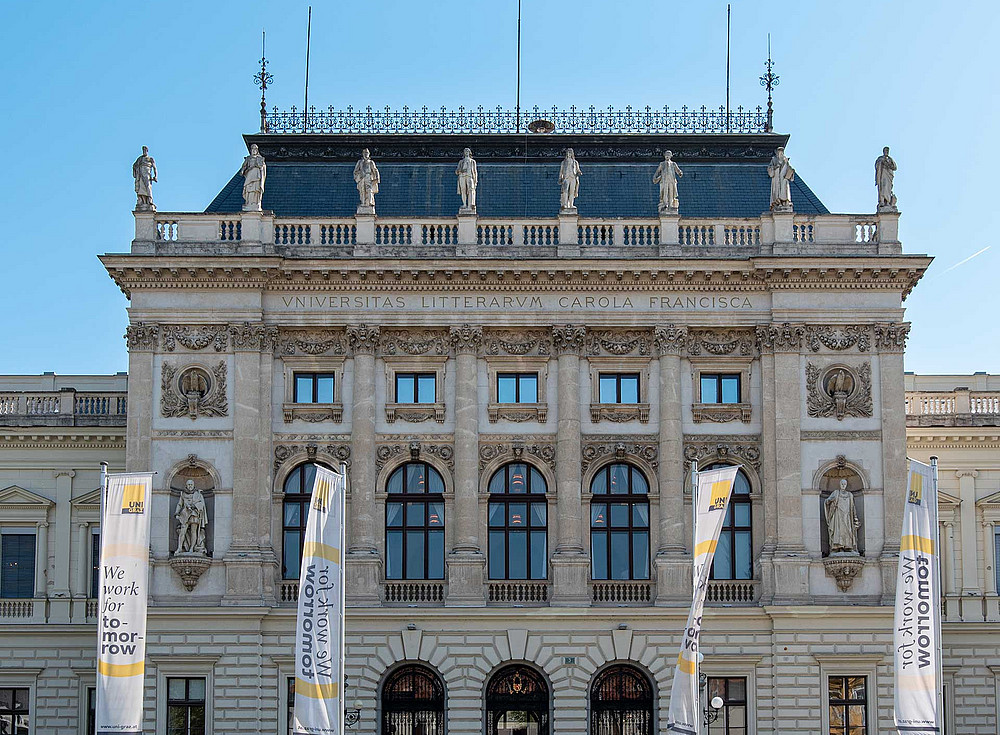
Main building of the University of Graz with four ‘We work for tomorrow’ flags in front of it ©Universität Graz

The University of Graz is working to continuously improve its environmental performance. The goal: climate neutrality by 2040. Photo: University of Graz/Julina Raggautz

This year, the University of Graz has once again received EMAS certification. Since the introduction of this environmental management system in 2016, the seal of approval has been renewed every three years after successful audits. As an EMAS-certified organisation, the university is committed to systematically improving its environmental performance and contributing to sustainable development at all levels. Progress is documented in the annual environmental statement. The statement for 2024 was recently published. Particularly pleasing: electricity consumption was the lowest since EMAS records began.


From successful measures to promote climate-friendly mobility to the Graz Centre of Physics, a showcase project for sustainable construction – the University of Graz is taking responsibility for a liveable future in all areas. The annual environmental statement shows what this means in concrete terms. It provides information on goals, measures and important environmental indicators, such as energy consumption, CO2 emissions and waste volumes. “With this report, we create transparency, make our activities visible and at the same time strengthen awareness of sustainable action in society,” says Rector Peter Riedler.

The fact that the University of Graz was able to reduce its electricity consumption in 2024 despite an increase in floor space is thanks to numerous small and large measures. These include increasing energy efficiency, for example by switching to LED lighting in many areas, and reducing staff presence during the Christmas period. However, more intensive efforts are still needed in the areas of district heating consumption and business mobility. Emissions have risen again in these areas, which is also reflected in the overall greenhouse gas balance.

One of the highlights of 2024 is the development of a strategy to promote biodiversity across the entire campus. In this way, the University of Graz is making an important contribution to increasing species diversity. The campus areas connect the Stadtpark and Schlossberg with Rosenberg, Hilmteich and Leechwald as stepping stone biotopes. To improve their function in the green corridor, additional refuges and habitats for flora and fauna are being created in collaboration with experts.

Environmental Statement of the University of Graz 2024.pdf

Ökoprofit seal of approval
One visible sign of the university's commitment and successes in environmental and climate protection is the Ökoprofit seal of approval. At the end of November 2025, the city of Graz once again awarded it to the University of Graz for its “very detailed and exemplary decarbonisation strategy. The 630 newly planned bicycle parking spaces, the planting of numerous trees and the dismantling of car parking spaces at the Centre of Physics are exemplary,” according to the commission's statement. The university has been participating in this programme since 2005. As part of Ökoprofit, it receives support in the form of environmental consulting, training courses on various sustainability topics and the opportunity to exchange best practice examples with other companies that carry this seal of approval.

In addition, since 2024, the University of Graz has been part of a network of around 100 organisations, companies and associations in Graz that have signed the “Climate Pact #bindabei”. The common goal: climate neutrality by 2040.

Comprehensive information about the university's goals, activities and achievements in climate and environmental protection can be found on the website “Climate-Neutral Uni Graz”.

created by Gudrun Pichler

Related news

What matters in the end: moral theologian takes stock of assisted suicide

Since 1 January 2022, assisted suicide has been legal in Austria under certain conditions. This was made possible by a ruling of the Constitutional Court, which overturned the blanket ban on assisting in suicide. Four years on, it is clear that: “Although the legal framework is in place, many pressing questions remain unanswered when it comes to its practical implementation,” says Johann Platzer, a moral theologian at the University of Graz.

Noise is the signal: new simulation method enables secure communication

Researchers from Graz, Vienna and Munich have developed a new simulation method that makes it possible to calculate quantum light using classical software – a step towards secure quantum communication.

Massacre and Memory: University of Graz addresses the wounds of history

A conference on 12 and 13 June 2026 at the Jesuit Refectory will focus on trauma in Eastern and South-Eastern Europe.

Uni Vibes: An open-air stage for science and street art

At the third Uni Vibes event hosted by the University of Graz, visitors enjoyed science, music and performances on campus. Guided tours focusing on democracy, educational sciences and the Graz Centre of Physics demonstrated how research shapes community life, urban development and culture.

Begin of page section:
Additional information:

University of Graz
Universitaetsplatz 3
8010 Graz
Austria
  • Contact
  • Web Editors
  • Moodle
  • UNIGRAZonline
  • Imprint
  • Data Protection Declaration
  • Accessibility Declaration
Weatherstation
Uni Graz

End of this page section. Go to overview of page sections

End of this page section. Go to overview of page sections

Begin of page section:

End of this page section. Go to overview of page sections