Begin of page section:
Page sections:

  • Go to contents (Accesskey 1)
  • Go to position marker (Accesskey 2)
  • Go to main navigation (Accesskey 3)
  • Go to sub navigation (Accesskey 4)
  • Go to additional information (Accesskey 5)
  • Go to page settings (user/language) (Accesskey 8)
  • Go to search (Accesskey 9)

End of this page section. Go to overview of page sections

Begin of page section:
Page settings:

English en
Deutsch de
Search
Login

End of this page section. Go to overview of page sections

Begin of page section:
Search:

Search for details about Uni Graz
Close

End of this page section. Go to overview of page sections


Search

Begin of page section:
Main navigation:

Page navigation:

  • University

    University
    • About the University
    • Organisation
    • Faculties
    • Library
    • Working at University of Graz
    • Campus
    Developing solutions for the world of tomorrow - that is our mission. Our students and our researchers take on the great challenges of society and carry the knowledge out.
  • Research Profile

    Research Profile
    • Our Expertise
    • Research Questions
    • Research Portal
    • Promoting Research
    • Research Transfer
    • Ethics in Research
    • Commission for Scientific Integrity
    Scientific excellence and the courage to break new ground. Research at the University of Graz creates the foundations for making the future worth living.
  • Studies

    Studies
    • Prospective Students
    • Students
  • Community

    Community
    • International
    • Location
    • Research and Business
    • Alumni
    The University of Graz is a hub for international research and brings together scientists and business experts. Moreover, it fosters the exchange and cooperation in study and teaching.
Topics
  • Sustainable University
  • Researchers answer
  • Work for us
Close menu

End of this page section. Go to overview of page sections

Begin of page section:
You are here:

University of Graz News Award for female researchers: University of Graz impresses at the SPIRIT Award

End of this page section. Go to overview of page sections

Wednesday, 11 February 2026

Award for female researchers: University of Graz impresses at the SPIRIT Award

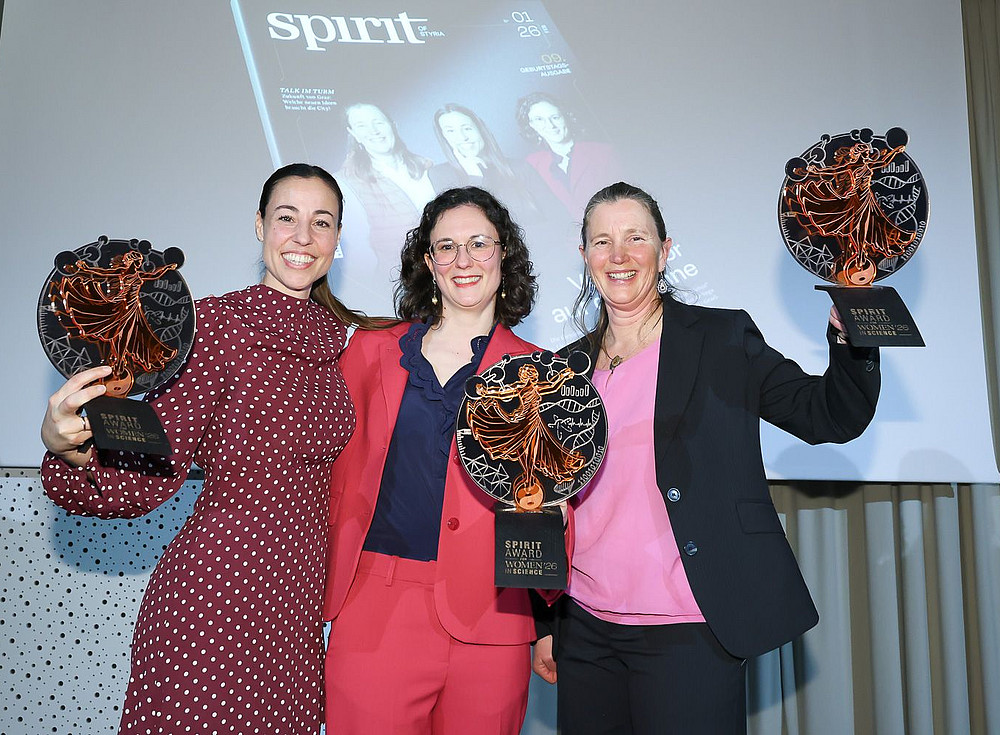
Three people stand side by side in festive clothing, holding large, round trophies up to the camera. Each trophy shows a stylized, dancing figure in copper color against a dark background. The people are wearing suits and a polka-dot dress; the clothing is in shades of red, blue, and black. In the background, there is a screen with the word “spirit” and a magazine or presentation graphic. The scene looks like an award ceremony in an indoor setting.

The winners of the WOMEN in SCIENCE Award: Raquel Gonzales de Vega, Anna Galler, and Anja Haase. Photo: Spirit of Styria/Wolf/Fuchs

On February 10, 2026, the SPIRIT Award for WOMEN in SCIENCE was presented for the second time—an award for outstanding female researchers in Styria. The winners, including Raquel Gonzalez de Vega from the University of Graz, impressed with innovative projects ranging from the detection of microplastics to revolutionary blood diagnostics.

Magical “Marie” moments and an unforgettable evening dedicated to Styrian female researchers. On February 10, the “SPIRIT Award for WOMEN in SCIENCE” was presented for the second time for outstanding research achievements by women in Styria. In front of over 200 guests, the winners were presented with the “Marie” trophy – named after Marie Curie.

The prizes were awarded in three categories: “Basic Research Junior & Senior,” “Applied Research Junior Scientist,” and “Applied Research Senior Scientist.” Raquel Gonzalez de Vega, a chemist at the University of Graz, took first place in the “Applied Research Junior Scientist” category. First place in the field of basic research went to TU Graz researcher Anna Galler, and the prize for “Applied Research Senior” was awarded to Anja Haase from Joanneum Research.

The diversity of the award-winning research topics was impressive: Galler is researching 2D quantum materials as the basis for a new generation of semiconductors. Gonzales de Vega developed a new method for detecting micro- and nanoplastic particles. And Haase is working on the development of innovative blood diagnostics (lab-on-a-chip) that can detect dangerous viral infections such as Ebola without the need for a laboratory.

The second and third place winners of the evening also received a “Marie”: Marta Nowakowska-Desplantes (Medical University of Graz) and Johanna Irrgeher (Montanuniversität Leoben), Laura Gregorc (Virtual Vehicle Research GmbH) and Nadine Weber (Nadine W., HyCentA Research GmbH), as well as Sandra Schlögl & Elisabeth Rossegger (Polymer Competence Center Leoben GmbH (PCCL) and Nicole Wermuth (LEC).

A total of 25 female researchers were nominated for the final. No fewer than 100 female researchers from various disciplines and 22 different institutions (universities, universities of applied sciences, research institutions, industry) had submitted entries for the award – a strong sign of Styria's status as a research location.
 

created by Kommunikation & Öffentlichkeitsarbeit

Related news

Uni Vibes: Where science and art come together

At the third Uni Vibes event hosted by the University of Graz, visitors enjoyed science, music and performances on campus. Guided tours focusing on democracy, educational sciences and the Graz Centre of Physics demonstrated how research shapes community life, urban development and culture.

Protest against budget cuts: universities send a united message in Graz

On 28 May, thousands of students, researchers and staff from all Styrian universities demonstrated in Graz against the announced budget cuts. University management and student representatives warned of severe consequences for research, teaching and the region’s standing as a centre of academic excellence.

Overcoming boundaries: Can we manage without prisons and camps?

The US immigration agency ICE has sparked fear and horror. Not only are migrants criminalised and brutally persecuted, but earlier this year, ICE officers killed two US citizens in Minneapolis. Against the backdrop of these dramatic events, the University of Graz is shedding light on the role of deportation and detention centres as part of the international conference ‘Camps, Belonging, and Abolition Democracy’. Researchers aim to develop scenarios for how a future without prisons and the death penalty can become a reality.

From one to many: Uni Graz researchers identify a mechanism for the origin of species

When a habitat changes, animals, plants and even humans must adapt to the new environmental conditions. Those who manage this fastest and best will prevail. Over time, new species that are specialised for specific habitats also develop. Zoologist Christian Sturmbauer and his research group at the University of Graz, together with international partners, have now demonstrated that the molecular biological process of “alternative splicing” – contrary to previous assumptions – contributes highly effectively to the formation of new species. Different combinations of parts of the same gene give rise to various, structurally slightly different variants of functional proteins. This leads very rapidly to significant changes. The research findings were published in the renowned journal Proceedings of the National Academy of Sciences.

Begin of page section:
Additional information:

University of Graz
Universitaetsplatz 3
8010 Graz
Austria
  • Contact
  • Web Editors
  • Moodle
  • UNIGRAZonline
  • Imprint
  • Data Protection Declaration
  • Accessibility Declaration
Weatherstation
Uni Graz

End of this page section. Go to overview of page sections

End of this page section. Go to overview of page sections

Begin of page section:

End of this page section. Go to overview of page sections