



Begin of page section:
Page sections:

  • Go to contents (Accesskey 1)
  • Go to position marker (Accesskey 2)
  • Go to main navigation (Accesskey 3)
  • Go to sub navigation (Accesskey 4)
  • Go to additional information (Accesskey 5)
  • Go to page settings (user/language) (Accesskey 8)
  • Go to search (Accesskey 9)

End of this page section. Go to overview of page sections

Begin of page section:
Page settings:

English en
Deutsch de
Search
Login

End of this page section. Go to overview of page sections

Begin of page section:
Search:

Search for details about Uni Graz
Close

End of this page section. Go to overview of page sections


Search

Begin of page section:
Main navigation:

Page navigation:

  • University

    University
    • About the University
    • Organisation
    • Faculties
    • Library
    • Working at University of Graz
    • Campus
    Developing solutions for the world of tomorrow - that is our mission. Our students and our researchers take on the great challenges of society and carry the knowledge out.
  • Research Profile

    Research Profile
    • Our Expertise
    • Research Questions
    • Research Portal
    • Promoting Research
    • Research Transfer
    • Ethics in Research
    • Commission for Scientific Integrity
    Scientific excellence and the courage to break new ground. Research at the University of Graz creates the foundations for making the future worth living.
  • Studies

    Studies
    • Prospective Students
    • Students
  • Community

    Community
    • International
    • Location
    • Research and Business
    • Alumni
    The University of Graz is a hub for international research and brings together scientists and business experts. Moreover, it fosters the exchange and cooperation in study and teaching.
  • Spotlight
Topics
  • Sustainable University
  • Researchers answer
  • Work for us
Close menu

End of this page section. Go to overview of page sections

Begin of page section:
You are here:

University of Graz News Four universities, one degree: first certificates awarded in pioneering Arqus consortium

End of this page section. Go to overview of page sections

Monday, 09 February 2026

Four universities, one degree: first certificates awarded in pioneering Arqus consortium

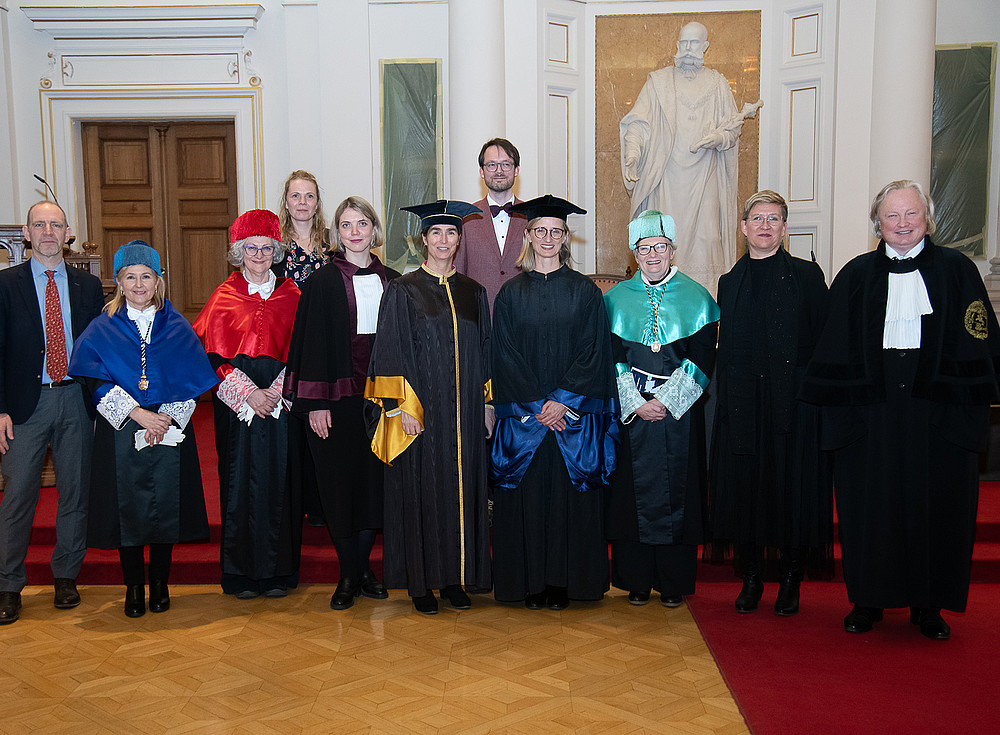
Group photo of university representatives in the Aula

University representatives celebrated the first Arqus graduates: Florian Bieber, Ana María García-Campaña, Amelia Díaz Pérez de Madrid, Janine Kläge, Ieva Giedraitytė, Mireille van Poppel, Stephan Kaschner, Emma Lantschner, Dorothy Kelly, Steffi Marung, and Artūras Vasiliauskas (from left). Photo: Fotogenia

The European University Alliance Arqus has been in existence since 2018, with the University of Graz collaborating with eight partner institutions at various levels. The first joint master's programme began in 2023. Twenty-one graduates recently celebrated their graduation in Graz.

The Joint Master's Programme in European Studies is the first joint degree programme offered by the University of Graz in collaboration with its partner institutions in Granada, Leipzig and Vilnius as part of the Arqus alliance. At the end of January, the graduates of the first cohort received their certificates in the auditorium. Representatives of the participating universities and students celebrated, some of them online. The ceremony can be viewed on YouTube.

Joint educational programmes within the alliance are designed to offer students a more enriching experience than a degree from a single university. Arqus coordinator Dorothy Kelly emphasised this in her keynote speech. "You as our alumni will be our ambassadors and we need you both out there and inside Arqus to help us to continue to improve and to enrich future students' experiences," Kelly concluded. Mireille van Poppel, Vice-Rector for International Affairs at the University of Graz, also referred to the added value of the alliance, which benefits students: "Getting to know different cultures, accepting, even embracing, celebrating the diversity within the different countries and organisations is the essence of having European Alliances and is the core of Arqus."

Feedback from graduates has been consistently positive, both in terms of the content of the programme and the opportunities for international networking. Interest in the joint master's programme is also high: last year, 150 applications were received for 60 places. The registration deadline for the autumn 2026 intake is 31 March. 

In addition to European Studies, three other Arqus Master's programmes are currently offered at the University of Graz: Food, Nutrition and Health, Cybersecurity and Cyberintelligence, and Translation. Further programmes are in development.

created by Dagmar Eklaude

Related news

Diversity in nature and science: How we talk about plants and each other

Ginkgo, kiwi, hemp: they exist as male and female plants. Anyone who paid attention in biology class will confirm this. But is this categorisation, established by Carl von Linné almost 300 years ago, still valid today? An interdisciplinary team at the University of Graz is questioning these attributions and using this as a starting point to provide food for thought for gender-sensitive interaction between students, scientific and teaching staff.

Around the world in eight stops: the Long Night of Research at the University of Graz

On 24 April from 5 pm, you can take a short trip around the globe at the University of Graz, discovering pecularities of foreign countries or new local features in the entrance hall of the University Library. The itinerary takes you through introduced animal species, political attitudes and the omnipotence of algorithms. There will also be a programme in the historic reading hall, as well as at the UniGraz@Museum and the University Archive.

Studying at the University of Graz: How to enrol

Ready for a new chapter in your life with the start of your studies at the University of Graz in the winter semester 2026/27? Here you will find information on deadlines, admission procedures, registration, and everything else you need to successfully start your studies in the fall.

Interpreting data: Why studies sometimes get it wrong

Hilmar Brohmer and Ziva Korda from the Institute of Psychology, together with 500 international colleagues, have re-evaluated a hundred scientific publications and have often come to different conclusions.

Begin of page section:
Additional information:

University of Graz
Universitaetsplatz 3
8010 Graz
Austria
  • Contact
  • Web Editors
  • Moodle
  • UNIGRAZonline
  • Imprint
  • Data Protection Declaration
  • Accessibility Declaration
Weatherstation
Uni Graz

End of this page section. Go to overview of page sections

End of this page section. Go to overview of page sections

Begin of page section:

End of this page section. Go to overview of page sections