Begin of page section:
Page sections:

  • Go to contents (Accesskey 1)
  • Go to position marker (Accesskey 2)
  • Go to main navigation (Accesskey 3)
  • Go to sub navigation (Accesskey 4)
  • Go to additional information (Accesskey 5)
  • Go to page settings (user/language) (Accesskey 8)
  • Go to search (Accesskey 9)

End of this page section. Go to overview of page sections

Begin of page section:
Page settings:

English en
Deutsch de
Search
Login

End of this page section. Go to overview of page sections

Begin of page section:
Search:

Search for details about Uni Graz
Close

End of this page section. Go to overview of page sections


Search

Begin of page section:
Main navigation:

Page navigation:

  • University

    University
    • About the University
    • Organisation
    • Faculties
    • Library
    • Working at University of Graz
    • Campus
    Developing solutions for the world of tomorrow - that is our mission. Our students and our researchers take on the great challenges of society and carry the knowledge out.
  • Research Profile

    Research Profile
    • Our Expertise
    • Research Questions
    • Research Portal
    • Promoting Research
    • Research Transfer
    • Ethics in Research
    • Commission for Scientific Integrity
    Scientific excellence and the courage to break new ground. Research at the University of Graz creates the foundations for making the future worth living.
  • Studies

    Studies
    • Prospective Students
    • Students
    • Welcome Weeks for First Year Students
  • Community

    Community
    • International
    • Location
    • Research and Business
    • Alumni
    The University of Graz is a hub for international research and brings together scientists and business experts. Moreover, it fosters the exchange and cooperation in study and teaching.
Topics
  • Sustainable University
  • Researchers answer
  • Work for us
Close menu

End of this page section. Go to overview of page sections

Begin of page section:
You are here:

University of Graz News Stil und Style

End of this page section. Go to overview of page sections

Wednesday, 22 December 2021

Stil und Style

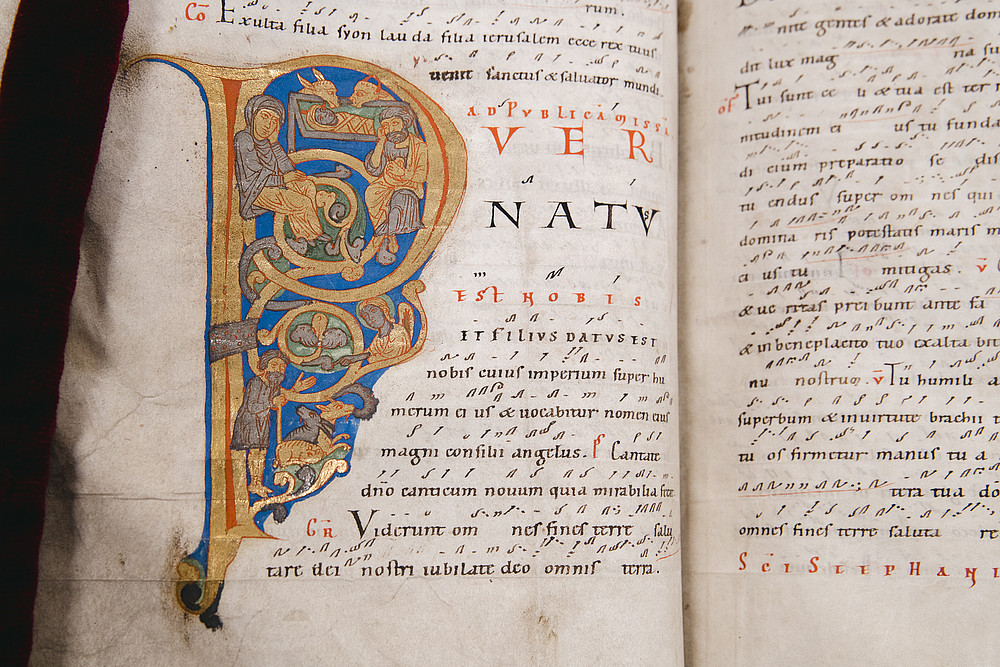
In vielen Handschriften, wie in dieser Missale, wurden auch prächtige Initialen eingefügt. Foto: Uni Graz/Tzivanopoulos

In vielen Handschriften, wie in dieser Missale, wurden auch prächtige Initialen eingefügt. Foto: Uni Graz/Tzivanopoulos

Handschriften verbergen oftmals Malereien – so auch über die Geburt Jesu. Ein Lokalaugenschein in den Sondersammlungen der Uni-Bibliothek.

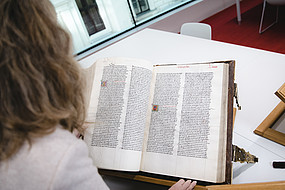
Die Stratter-Bibel ist ein besonderes Stück. Die Handschrift aus dem 15. Jahrhundert war ein Hochzeitsgeschenk des Bischofs von Salzburg, Bernhard von Rohr, an seinen Schwager Andreas Kreig. Geschrieben von Erasmus Stratter in bayrisch-österreichischer Mundart, illustriert vom Salzburger Buchmaler Ulrich Schreier, wurde die spätmittelalterliche Handschrift in einem Ochsenkarren über die Alpen nach Graz gebracht. Die Schenkung an das Jesuitenkollegium erreichte vor der Gründung der Universität Graz im Jahre 1585 deren Bibliothek. Bis heute wird sie mit der Signatur „MS 48“ in der UB verwahrt und für Forschungszwecke zur Verfügung gestellt. Buchmalereien aus mittelalterlichen Handschriften sind auch heute noch beliebte und gern gesehene Motive zur Weihnachtszeit.
 

„Die Haut von rund 330 Schafen wurde für die Produktion dieser schmuckvollen Handschrift mit 656 Blättern verwendet. Sehr exquisit und wertvoll auch die Initialen zu den einzelnen Kapiteln“, erzählt Pamela Stückler und blättert langsam durch die Stratter-Bibel. Sie stoppt beim Lukas-Evangelium, das die Geburt von Jesus Christus beschreibt. Die Leiterin der Universitätsbibliothek Graz ergänzt: „Wir wissen, dass die Handschrift von einem frühen Druckwerk, einer Inkunabel, abgeschrieben worden ist und in erster Linie als Ausstellungsstück und nicht als Gebrauchsliteratur für die Liturgie verwendet wurde. Deshalb vielleicht auch die primäre Verwendung von Initialen und keiner bildlichen Miniaturen.“
 

Weitaus detailreicher ausgeschmückt ist die Geburt Jesu in der Handschrift MS 444: Maria mit dem Kind in der Krippe, Tiere und die Engel in gut erkennbarer Form. Dieses „Missale“, ein Messbuch, aus dem frühen 12. Jahrhundert ist in lateinischer Sprache und stammt aus dem Augustiner Chorherrenstift-Seckau. Es wird aber vermutet, dass das Werk in einem Skriptorium des Salzburger Domstifts entstanden ist. Üblich für den Entstehungsort Salzburg ist dabei die Kolorierung der Initialen mit grüner und blauer Farbe. Darüber hinaus wurde auch Gold- und Silbertinte als Gestaltungsmittel eingesetzt. Eine Besonderheit stellt ein sehr sorgfältig an das Pergamentblatt genähtes, violettes Stück Seidentuch dar, das die Abbildung eines heiligen Priesters schützen sollte.

Das Leben Jesu als Bildgeschichte
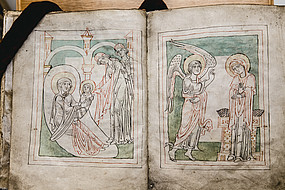
Anders aufbereitet ist das Weihnachtsevangelium in der MS 764 aus der zweiten Hälfte des 12. Jahrhunderts. Die Handschrift war wahrscheinlich für das Nonnenstift Seckau gedacht und ist in vulgata, in lateinischer Gebrauchssprache und mit deutschen Textpassagen verfasst. Vordergründig sind aber die großzügig angelegten Malereien, die das Leben von Jesus detailreich beschreiben.
 

Die Bibliothek der Universität Graz verfügt über einen reichen Schatz an historischen und einzigartigen Schriften. In einem aufwendigen Prozess wurden nun 500 Handschriften neu digital erfasst, hochauflösend eingescannt und in einer Datenbank registriert. Der Bestand ist öffentlich zugänglich und weltweit erreichbar – so auch die Miniaturen, die die Weihnachtsgeschichte detailreich erzählen.


Diese Handschriften und mehr online unter https://unipub.uni-graz.at/obvugrscript
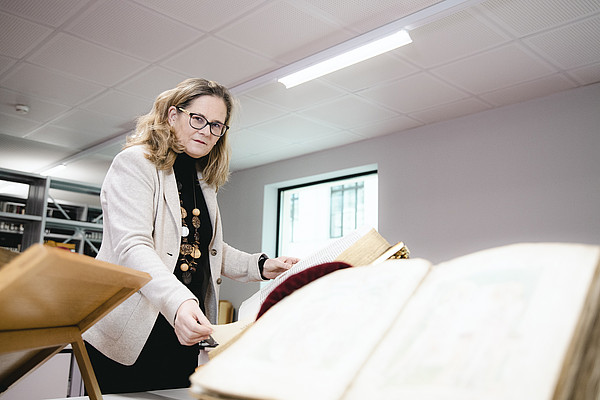
Pamela Stückler, die Leiterin der UB Graz, ist Expertin für alte Schriften. Beim Schmökern in der Stratter-Bibel sucht sie nach dem Weihnachtsevangelium. Fotos: Uni Graz/Tzivanopoulos
created by Konstantin Tzivanopoulos

Related news

Electrifying: Researchers film the first moments on the way from light to electricity

Physicists at the University of Graz (Austria), in collaboration with colleagues from Marburg University and Forschungszentrum Jülich (Germany), have achieved a scientific breakthrough. For the first time, the generation of electrical energy from light has been filmed and described theoretically. This work is of far-reaching significance, not least for optimising sustainable energy production from photovoltaics. This is because it provides fundamental building blocks for understanding the physical processes that take place, for example, in organic solar cells. The paper was published in the journal Physical Review X, one of the world’s most prestigious physics journals.

University of Graz: Working together to make Styria a sustainable centre of learning

Round table calls for sustainable funding for the 2028–2030 performance agreement period between the five Styrian universities and the federal government.

How can we teach using YouTube and AI? The University of Graz is strengthening media education in schools

A journey through the blood vessels using VR headsets brings biology lessons to life. An interactive quiz brings physics to life. The YouTube video explains the First World War. Whilst mobile phones are increasingly being banned from the classroom, social media platforms, apps and AI are playing an ever-greater role in knowledge transfer at school. But how can teaching with media be made even more effective? What are the challenges in media-based teaching? At the University of Graz, researchers are discussing these issues at a conference being held in Austria for the first time.

Jurassic Sounds: Biologist reconstructs insect songs from 165 million years ago

It was apparently not just the roars of the dinosaurs that made up the soundscape of the animal world during the Jurassic period. Crickets and grasshoppers communicated through a variety of songs and high-pitched sounds, as Thorin Jonsson from the Institute of Biology at the University of Graz discovered together with colleagues from the universities of Lincoln, Bristol (UK), Beijing (China) and Tempe (USA). The findings on what are so far the oldest traces of sound on Earth have just been published in the journal PNAS.

Begin of page section:
Additional information:

University of Graz
Universitaetsplatz 3
8010 Graz
Austria
  • Contact
  • Web Editors
  • Moodle
  • UNIGRAZonline
  • Imprint
  • Data Protection Declaration
  • Accessibility Declaration
Weatherstation
Uni Graz

End of this page section. Go to overview of page sections

End of this page section. Go to overview of page sections

Begin of page section:

End of this page section. Go to overview of page sections