Begin of page section:
Page sections:

  • Go to contents (Accesskey 1)
  • Go to position marker (Accesskey 2)
  • Go to main navigation (Accesskey 3)
  • Go to sub navigation (Accesskey 4)
  • Go to additional information (Accesskey 5)
  • Go to page settings (user/language) (Accesskey 8)
  • Go to search (Accesskey 9)

End of this page section. Go to overview of page sections

Begin of page section:
Page settings:

English en
Deutsch de
Search
Login

End of this page section. Go to overview of page sections

Begin of page section:
Search:

Search for details about Uni Graz
Close

End of this page section. Go to overview of page sections


Search

Begin of page section:
Main navigation:

Page navigation:

  • University

    University
    • About the University
    • Organisation
    • Faculties
    • Library
    • Working at University of Graz
    • Campus
    Developing solutions for the world of tomorrow - that is our mission. Our students and our researchers take on the great challenges of society and carry the knowledge out.
  • Research Profile

    Research Profile
    • Our Expertise
    • Research Questions
    • Research Portal
    • Promoting Research
    • Research Transfer
    • Ethics in Research
    • Commission for Scientific Integrity
    Scientific excellence and the courage to break new ground. Research at the University of Graz creates the foundations for making the future worth living.
  • Studies

    Studies
    • Prospective Students
    • Students
    • Welcome Weeks for First Year Students
  • Community

    Community
    • International
    • Location
    • Research and Business
    • Alumni
    The University of Graz is a hub for international research and brings together scientists and business experts. Moreover, it fosters the exchange and cooperation in study and teaching.
Topics
  • Sustainable University
  • Researchers answer
  • Work for us
Close menu

End of this page section. Go to overview of page sections

Begin of page section:
You are here:

University of Graz News Spieglein, Spieglein ...

End of this page section. Go to overview of page sections

Thursday, 07 February 2013

Spieglein, Spieglein ...

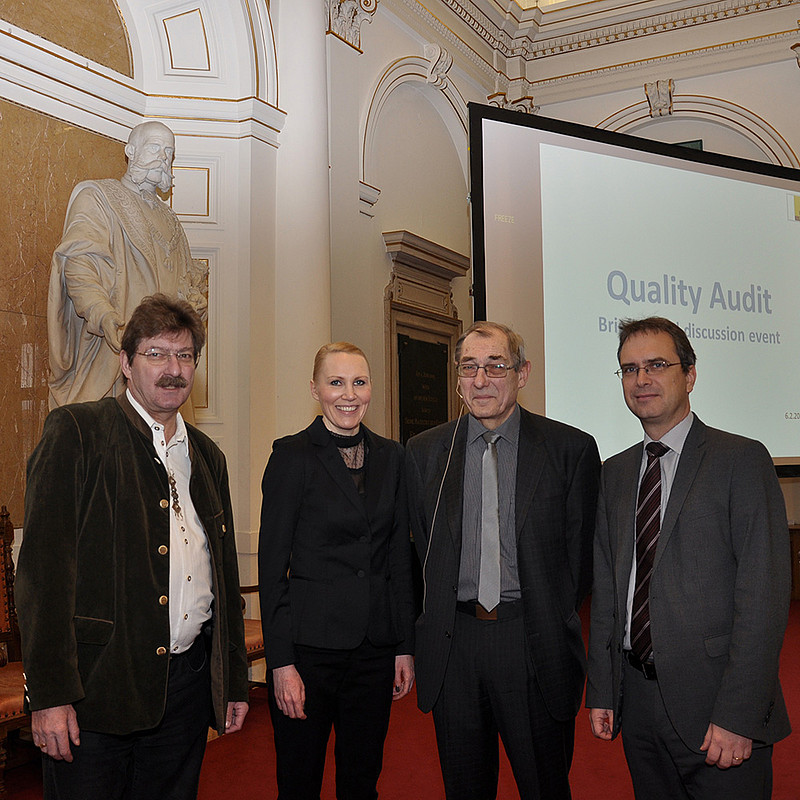
Kick-Off am 6. Februar: Vizerektor Peter Scherrer, Finheec-Koordinatorin Kirsi Hiltunen, Auditgroup-Leiter Jon Haakstad und Vizerektor Peter Riedler (v. l.)

Kick-Off am 6. Februar: Vizerektor Peter Scherrer, Finheec-Koordinatorin Kirsi Hiltunen, Auditgroup-Leiter Jon Haakstad und Vizerektor Peter Riedler (v. l.)

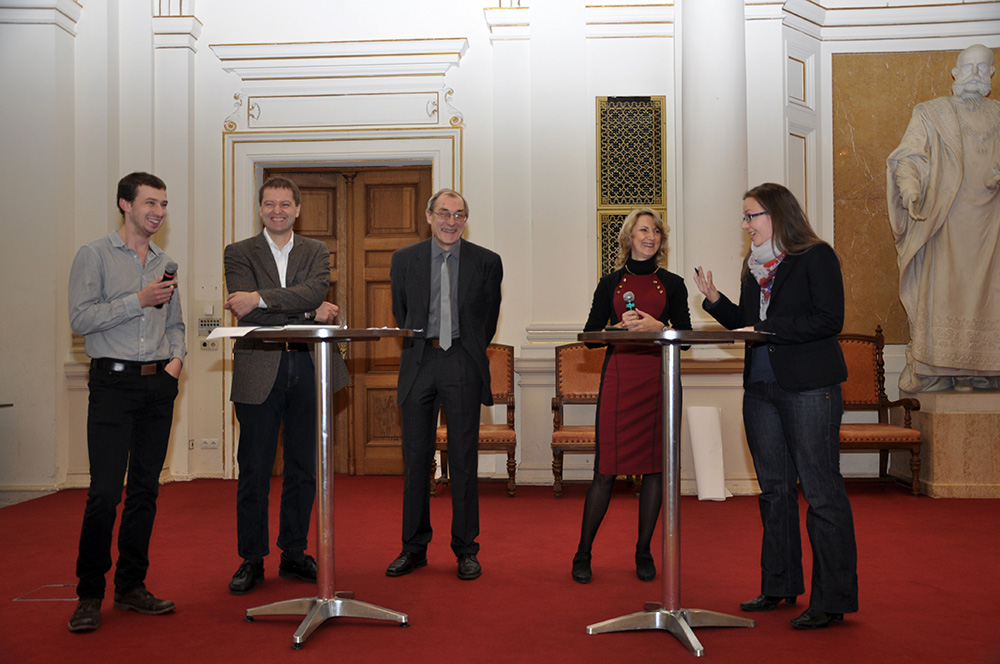
Wünsche und Erwartungen des Podiums: Stefan Thum (ÖH Uni Graz), Christoph Gattringer (NAWI-Vizedekan), Jon Haakstad (Auditgroup), Margit Reitbauer (GEWI-Vizestudiendekanin) und Alexandra Dorfer (Lehr- und Studienservices)

Wünsche und Erwartungen des Podiums (v. l.): Stefan Thum (ÖH Uni Graz), Christoph Gattringer (NAWI-Vizedekan), Jon Haakstad (Auditgroup), Margit Reitbauer (GEWI-Vizestudiendekanin) und Alexandra Dorfer (Lehr- und Studienservices)

Die Uni Graz nimmt ihr Qualitätsmanagement-System in Augenschein: Interviews des GutachterInnen-Teams im März

Das Qualitätsmanagement-System der Uni Graz wurde erfolgreich aufgebaut, nun wird es einer externen Begutachtung unterzogen. Sechs internationale ExpertInnen werfen derzeit einen Blick auf die Verbesserung des Qualitätsmanagement-Systems. Die Evaluierung wird in Form eines „Quality Audits“ 2012–2013 nach dem Verfahren der finnischen Qualitätsagentur FINHEEC durchgeführt. Dazu wird das ExpertInnen-Team im kommenden März die Uni Graz besuchen und etwa 150 VertreterInnen aller Ebenen der Universität interviewen. Details zu diesem Vor-Ort-Besuch der GutachterInnen wurden am 6. Februar 2013 in der Aula präsentiert und diskutiert. „Verbesserung der Qualität ist ein kontinuierlicher Prozess an der Uni Graz. Wir nehmen mit der Betrachtung von außen eine Bestimmung unseres Status Quo vor“, begründete Vizerektor Peter Riedler das gesetzlich vorgeschriebene Auditverfahren.


Zeichen für den europäischen Hochschulraum
Der Vorsitzende des GutacherInnen-Teams Jon Haakstad erklärte die Bedeutung dieses Pilotprojektes – erstmals führt eine österreichische Uni ein derartiges Verfahren mit einer internationalen Agentur und deutete dies auch als ein wichtiges Zeichen für den europäischen Hochschulraum.
Auf dem Podium beleuchteten unter der Leitung von Alexandra Dorfer, Leiterin des Lehr- und Studienservices, Stefan Thum (ÖH Uni Graz), NAWI-Vizedekan Christoph Gattringer, Gutachter Jon Haakstad und GEWI-Vizestudiendekanin Margit Reitbauer die Erwartungen an den Prozess. Der oft geringere Stellenwert der Lehre sowie die Notwendigkeit bürokratischer Abläufe rund um das Qualitätsmanagement-System zählten zu den Themen, die das Publikum in die Diskussion miteinbrachte.


Weiterentwicklung
Ausgehend von den Interviews Mitte März vor Ort an der Uni Graz werden die externen, überaus erfahrenen GutachterInnen das Qualitätsmanagement bewerten und in Folge einen Auditreport vorlegen. Dieser Bericht wird die Entscheidung über eine Zertifizierung und die Empfehlungen enthalten, die wiederum die Basis für die Weiterentwicklung des Systems bilden. Und was haben die Uni-MitarbeiterInnen davon? Die ExpertInnen werden beurteilen, ob die Ziele des QM-Systems erreicht werden und welchen Nutzen das QM-System und seine Instrumente bieten – sowohl für MitarbeiterInnen als auch für Studierende.


Das GutachterInnen-Team:

  • Jon Haakstad, stellvertretender Direktor der Norwegischen Agentur für Qualitätssicherung für Bildung, Vorsitzender des Audit-Teams für die Uni Graz (N)
  • Mark Frederiks, Koordinator der Abteilung für internationale Politik der Akkreditierungs-Organisation der Niederlande und von Flandern (NL)
  • Kirsi Levä, Chef-Ingenieurin der finnischen Sicherheits- und Chemie-Agentur Tukes (FIN)
  • Hannele Keränen, stellvertretende Vizerektorin und Qualitätsmanagerin der Kemi-Tornio University of Applied Sciences (FIN)
  • Jacques Lanarès, Vizerektor für Qualität und Personal, Universität Lausanne (CH)
  • Anca Prisăcariu, Studentin des Masterstudiums Educational Management, National School of Political and Administrative Studies in Bukarest (RO)
created by Andreas Schweiger

Related news

A fresh start, a calling, holidays: what draws people from other career paths to teaching

They used to develop software; now they teach maths in the classroom. Career changers are expected to help address the shortage of qualified teachers in Austria’s schools. In their doctoral theses at the Institute for Educational Research and Teacher Training at the University of Graz, Melanie Gürentz and Claudia Mair examined how these new teachers perceive their new professional roles.

Talent Talks bridge the gap in career guidance

The Styrian Chamber of Commerce (WKO Steiermark), the Styrian Chamber of Labour (AK Steiermark) and the AMS are joining forces when it comes to training young people and, through the “Talent Talks”, are creating a seamless pathway to career guidance. This takes preparation and follow-up support – just in time for the start of the term and the scheme’s tenth anniversary – to a whole new level. A new survey conducted by the Talent Centre among 2,687 former participants to mark the anniversary shows just how important this development is. Of the young people who received follow-up support from the Talent Report, 74.6 per cent stated that they had a good understanding of their own strengths and talents following the Talent Check. Without follow-up support, the figure was 66.5 per cent – a significant difference of 8.1 percentage points.

ERC Starting Grants: three million euros for two researchers at the University of Graz

Two researchers from the University of Graz have secured prestigious and generously funded grants from the EU. Starting Grants from the European Research Council (ERC), each worth 1.5 million euros, have been awarded to the human geographer Heide Bruckner and the social scientist Silvana Weiss.

Austria’s emissions rose in 2025: University of Graz researchers analyse the causes

The Environment Agency Austria has today published the figures for the country’s greenhouse gas emissions in 2025. While emissions fell sharply year on year from 2022 to 2024, they rose again by just under 0.7 per cent in 2025. Researchers at the University of Graz have analysed how much of this increase was due to structural changes in the economy and how much was attributable to external factors over which there is little control. “In 2025, the colder winter compared with 2024 increased emissions by 0.81 per cent, while the weak economy reduced them by 0.38 per cent. If we factor out these influences, we find an underlying increase of 0.26 per cent compared with the previous year,” reports economist Karl Steininger. “This clearly means that Austria is not on track to meet its climate targets, which require a substantial reduction in emissions by 2030.”

Begin of page section:
Additional information:

University of Graz
Universitaetsplatz 3
8010 Graz
Austria
  • Contact
  • Web Editors
  • Moodle
  • UNIGRAZonline
  • Imprint
  • Data Protection Declaration
  • Accessibility Declaration
Weatherstation
Uni Graz

End of this page section. Go to overview of page sections

End of this page section. Go to overview of page sections

Begin of page section:

End of this page section. Go to overview of page sections