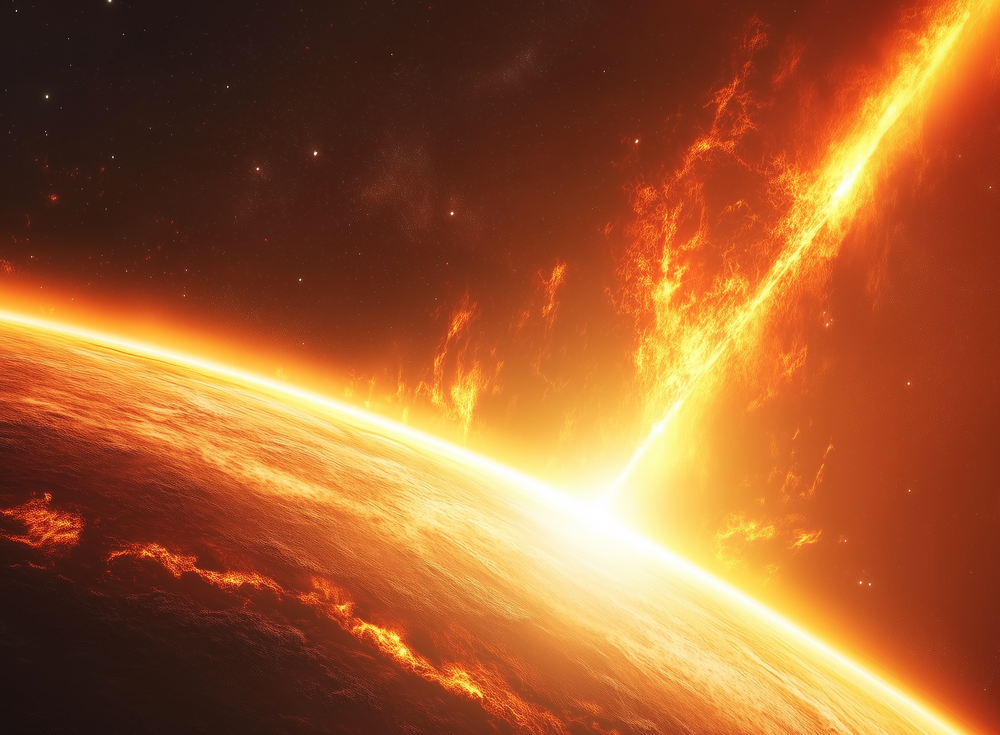
The sun determines the daily routine of all living creatures, and the respective solstices in summer and winter are associated with different celebrations and festivities in numerous cultures. And from a distance of 150 million kilometres, it also appears quite peaceful to us. But if you take a closer look, the sun turns out to be an extremely temperamental star. The unusually strong solar storms of the past year, which made themselves felt through impressive northern lights even at low latitudes, are testament to this alone. But can our star also become a true fury? Evidence of the most violent solar “tantrums” can be found in ancient tree trunks and in samples of millennia-old glacial ice. However, these indirect sources do not provide any information about the frequency of superflares. And direct measurements of the amount of radiation reaching the Earth from the Sun have only existed since the beginning of the space age.
Another way to get to the bottom of our star's long-term behaviour is to look at the stars, as in the current study. Modern space telescopes observe thousands upon thousands of stars and record their brightness fluctuations. Superflares, which release more than 1015 joules of energy in a short period of time, reveal themselves in the measurement data through short, very intense brightness peaks in visible light. In a recent study, the team of Sami Solanki, Director at the Max Planck Institute for Solar System Research, analysed the data of 56,450 sun-like stars observed by NASA's Kepler Space Telescope between 2009 and 2013.
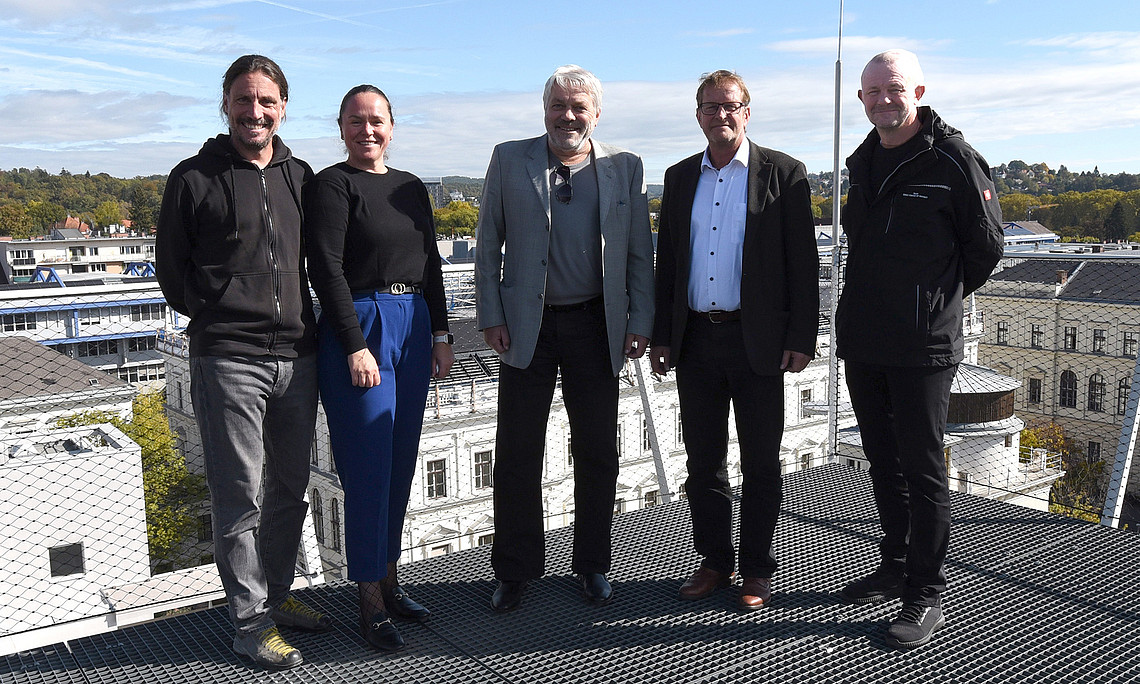
“We cannot observe the Sun over thousands of years,” explains Solanki, co-author of the study, the basic idea of the research. “Instead, however, we can monitor the behaviour of thousands of Sun-like stars over short periods of time. This helps us to estimate how often superflares occur,” he adds. The team included researchers from the University of Oulu (Finland), the National Astronomical Observatory of Japan, the University of Colorado Boulder (USA), the Center for Atomic and Alternative Energies Paris Saclay, the University of Paris-Cité and the University of Graz.
Distant stars as a blueprint for the Sun
The newly appointed Professor of Astrophysics, Alexander Shapiro, emphasises the significance of the study for the University of Graz: “The study of solar activity and solar flares has been one of the main focuses of the astrophysicists at the University of Graz for more than two decades. Since recently, their research has also been extending to far-away stars that can provide us with a missing piece of the puzzle in our quest for understanding the Sun and solar-terrestrial connection. The data from the Kepler telescope used in the study provides a total of 220,000 years of stellar activity.”
Crucial for the study was the careful selection of the stars to be taken into account. After all, the chosen stars should be particularly close “relatives” of the Sun. The scientists therefore only admitted stars whose surface temperature and brightness were similar to the Sun’s. The researchers also ruled out numerous sources of error, such as cosmic radiation, passing asteroids or comets, as well as non-sun-like stars that in Kepler images may by chance flare up in the vicinity of a sun-like star. To do this, the team carefully analyzed the images of each potential superflare - only a few pixels in size - and only counted those events that could reliably be assigned to one of the selected stars.
In this way, the researchers identified 2889 superflares on 2527 of the 56450 observed stars. This means that on average, one sun-like star produces a superflare approximately once per century.
“High performance dynamo computations of these solar-type stars easily explain the magnetic origins of the intense release of energy during such superflares”, said coauthor Allan Sacha Brun of the Commissariat of Atomic and Alternative Energies of Paris-Saclay and the University of Paris-Cité.
Surprisingly frequent
“We were very surprised that sun-like stars are prone to such frequent superflares”, said first author Dr. Valeriy Vasilyev from the MPS. Earlier surveys by other research groups had found average intervals of a thousand or even ten thousand years. However, earlier studies were unable to determine the exact source of the observed flare and therefore had to limit themselves to stars that did not have any too close neighbors in the telescope images. The current study is the most precise and sensitive to date.
Longer average time intervals between extreme solar events have also been suggested by studies looking for evidence of violent solar storms impacting Earth. When a particularly high flux of energetic particles from the Sun reaches the Earth's atmosphere, they produce a detectable amount of radioactive atoms such as the radioactive carbon isotope 14C. These atoms are then deposited in natural archives such as tree rings and glacial ice. Even thousands of years later, the sudden influx of high-energy solar particles can thus be deduced by measuring the amount of 14C using modern technologies.
In this way, researchers were able to identify five extreme solar particle events and three candidates within the past twelve thousand years of the Holocene, leading to an average occurance rate of once per 1500 years. The most violent is believed to have occurred in the year 775 AD. However, it is quite possible that more such violent particle events and also more superflares occurred on the Sun in the past. “It is unclear whether gigantic flares are always accompanied by coronal mass ejections and what is the relationship between superflares and extreme solar particle events. This requires further investigation”, co-author Prof. Dr. Ilya Usoskin from the University of Oulu in Finland pointed out. Looking at the terrestrial evidence of past extreme solar events could therefore underestimate the frequency of superflares.
Forecasting dangerous space weather
The new study does not reveal when the Sun will throw its next fit. However, the results urge caution. “The new data are a stark reminder that even the most extreme solar events are part of the Sun's natural repertoire,” said coauthor Dr. Natalie Krivova from the MPS. During the Carrington event of 1859, one of the most violent solar storms of the past 200 years, the telegraph network collapsed in large parts of northern Europe and North America. According to estimates, the associated flare released only a hundredth of the energy of a superflare. Today, in addition to the infrastructure on the Earth's surface, especially satellites would be at risk.
The most important preparation for strong solar storms is therefore reliable and timely forecasting. As a precaution, satellites, for example, could be switched off. From 2031, ESA’s space probe Vigil will help in the endeavor of forecasting. From its observation position in space, it will look at the Sun from the side and notice sooner than Earth-bound probes when processes that might drive dangerous space weather are brewing up on our star. The MPS is currently developing the Polarimetric and Magnetic Imager for this mission.