Begin of page section:
Page sections:

  • Go to contents (Accesskey 1)
  • Go to position marker (Accesskey 2)
  • Go to main navigation (Accesskey 3)
  • Go to sub navigation (Accesskey 4)
  • Go to additional information (Accesskey 5)
  • Go to page settings (user/language) (Accesskey 8)
  • Go to search (Accesskey 9)

End of this page section. Go to overview of page sections

Begin of page section:
Page settings:

English en
Deutsch de
Search
Login

End of this page section. Go to overview of page sections

Begin of page section:
Search:

Search for details about Uni Graz
Close

End of this page section. Go to overview of page sections


Search

Begin of page section:
Main navigation:

Page navigation:

  • University

    University
    • About the University
    • Organisation
    • Faculties
    • Library
    • Working at University of Graz
    • Campus
    Developing solutions for the world of tomorrow - that is our mission. Our students and our researchers take on the great challenges of society and carry the knowledge out.
  • Research Profile

    Research Profile
    • Our Expertise
    • Research Questions
    • Research Portal
    • Promoting Research
    • Research Transfer
    • Ethics in Research
    • Commission for Scientific Integrity
    Scientific excellence and the courage to break new ground. Research at the University of Graz creates the foundations for making the future worth living.
  • Studies

    Studies
    • Prospective Students
    • Students
    • Welcome Weeks for First Year Students
  • Community

    Community
    • International
    • Location
    • Research and Business
    • Alumni
    The University of Graz is a hub for international research and brings together scientists and business experts. Moreover, it fosters the exchange and cooperation in study and teaching.
Topics
  • Sustainable University
  • Researchers answer
  • Work for us
Close menu

End of this page section. Go to overview of page sections

Begin of page section:
You are here:

University of Graz News Sommernacht und Spielwiese

End of this page section. Go to overview of page sections

Wednesday, 10 June 2015

Sommernacht und Spielwiese

Der Multikulti-Ball verwandelt den Campus in eine „Spielwiese“ für Erwachsene mit Karussell, Wurfspielen und Boccia-Bahn. Foto: Schubidu Quartet
Der Multikulti-Ball verwandelt den Campus in eine „Spielwiese“ für Erwachsene mit Karussell, Wurfspielen und Boccia-Bahn. Foto: Schubidu Quartet

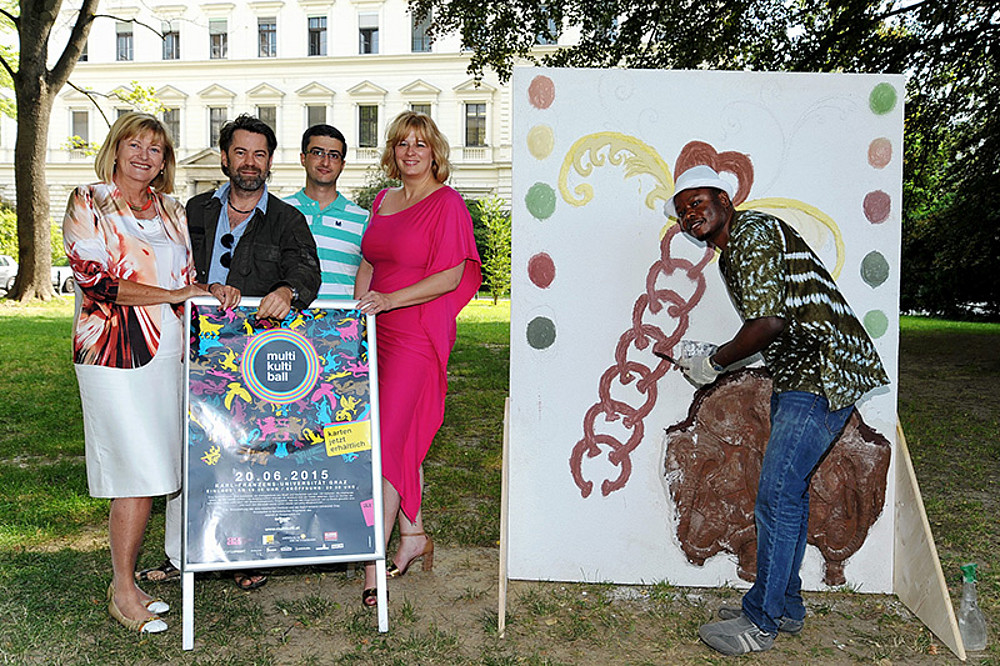
Lüfteten die Geheimnisse des Multikulti-Balls 2015: Rektorin Christa Neuper, Sandy Lopicic, musikalischer Leiter, Ehrengast Muhamad Al Diri, Claudia Unger, Leiterin des Afro-Asiatischen Instituts, und der nigerianische Künstler Samson Ogiamien (v.l.), F

Lüfteten die Geheimnisse des Multikulti-Balls 2015: Rektorin Christa Neuper, Sandy Lopicic, musikalischer Leiter, Ehrengast Muhamad Al Diri, Claudia Unger, Leiterin des Afro-Asiatischen Instituts, und der nigerianische Künstler Samson Ogiamien (v.l.), Foto: cp-pictures


Der Multikulti-Ball 2015 mit La Strada-Feeling und Campus-Karussell

Eine Sommernacht, eine Spielwiese, ein Klanggebäude aus Musik und Menschen aus über 100 Nationen, die miteinander feiern, tanzen, essen, trinken – so leidenschaftlich wird am 18. Multikulti-Ball am 20. Juni 2015 die Vielfalt zelebriert. Das ist auch der Grund, warum die bunte Ballnacht des Afro-Asiatischen Instituts und der Karl-Franzens-Universität  Graz so beliebt ist: Hier treffen wunderschöne Roben auf bunte Festtrachten aus aller Welt.

Am 10. Juni 2015 wurden bei einem Pressegespräch die Geheimnisse dieser Sommernacht mit La Strada-Feeling gelüftet.

Der Innenhof des Hauptgebäudes der Uni Graz verwandelt sich am 20. Juni in einen kunterbunten Fest- und Konzertsaal mit kulturellen und kulinarischen Genüssen. Ein Teil des Campus präsentiert sich als „Spielwiese“ für Erwachsene mit Karussell, Wurfspielen und Boccia-Bahn. Der wunderbare Lesesaal der Universitätsbibliothek wird vom Publikum genauso in Besitz genommen wie die Aula, beides wohl außergewöhnliche Ball-Locations.

Toleranz, Dialog und Vielfalt
„Die Ballnacht steht im Zeichen der Toleranz und Weltoffenheit“, betonte Rektorin Christa Neuper. „Mit Studierenden und WissenschafterInnen aus mehr als 100 Ländern ist die Universität täglich eine Plattform des multikulturellen Dialogs.“

Claudia Unger, Leiterin des Afro-Asiatischen Instituts, verwies auf den guten Zweck der Unterhaltung: „Der Reinerlös des Balls fließt in ein Stipendienprogramm, durch das internationale Studierende aus Afrika, Asien und Lateinamerika die Möglichkeit erhalten, in Österreich zu studieren.“

Giving Voice

Ganz im Zeichen der kulturellen Vielfalt steht auch das abwechslungsreiche Programm, das das Team von La Strada Graz gemeinsam mit dem Musiker Sandy Lopicic erarbeitet hat. "Giving Voice" – den Dingen eine Stimme zu geben, zieht sich als roter Faden durch das gesamte künstlerische Programm für den Multikulti-Ball 2015.

Ehrengäste

Mit dem Ehrengast setzen die Veranstalter heuer ein aktuelles Zeichen: Angesichts der Kriege im Nahen Osten und der Flüchtlingsdramen wird „Giving Voice“ ganz konkret umgesetzt: Muhamad Al Diri, Zahnarzt aus Syrien, der vor einem halben Jahr nach Österreich aufgrund von persönlicher Verfolgung und Lebensgefahr flüchten musste, ist heuer der Ehrengast und gibt den vielen Facetten aktueller Ereignisse sein Gesicht.  Seine Stimme erhebt Dr. Al Diri nicht nur für seine Familienmitglieder, die nach wie vor in Damaskus leben, sondern für alle, die von diesem Krieg betroffen sind.

Die Multikulti-Card 2015, die stets besonderes multikulturelles Engagement auszeichnet, erhält heuer Sonja Perkic-Krempl, eine engagierte Kämpferin gegen Menschenrechtsverletzungen. Sie unterstützte das österreichische Zeugenbegleitungsprogramm in Guatemala,  erstellte eine Studie über die Verbindung von guatemalischen Frauenmorden und dem organisierten Verbrechen und erhielt für ihre durchaus gefährliche Arbeit u.a. den Menschenrechtspreis des Landes Steiermark.

Multikulti-Ball 2015
Samstag, 20. Juni 2015, Einlass ab 19.30 Uhr
Karl-Franzens-Universität Graz
Eröffnung im Innenhof um 21 Uhr
www.multikulti.at

created by Andreas Schweiger

Related news

Jurassic Sounds: Biologist reconstructs insect songs from 165 million years ago

It was apparently not just the roars of the dinosaurs that made up the soundscape of the animal world during the Jurassic period. Crickets and grasshoppers communicated through a variety of songs and high-pitched sounds, as Thorin Jonsson from the Institute of Biology at the University of Graz discovered together with colleagues from the universities of Lincoln, Bristol (UK), Beijing (China) and Tempe (USA). The findings on what are so far the oldest traces of sound on Earth have just been published in the journal PNAS.

EU funding boosts international exchange between universities

The University of Graz is further expanding its international study opportunities through the European university alliance Arqus and is taking the lead in two key projects. In future, students will benefit from even more joint degree programmes and from simplified recognition of academic achievements through the Joint European Degree Label.

Rescue and risks: Researchers have surveyed public perceptions of AI

The use of artificial intelligence has had to be made transparent since 2 August 2026. The EU’s AI Act, which has been in force since then, also sets out how risky an application is and which security measures apply as a result. However, the assessment of risks by the legislation differs in some cases significantly from the perceptions of the Austrian public. This is the finding of a representative study carried out by data scientist Stefan Thalmann from the University of Graz and his team.

The Healing Sea: Researchers discover new approaches to treating chronic inflammation in sponges

Chronic inflammation plays a key role in many diseases, ranging from metabolic disorders and cardiovascular diseases to tissue damage following injuries or infections. “Normally, the body is able to resolve inflammation on its own. If this process becomes unbalanced, immune cells remain permanently active and continue to drive negative changes in the tissue,” explains Andreas Koeberle, a pharmacist at the University of Graz.

Begin of page section:
Additional information:

University of Graz
Universitaetsplatz 3
8010 Graz
Austria
  • Contact
  • Web Editors
  • Moodle
  • UNIGRAZonline
  • Imprint
  • Data Protection Declaration
  • Accessibility Declaration
Weatherstation
Uni Graz

End of this page section. Go to overview of page sections

End of this page section. Go to overview of page sections

Begin of page section:

End of this page section. Go to overview of page sections