Begin of page section:
Page sections:

  • Go to contents (Accesskey 1)
  • Go to position marker (Accesskey 2)
  • Go to main navigation (Accesskey 3)
  • Go to sub navigation (Accesskey 4)
  • Go to additional information (Accesskey 5)
  • Go to page settings (user/language) (Accesskey 8)
  • Go to search (Accesskey 9)

End of this page section. Go to overview of page sections

Begin of page section:
Page settings:

English en
Deutsch de
Search
Login

End of this page section. Go to overview of page sections

Begin of page section:
Search:

Search for details about Uni Graz
Close

End of this page section. Go to overview of page sections


Search

Begin of page section:
Main navigation:

Page navigation:

  • University

    University
    • About the University
    • Organisation
    • Faculties
    • Library
    • Working at University of Graz
    • Campus
    Developing solutions for the world of tomorrow - that is our mission. Our students and our researchers take on the great challenges of society and carry the knowledge out.
  • Research Profile

    Research Profile
    • Our Expertise
    • Research Questions
    • Research Portal
    • Promoting Research
    • Research Transfer
    • Ethics in Research
    Scientific excellence and the courage to break new ground. Research at the University of Graz creates the foundations for making the future worth living.
  • Studies

    Studies
    • Prospective Students
    • Students
  • Community

    Community
    • International
    • Location
    • Research and Business
    • Alumni
    The University of Graz is a hub for international research and brings together scientists and business experts. Moreover, it fosters the exchange and cooperation in study and teaching.
  • Spotlight
Topics
  • Our digital Advent calendar
  • Sustainable University
  • Researchers answer
  • Work for us
Close menu

End of this page section. Go to overview of page sections

Begin of page section:
You are here:

University of Graz News Signals from the roots: how the plant hormone cytokinin influences flowering

End of this page section. Go to overview of page sections

Wednesday, 02 July 2025

Signals from the roots: how the plant hormone cytokinin influences flowering

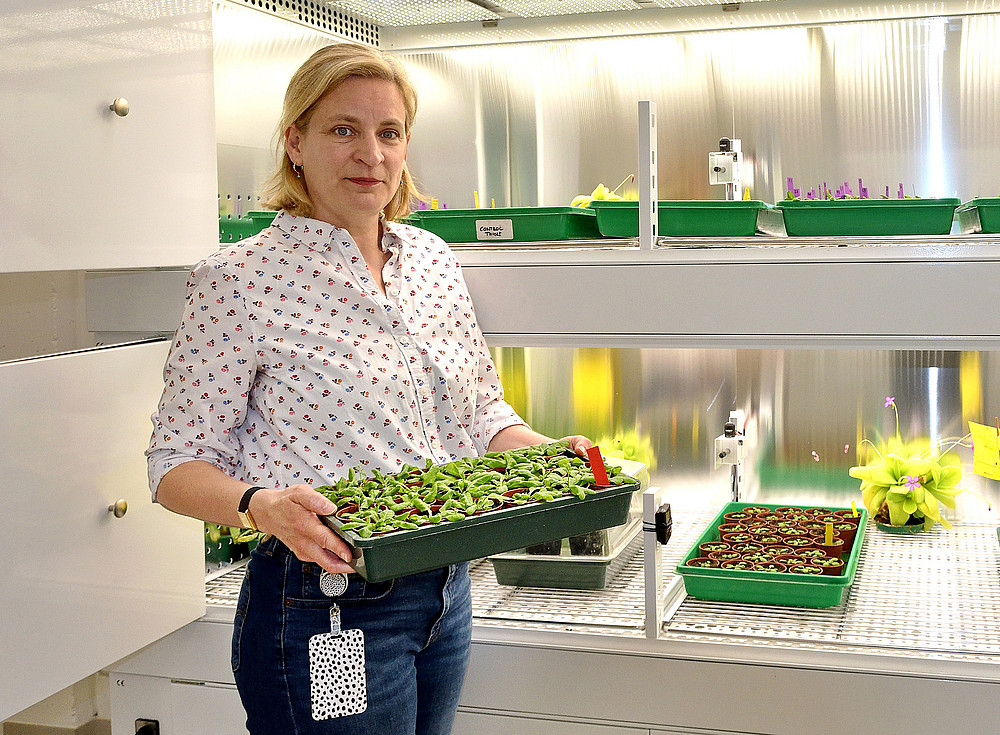
Isabel Bartrina holds a tray of small young plants in her hands, behind her is an illuminated cabinet with more plants ©University of Graz / Pichler

Isabel Bartrina uses thale cress (Arabidopsis thaliana) as a model for her research. Photo: University of Graz / Pichler

Many do it in spring, others wait a little longer and some really get going in winter – when a plant begins to flower is controlled by various internal and external signals. In a study published in the renowned scientific journal Plant Physiology, researchers at the University of Graz were able to clarify the role played by the hormone cytokinin in this process. The findings are also interesting with regard to the breeding of crops for agriculture. In view of changing climatic conditions, adjustments to the start of flowering could help to secure yields.


The growth cycle of plants is influenced by a number of external conditions, above all temperature and sunlight. However, there are also internal controlling factors. These include the plant hormone cytokinin. “Cytokinin promotes flowering in both long and short days, with a particularly strong effect when there are only a few hours of daylight,” reports Isabel Bartrina, first and corresponding author of a current publication on this topic.

The plant physiologist from Tomáš Werner's research group at the University of Graz has investigated how cytokinin regulates flowering. “The strongest influence is exerted by specific forms of the hormone that are produced in the root: the so-called trans-zeatin,” says Bartrina. “If its transport is disrupted, flowering is delayed. These results reveal a surprising and hitherto little-noticed role of the roots in flowering induction.”

Cytokinin influences the levels of the microRNA molecules miR156 and miR172, which regulate the ageing process. “The higher the cytokinin level, the faster the plant matures, so to speak. Only when it has reached this stage can it flower,” explains the researcher. If the hormone is missing, flowering is delayed. The scientists used thale cress (Arabidopsis thaliana) as a model for their investigations.

The new findings could be used to breed crops whose flowering time needs to be adapted to climatic conditions or other requirements. This could be to avoid damage from late frosts or to ensure optimal pollination by bees.

Publication
Root-derived cytokinin regulates Arabidopsis thaliana flowering time through components of the age pathway
Plant Physiology
https://doi.org/10.1093/plphys/kiaf204


⇒ If you want to find out more about the inner life of plants and their secrets of success, you can study Biology at the University of Graz

Related news

Chemical Christmas show at the University of Graz: An explosive evening at the Schauspielh

At the beginning of December, the University of Graz transformed the theater into a laboratory: as part of “Chemical Life,” teacher training students staged a chemical Christmas show for Styrian school classes—complete with ethanol rockets, nitrogen snow, and glowing effects. An evening designed to inspire interest in studying chemistry.

Train by train: Koralm railway accelerates exchange between the Universities

Lectures at the University of Klagenfurt in the morning, seminars at the University of Graz in the afternoon: Austria's longest tunnel and a journey time of around 45 minutes make it easy. The Koralm railway increases the speed of networking between the two university locations. The collaboration builds on existing cooperation - for example in the areas of teacher training, Slavic studies and as employers, the universities are well coordinated.

On the trail of the Big Bang: University of Graz receives 1.5 million euros for doctoral programmes

The Austrian Science Fund FWF has selected the Doctoral Programme in Theoretical Particle Physics at the University of Graz for funding from the Doc.funds. Six young scientists will be funded for 3.5 years. They will gain fundamentally new insights into the origins of the world.

From trans women and knee prostheses: sports science prizes awarded

Walking better with a prosthesis, successfully getting rid of excess weight, training more effectively, more fairness for trans people in sport: these were the topics addressed by the students at the University of Graz who were awarded the sports science prizes for their Master's theses on 3 December 2025.

Begin of page section:
Additional information:

University of Graz
Universitaetsplatz 3
8010 Graz
Austria
  • Contact
  • Web Editors
  • Moodle
  • UNIGRAZonline
  • Imprint
  • Data Protection Declaration
  • Accessibility Declaration
Weatherstation
Uni Graz

End of this page section. Go to overview of page sections

End of this page section. Go to overview of page sections

Begin of page section:

End of this page section. Go to overview of page sections