Begin of page section:
Page sections:

  • Go to contents (Accesskey 1)
  • Go to position marker (Accesskey 2)
  • Go to main navigation (Accesskey 3)
  • Go to sub navigation (Accesskey 4)
  • Go to additional information (Accesskey 5)
  • Go to page settings (user/language) (Accesskey 8)
  • Go to search (Accesskey 9)

End of this page section. Go to overview of page sections

Begin of page section:
Page settings:

English en
Deutsch de
Search
Login

End of this page section. Go to overview of page sections

Begin of page section:
Search:

Search for details about Uni Graz
Close

End of this page section. Go to overview of page sections


Search

Begin of page section:
Main navigation:

Page navigation:

  • University

    University
    • About the University
    • Organisation
    • Faculties
    • Library
    • Working at University of Graz
    • Campus
    Developing solutions for the world of tomorrow - that is our mission. Our students and our researchers take on the great challenges of society and carry the knowledge out.
  • Research Profile

    Research Profile
    • Our Expertise
    • Research Questions
    • Research Portal
    • Promoting Research
    • Research Transfer
    • Ethics in Research
    • Commission for Scientific Integrity
    Scientific excellence and the courage to break new ground. Research at the University of Graz creates the foundations for making the future worth living.
  • Studies

    Studies
    • Prospective Students
    • Students
  • Community

    Community
    • International
    • Location
    • Research and Business
    • Alumni
    The University of Graz is a hub for international research and brings together scientists and business experts. Moreover, it fosters the exchange and cooperation in study and teaching.
Topics
  • Sustainable University
  • Researchers answer
  • Work for us
Close menu

End of this page section. Go to overview of page sections

Begin of page section:
You are here:

University of Graz News Signals from the roots: how the plant hormone cytokinin influences flowering

End of this page section. Go to overview of page sections

Wednesday, 02 July 2025

Signals from the roots: how the plant hormone cytokinin influences flowering

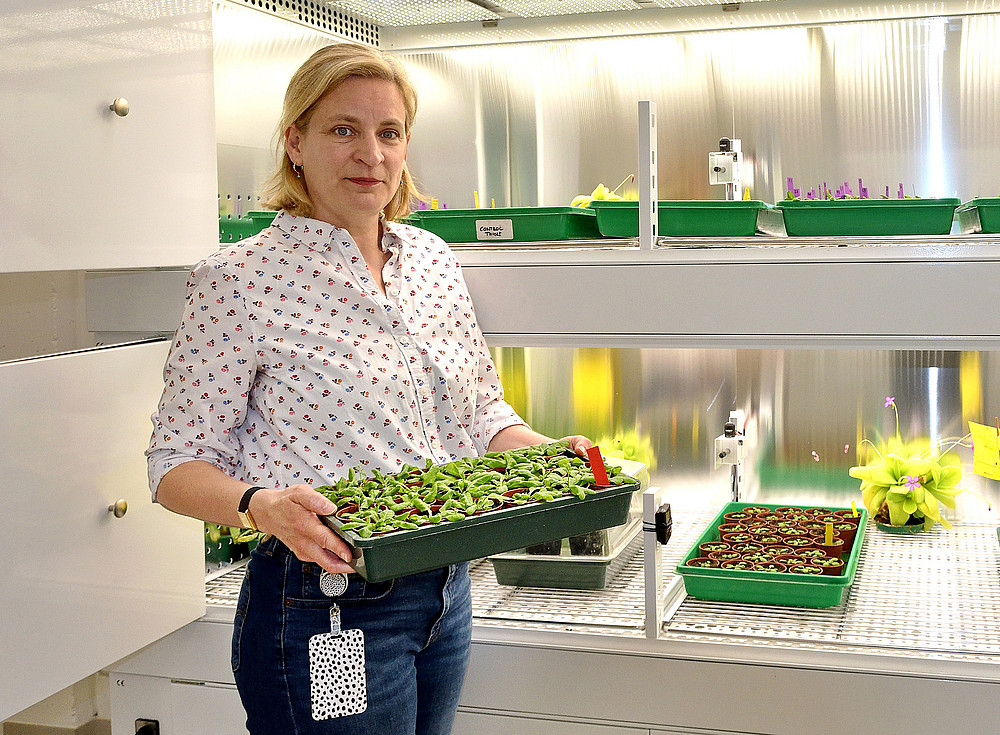
Isabel Bartrina holds a tray of small young plants in her hands, behind her is an illuminated cabinet with more plants ©University of Graz / Pichler

Isabel Bartrina uses thale cress (Arabidopsis thaliana) as a model for her research. Photo: University of Graz / Pichler

Many do it in spring, others wait a little longer and some really get going in winter – when a plant begins to flower is controlled by various internal and external signals. In a study published in the renowned scientific journal Plant Physiology, researchers at the University of Graz were able to clarify the role played by the hormone cytokinin in this process. The findings are also interesting with regard to the breeding of crops for agriculture. In view of changing climatic conditions, adjustments to the start of flowering could help to secure yields.


The growth cycle of plants is influenced by a number of external conditions, above all temperature and sunlight. However, there are also internal controlling factors. These include the plant hormone cytokinin. “Cytokinin promotes flowering in both long and short days, with a particularly strong effect when there are only a few hours of daylight,” reports Isabel Bartrina, first and corresponding author of a current publication on this topic.

The plant physiologist from Tomáš Werner's research group at the University of Graz has investigated how cytokinin regulates flowering. “The strongest influence is exerted by specific forms of the hormone that are produced in the root: the so-called trans-zeatin,” says Bartrina. “If its transport is disrupted, flowering is delayed. These results reveal a surprising and hitherto little-noticed role of the roots in flowering induction.”

Cytokinin influences the levels of the microRNA molecules miR156 and miR172, which regulate the ageing process. “The higher the cytokinin level, the faster the plant matures, so to speak. Only when it has reached this stage can it flower,” explains the researcher. If the hormone is missing, flowering is delayed. The scientists used thale cress (Arabidopsis thaliana) as a model for their investigations.

The new findings could be used to breed crops whose flowering time needs to be adapted to climatic conditions or other requirements. This could be to avoid damage from late frosts or to ensure optimal pollination by bees.

Publication
Root-derived cytokinin regulates Arabidopsis thaliana flowering time through components of the age pathway
Plant Physiology
https://doi.org/10.1093/plphys/kiaf204


 

⇒ If you want to find out more about the inner life of plants and their secrets of success, you can study Biology at the University of Graz

Related news

Superti-Furga will becomefounding director of the CORI Institute in Graz

The Austrian Academy of Sciences (ÖAW) is establishing a new flagship centre for research into metabolic diseases in collaboration with the three universities in Graz. This innovative research approach combines mathematics and experimental biology with artificial intelligence

A match for life

Stem cell donations save lives. However, the only way to determine who is ultimately compatible with whom is through a testing process. Pharmacist Marion Mußbacher explains the mechanisms behind this. On 6 May 2026, the ÖH and the charity “Geben für Leben” are calling for people to come forward for typing at the University of Graz.

Mild Research Night: Around 750 visitors travelled around the world at the university

Lovely weather and a wide range of research topics drew visitors to the University of Graz last Friday. Highlights included a journey around the globe in eight stops, a ‘speed-dating’ session with books, insights into Alfred Wegener’s Greenland expedition, and guided tours of the democracy exhibition at the UniGraz@Museum.

Career Booster: How the Research Careers Campus supports researchers

They are innovative, creative and productive – researchers who have not yet been appointed to a professorship make a massive contribution to a university’s research output. To provide them with even better support on their career path, the University of Graz has established the Research Careers Campus. The official launch took place on 22 April 2026 with a ‘festival’.

Begin of page section:
Additional information:

University of Graz
Universitaetsplatz 3
8010 Graz
Austria
  • Contact
  • Web Editors
  • Moodle
  • UNIGRAZonline
  • Imprint
  • Data Protection Declaration
  • Accessibility Declaration
Weatherstation
Uni Graz

End of this page section. Go to overview of page sections

End of this page section. Go to overview of page sections

Begin of page section:

End of this page section. Go to overview of page sections