Begin of page section:
Page sections:

  • Go to contents (Accesskey 1)
  • Go to position marker (Accesskey 2)
  • Go to main navigation (Accesskey 3)
  • Go to sub navigation (Accesskey 4)
  • Go to additional information (Accesskey 5)
  • Go to page settings (user/language) (Accesskey 8)
  • Go to search (Accesskey 9)

End of this page section. Go to overview of page sections

Begin of page section:
Page settings:

English en
Deutsch de
Search
Login

End of this page section. Go to overview of page sections

Begin of page section:
Search:

Search for details about Uni Graz
Close

End of this page section. Go to overview of page sections


Search

Begin of page section:
Main navigation:

Page navigation:

  • University

    University
    • About the University
    • Organisation
    • Faculties
    • Library
    • Working at University of Graz
    • Campus
    Developing solutions for the world of tomorrow - that is our mission. Our students and our researchers take on the great challenges of society and carry the knowledge out.
  • Research Profile

    Research Profile
    • Our Expertise
    • Research Questions
    • Research Portal
    • Promoting Research
    • Research Transfer
    • Ethics in Research
    • Commission for Scientific Integrity
    Scientific excellence and the courage to break new ground. Research at the University of Graz creates the foundations for making the future worth living.
  • Studies

    Studies
    • Prospective Students
    • Students
  • Community

    Community
    • International
    • Location
    • Research and Business
    • Alumni
    The University of Graz is a hub for international research and brings together scientists and business experts. Moreover, it fosters the exchange and cooperation in study and teaching.
  • Spotlight
Topics
  • Sustainable University
  • Researchers answer
  • Work for us
Close menu

End of this page section. Go to overview of page sections

Begin of page section:
You are here:

University of Graz News Safe without a jab

End of this page section. Go to overview of page sections

Wednesday, 13 October 2021

Safe without a jab

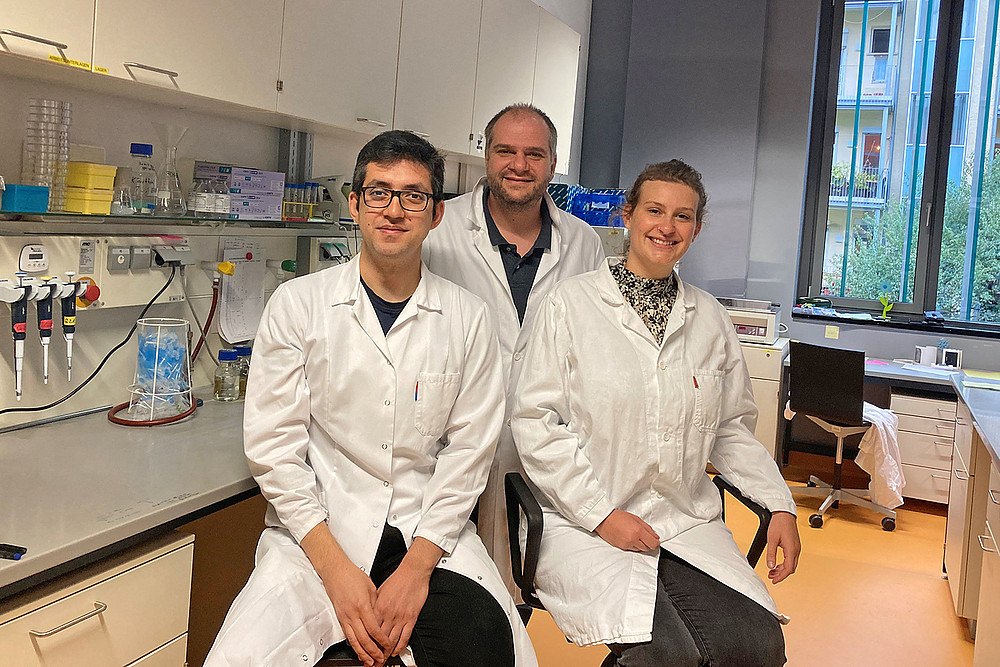
Himadri Thapa, Stefan Schild and Anna Müller (f.l.t.r.) have developed a potential vaccine against Covid-19. Photo: University of Graz

Himadri Thapa, Stefan Schild and Anna Müller (f.l.t.r.) have developed a potential vaccine against Covid-19. Photo: University of Graz

Uni Graz is developing potential vaccine against Covid-19

Some fear the needle, others genetic manipulation, and in large parts of the world distribution problems are the primary reason why vaccination targets are not being reached. The most effective RNA vaccines against Covid-19 currently available will not be enough to permanently combat the pandemic. Against this background, molecular biologists at the University of Graz have developed a vaccine candidate that is inexpensive to produce, storable at room temperature and can be administered as a nasal spray with no need for trained personnel. The invention has already been registered for a patent and published in the journal Frontiers in Microbiology.

“Hitchhiking” on the bacterial membrane
As a carrier material for the vaccine, Stefan Schild from the Institute of Molecular Biosciences uses the constricted outer membranes of cholera and coli bacteria, which he has been researching for more than a decade. The scientist and his team “load” these bacteria with information about the spike protein characteristic for the Covid pathogen, giving the immune system the tools to recognise the virus as an enemy and fight it. The potential vaccine was as effective as the vaccines already approved in mice as model organisms. The University of Graz is now looking for industrial partners for clinical studies.

Trump card for the next pandemic
Even if this newly developed method can no longer break the current wave, Schild sees great potential for the new technology: “In Africa, only three percent of the population are immunised, and the vaccines currently available will certainly not be enough to bring the pandemic under control in the long term.” He sees the simple production and distribution method as a major plus for his candidate, which he developed in close collaboration with Tufts University in Massachusetts (USA). Easy administration as a nose spray is also likely to increase the effectiveness of the vaccine as the defence mechanisms in the mucous membranes are activated, which is not the case with intramuscular injections. In addition, the proven carrier material can be adapted for a whole range of other infectious diseases.


Publication:
Himadri Bahadur Thapa, Anna M. Müller, Andrew Camilli, Stefan Schild: „An intranasal vaccine based on outer membrane vesicles against SARS-CoV-2“, Frontiers in Microbiology


created by Dagmar Eklaude

Related news

Higher Education Strategy 2040: Austria’s universities on course for the future

Austria has 77 higher education institutions, which is above the EU average – but does this really make sense? The new Higher Education Strategy 2040 focuses on cooperation rather than mergers. As one of the six largest universities in Austria, the University of Graz plays a central role in this.

Climate research in Greenland: Old data provides new insights

The polar explorer and University of Graz professor Alfred Wegener left behind a unique collection of climate data from Greenland. A research team from the University of Graz is now analysing this 100-year-old treasure trove of data and comparing it with current measurements.

Diversity in nature and science: How we talk about plants and each other

Ginkgo, kiwi, hemp: they exist as male and female plants. Anyone who paid attention in biology class will confirm this. But is this categorisation, established by Carl von Linné almost 300 years ago, still valid today? An interdisciplinary team at the University of Graz is questioning these attributions and using this as a starting point to provide food for thought for gender-sensitive interaction between students, scientific and teaching staff.

Around the world in eight stops: the Long Night of Research at the University of Graz

On 24 April from 5 pm, you can take a short trip around the globe at the University of Graz, discovering pecularities of foreign countries or new local features in the entrance hall of the University Library. The itinerary takes you through introduced animal species, political attitudes and the omnipotence of algorithms. There will also be a programme in the historic reading hall, as well as at the UniGraz@Museum and the University Archive.

Begin of page section:
Additional information:

University of Graz
Universitaetsplatz 3
8010 Graz
Austria
  • Contact
  • Web Editors
  • Moodle
  • UNIGRAZonline
  • Imprint
  • Data Protection Declaration
  • Accessibility Declaration
Weatherstation
Uni Graz

End of this page section. Go to overview of page sections

End of this page section. Go to overview of page sections

Begin of page section:

End of this page section. Go to overview of page sections