Begin of page section:
Page sections:

  • Go to contents (Accesskey 1)
  • Go to position marker (Accesskey 2)
  • Go to main navigation (Accesskey 3)
  • Go to sub navigation (Accesskey 4)
  • Go to additional information (Accesskey 5)
  • Go to page settings (user/language) (Accesskey 8)
  • Go to search (Accesskey 9)

End of this page section. Go to overview of page sections

Begin of page section:
Page settings:

English en
Deutsch de
Search
Login

End of this page section. Go to overview of page sections

Begin of page section:
Search:

Search for details about Uni Graz
Close

End of this page section. Go to overview of page sections


Search

Begin of page section:
Main navigation:

Page navigation:

  • University

    University
    • About the University
    • Organisation
    • Faculties
    • Library
    • Working at University of Graz
    • Campus
    Developing solutions for the world of tomorrow - that is our mission. Our students and our researchers take on the great challenges of society and carry the knowledge out.
  • Research Profile

    Research Profile
    • Our Expertise
    • Research Questions
    • Research Portal
    • Promoting Research
    • Research Transfer
    • Ethics in Research
    Scientific excellence and the courage to break new ground. Research at the University of Graz creates the foundations for making the future worth living.
  • Studies

    Studies
    • Prospective Students
    • Students
  • Community

    Community
    • International
    • Location
    • Research and Business
    • Alumni
    The University of Graz is a hub for international research and brings together scientists and business experts. Moreover, it fosters the exchange and cooperation in study and teaching.
  • Spotlight
Topics
  • Our digital Advent calendar
  • Sustainable University
  • Researchers answer
  • Work for us
Close menu

End of this page section. Go to overview of page sections

Begin of page section:
You are here:

University of Graz News Safe without a jab

End of this page section. Go to overview of page sections

Wednesday, 13 October 2021

Safe without a jab

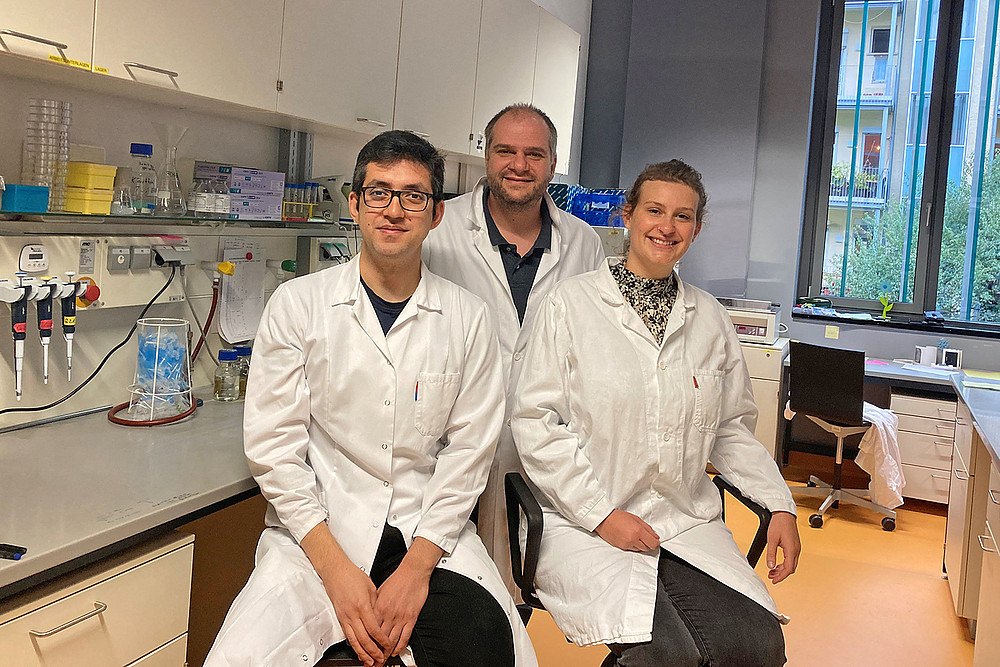
Himadri Thapa, Stefan Schild and Anna Müller (f.l.t.r.) have developed a potential vaccine against Covid-19. Photo: University of Graz

Himadri Thapa, Stefan Schild and Anna Müller (f.l.t.r.) have developed a potential vaccine against Covid-19. Photo: University of Graz

Uni Graz is developing potential vaccine against Covid-19

Some fear the needle, others genetic manipulation, and in large parts of the world distribution problems are the primary reason why vaccination targets are not being reached. The most effective RNA vaccines against Covid-19 currently available will not be enough to permanently combat the pandemic. Against this background, molecular biologists at the University of Graz have developed a vaccine candidate that is inexpensive to produce, storable at room temperature and can be administered as a nasal spray with no need for trained personnel. The invention has already been registered for a patent and published in the journal Frontiers in Microbiology.

“Hitchhiking” on the bacterial membrane
As a carrier material for the vaccine, Stefan Schild from the Institute of Molecular Biosciences uses the constricted outer membranes of cholera and coli bacteria, which he has been researching for more than a decade. The scientist and his team “load” these bacteria with information about the spike protein characteristic for the Covid pathogen, giving the immune system the tools to recognise the virus as an enemy and fight it. The potential vaccine was as effective as the vaccines already approved in mice as model organisms. The University of Graz is now looking for industrial partners for clinical studies.

Trump card for the next pandemic
Even if this newly developed method can no longer break the current wave, Schild sees great potential for the new technology: “In Africa, only three percent of the population are immunised, and the vaccines currently available will certainly not be enough to bring the pandemic under control in the long term.” He sees the simple production and distribution method as a major plus for his candidate, which he developed in close collaboration with Tufts University in Massachusetts (USA). Easy administration as a nose spray is also likely to increase the effectiveness of the vaccine as the defence mechanisms in the mucous membranes are activated, which is not the case with intramuscular injections. In addition, the proven carrier material can be adapted for a whole range of other infectious diseases.

Publication:
Himadri Bahadur Thapa, Anna M. Müller, Andrew Camilli, Stefan Schild: „An intranasal vaccine based on outer membrane vesicles against SARS-CoV-2“, Frontiers in Microbiology


created by Dagmar Eklaude

Related news

Semester abroad without barriers: University of Graz wins award for promoting inclusion

The University of Graz has been awarded the Internationalization Award for its new inclusion initiative. Students with fewer opportunities now also receive financial support for their semester abroad outside Europe.

Fair distribution: Researchers determine just greenhouse gas budgets for all EU regions

Ten years ago, on 12 December 2015, the Paris Climate Agreement was signed at the UN Climate Conference. In order to limit global warming to well below two degrees, only a certain amount of CO2 may be emitted worldwide. While the focus was originally on national emission targets, more than 200 subnational regions and almost 300 cities have now adopted their own targets. But how many emissions are they fairly entitled to? Researchers at the University of Graz have now developed transparent criteria for fair distribution at the subnational level for the first time and determined corresponding greenhouse gas budgets for all European regions. The paper was published today in the scientific journal Nature Communications.

Chemical Christmas show at the University of Graz: An explosive evening at the Schauspielh

At the beginning of December, the University of Graz transformed the theater into a laboratory: as part of “Chemical Life,” teacher training students staged a chemical Christmas show for Styrian school classes—complete with ethanol rockets, nitrogen snow, and glowing effects. An evening designed to inspire interest in studying chemistry.

Train by train: Koralm railway accelerates exchange between the Universities

Lectures at the University of Klagenfurt in the morning, seminars at the University of Graz in the afternoon: Austria's longest tunnel and a journey time of around 45 minutes make it easy. The Koralm railway increases the speed of networking between the two university locations. The collaboration builds on existing cooperation - for example in the areas of teacher training, Slavic studies and as employers, the universities are well coordinated.

Begin of page section:
Additional information:

University of Graz
Universitaetsplatz 3
8010 Graz
Austria
  • Contact
  • Web Editors
  • Moodle
  • UNIGRAZonline
  • Imprint
  • Data Protection Declaration
  • Accessibility Declaration
Weatherstation
Uni Graz

End of this page section. Go to overview of page sections

End of this page section. Go to overview of page sections

Begin of page section:

End of this page section. Go to overview of page sections