Begin of page section:
Page sections:

  • Go to contents (Accesskey 1)
  • Go to position marker (Accesskey 2)
  • Go to main navigation (Accesskey 3)
  • Go to sub navigation (Accesskey 4)
  • Go to additional information (Accesskey 5)
  • Go to page settings (user/language) (Accesskey 8)
  • Go to search (Accesskey 9)

End of this page section. Go to overview of page sections

Begin of page section:
Page settings:

English en
Deutsch de
Search
Login

End of this page section. Go to overview of page sections

Begin of page section:
Search:

Search for details about Uni Graz
Close

End of this page section. Go to overview of page sections


Search

Begin of page section:
Main navigation:

Page navigation:

  • University

    University
    • About the University
    • Organisation
    • Faculties
    • Library
    • Working at University of Graz
    • Campus
    Developing solutions for the world of tomorrow - that is our mission. Our students and our researchers take on the great challenges of society and carry the knowledge out.
  • Research Profile

    Research Profile
    • Our Expertise
    • Research Questions
    • Research Portal
    • Promoting Research
    • Research Transfer
    • Ethics in Research
    Scientific excellence and the courage to break new ground. Research at the University of Graz creates the foundations for making the future worth living.
  • Studies

    Studies
    • Prospective Students
    • Students
  • Community

    Community
    • International
    • Location
    • Research and Business
    • Alumni
    The University of Graz is a hub for international research and brings together scientists and business experts. Moreover, it fosters the exchange and cooperation in study and teaching.
  • Spotlight
Topics
  • Our digital Advent calendar
  • Sustainable University
  • Researchers answer
  • Work for us
Close menu

End of this page section. Go to overview of page sections

Begin of page section:
You are here:

University of Graz News Sauber und schnell

End of this page section. Go to overview of page sections

Wednesday, 06 April 2022

Sauber und schnell

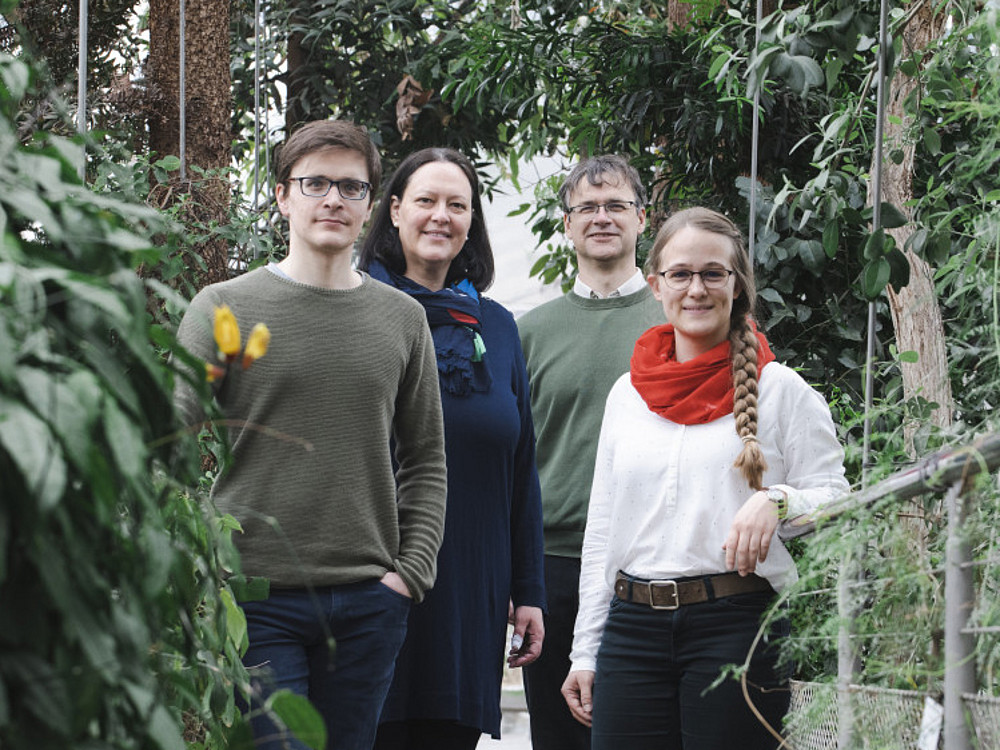
Christoph Winkler, Silvia Glück, Wolfgang Kroutil und Sarah Bierbaumer (v.l.) haben einen grünen Turbo für die Pharmaindustrie entwickelt. Foto: Uni Graz/Tzivanopoulos.

Christoph Winkler, Silvia Glück, Wolfgang Kroutil und Sarah Bierbaumer (v.l.) haben einen grünen Turbo für die Pharmaindustrie entwickelt. Foto: Uni Graz/Tzivanopoulos.

ForscherInnen entwickeln grünen Turbo für die Pharmaindustrie

Fieberhaft sucht die Welt nach sauberer Energie. Der völlige Ausstieg aus Öl, Gas und Kohle wird in vielen Bereichen noch dauern. Für die Herstellung von Medikamenten meldet sich eine tadellose Alternative aber verlässlich jeden Morgen: das Sonnenlicht. ForscherInnen der Universität Graz nutzen diese Energiequelle und steigern damit die Effizienz in der Produktion von Pharmazeutika um 100 Prozent. Im Fachjournal „Angewandte Chemie“ hat das Team rund um Silvia Glück und Wolfgang Kroutil kürzlich diese Ergebnisse veröffentlicht. Sie könnten die Pharmaindustrie bald sehr viel grüner machen.

Manche Moleküle sind wie Bild und Spiegelbild
Bei der Herstellung von Medikamenten wird viel Abfall produziert. Das liegt unter anderem daran, dass in manchen Fällen die Hälfte des Ausgangsmaterials für bestimmte Herstellungsschritte unbrauchbar ist. Schuld daran ist die Struktur der eingesetzten Moleküle. „Manche von ihnen kommen in zwei Formen vor, die einander ähneln wie Bild und Spiegelbild. Während sich die eine Variante als pharmazeutischer Wirkstoff eignet, kann die andere Schaden anrichten“, erklärt Wolfgang Kroutil. Bislang wurde die unerwünschte Molekül-Form deshalb einfach als Müll entsorgt. Gleichzeitig suchen WissenschafterInnen nach Wegen, um auch sie nutzbar zu machen.

Hier kommt Licht in die Sache
Den ChemikerInnen der Uni Graz ist genau das jetzt gelungen. Silvia Glück beschreibt die Methode: „Zunächst beschleunigen wir die Reaktion mit Biokatalysatoren. Diese umweltfreundlichen ‚Turbo‘-Teilchen sind fähig, zwischen den beiden Molekül-Formen zu unterscheiden. Zusammen mit dem zweiten Schritt, in dem mit der Energie des Sonnenlichts Sauerstoff aktiviert wird, kann die unerwünschte Molekül-Form in die gewünschte umgewandelt werden. Das Ergebnis ist zu hundert Prozent brauchbares Material bei einer völlig schadstofffreien, natürlichen Produktionskette.“  

Das Projekt wird vom österreichischen Wissenschaftsfonds FWF gefördert und ist Teil des Profilbildenden Bereichs BioHealth an der Universität Graz.

Publikation: S. Bierbaumer, L. Schmermund, A. List, C. K. Winkler,* S. M. Glueck,* W. Kroutil, Synthesis of Enantiopure Sulfoxides by Concurrent Photocatalytic Oxidation and Biocatalytic Reduction. Angewandte Chemie Internation Edition 2022, e202117103. https://onlinelibrary.wiley.com/doi/full/10.1002/anie.202117103 

created by Gerhild Leljak

Related news

Semester abroad without barriers: University of Graz wins award for promoting inclusion

The University of Graz has been awarded the Internationalization Award for its new inclusion initiative. Students with fewer opportunities now also receive financial support for their semester abroad outside Europe.

Fair distribution: Researchers determine just greenhouse gas budgets for all EU regions

Ten years ago, on 12 December 2015, the Paris Climate Agreement was signed at the UN Climate Conference. In order to limit global warming to well below two degrees, only a certain amount of CO2 may be emitted worldwide. While the focus was originally on national emission targets, more than 200 subnational regions and almost 300 cities have now adopted their own targets. But how many emissions are they fairly entitled to? Researchers at the University of Graz have now developed transparent criteria for fair distribution at the subnational level for the first time and determined corresponding greenhouse gas budgets for all European regions. The paper was published today in the scientific journal Nature Communications.

Chemical Christmas show at the University of Graz: An explosive evening at the Schauspielh

At the beginning of December, the University of Graz transformed the theater into a laboratory: as part of “Chemical Life,” teacher training students staged a chemical Christmas show for Styrian school classes—complete with ethanol rockets, nitrogen snow, and glowing effects. An evening designed to inspire interest in studying chemistry.

Train by train: Koralm railway accelerates exchange between the Universities

Lectures at the University of Klagenfurt in the morning, seminars at the University of Graz in the afternoon: Austria's longest tunnel and a journey time of around 45 minutes make it easy. The Koralm railway increases the speed of networking between the two university locations. The collaboration builds on existing cooperation - for example in the areas of teacher training, Slavic studies and as employers, the universities are well coordinated.

Begin of page section:
Additional information:

University of Graz
Universitaetsplatz 3
8010 Graz
Austria
  • Contact
  • Web Editors
  • Moodle
  • UNIGRAZonline
  • Imprint
  • Data Protection Declaration
  • Accessibility Declaration
Weatherstation
Uni Graz

End of this page section. Go to overview of page sections

End of this page section. Go to overview of page sections

Begin of page section:

End of this page section. Go to overview of page sections