Begin of page section:
Page sections:

  • Go to contents (Accesskey 1)
  • Go to position marker (Accesskey 2)
  • Go to main navigation (Accesskey 3)
  • Go to sub navigation (Accesskey 4)
  • Go to additional information (Accesskey 5)
  • Go to page settings (user/language) (Accesskey 8)
  • Go to search (Accesskey 9)

End of this page section. Go to overview of page sections

Begin of page section:
Page settings:

English en
Deutsch de
Search
Login

End of this page section. Go to overview of page sections

Begin of page section:
Search:

Search for details about Uni Graz
Close

End of this page section. Go to overview of page sections


Search

Begin of page section:
Main navigation:

Page navigation:

  • University

    University
    • About the University
    • Organisation
    • Faculties
    • Library
    • Working at University of Graz
    • Campus
    Developing solutions for the world of tomorrow - that is our mission. Our students and our researchers take on the great challenges of society and carry the knowledge out.
  • Research Profile

    Research Profile
    • Our Expertise
    • Research Questions
    • Research Portal
    • Promoting Research
    • Research Transfer
    • Ethics in Research
    Scientific excellence and the courage to break new ground. Research at the University of Graz creates the foundations for making the future worth living.
  • Studies

    Studies
    • Prospective Students
    • Students
  • Community

    Community
    • International
    • Location
    • Research and Business
    • Alumni
    The University of Graz is a hub for international research and brings together scientists and business experts. Moreover, it fosters the exchange and cooperation in study and teaching.
  • Spotlight
Topics
  • Our digital Advent calendar
  • Sustainable University
  • Researchers answer
  • Work for us
Close menu

End of this page section. Go to overview of page sections

Begin of page section:
You are here:

University of Graz News Researchers at the University of Graz provide evidence of climate change in the atmosphere

End of this page section. Go to overview of page sections

Monday, 24 November 2025

Researchers at the University of Graz provide evidence of climate change in the atmosphere

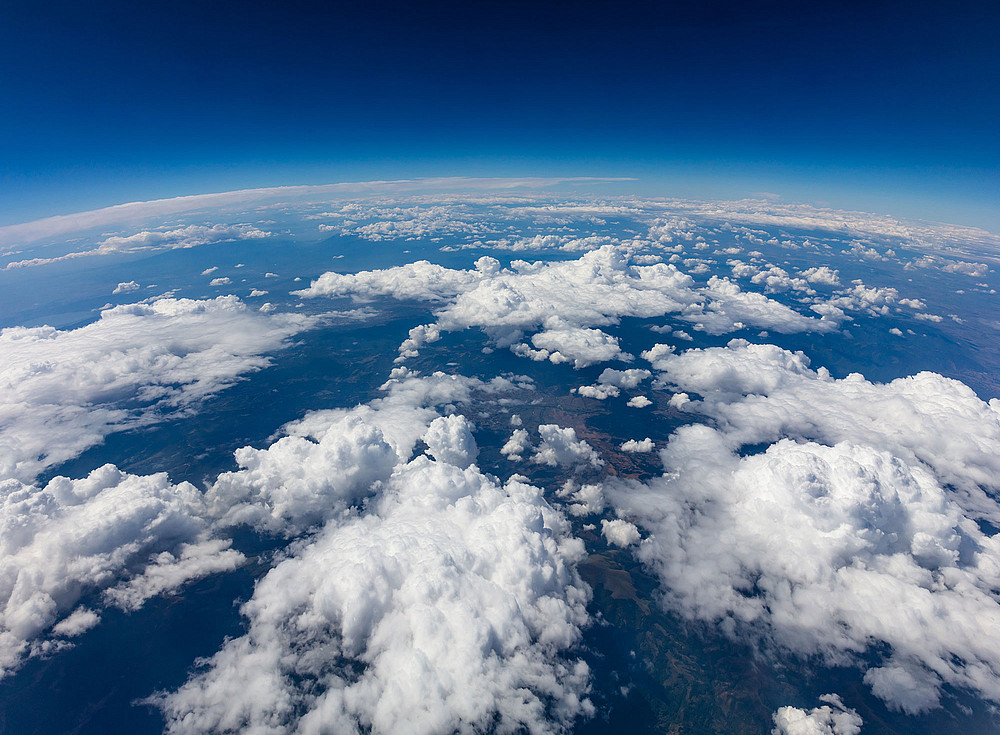
View of the Earth from above, irregular white bands of clouds, blue horizon ©Rawf8 - stock.adobe.com

The expansion of the troposphere is presumably linked to changes in weather patterns on Earth. Photo: Rawf8 - stock.adobe.com

Human-induced climate change is leaving clear traces in the atmosphere. Using satellite data, researchers at the Wegener Center at the University of Graz proved that the troposphere has expanded by up to 500 meters in some regions over the last two decades. The increase was most pronounced in the mid-latitudes of the northern hemisphere. This is also likely to be a sign of changes in the strong westerly winds, known as jet streams, and thus influences weather patterns. The new findings were recently published in the research journal Atmospheric Chemistry and Physics.


The tropopause is a good indicator of climate change. It forms the boundary between the troposphere – the weather layer – and the stratosphere above it. It lies at an altitude of eight to 17 kilometres above the Earth's surface, with the distance being greatest over the tropics and least over the poles. With temperatures between -40 and -80 degrees Celsius, the tropopause is one of the coldest places in the atmosphere. When the weather layer warms up, for example due to rising CO2 emissions, it expands. This causes the boundary to the stratosphere to move upwards.

A new study shows: “Over the past 23 years, the tropopause has risen worldwide by between 100 and almost 500 metres, depending on the region. The shift was most pronounced in the mid-latitudes of the northern hemisphere, particularly over Asia in autumn and winter. The development over the last years is particularly striking, with the weather layer above the tropics warming unusually strongly,” reports Florian Ladstädter, lead author of the publication. The geophysicist is part of the Global Climate Analysis research group led by Andrea Steiner at the Wegener Center at the University of Graz. Using satellite data from radio occultation measurements, the scientists have documented global changes in the tropopause over more than two decades. “Our study provides, for the first time, a reliable, seasonally and spatially high-resolution picture that reveals both regional details and differences over the course of the year,” says Andrea Steiner, emphasising the significance of the publication. 

According to the researchers, it can be assumed that the observed trend indicates changes in both the jet streams in the troposphere and global circulation in the stratosphere – with consequences for global meteorological phenomena as well as for weather patterns at the regional level.

Publication
Ladstädter, F., Stocker, M., Scher, S., and Steiner, A. K.: Observed changes in the temperature and height of the globally resolved lapserate tropopause, Atmos. Chem. Phys., 25, 16053–16062, https://doi.org/10.5194/acp-25-16053-2025


If you want to understand how the climate and other natural phenomena work, studying physics is a good choice.

created by Gudrun Pichler

Related news

On the trail of the Big Bang: University of Graz receives 1.5 million euros for doctoral programmes

The Austrian Science Fund FWF has selected the Doctoral Programme in Theoretical Particle Physics at the University of Graz for funding from the Doc.funds. Six young scientists will be funded for 3.5 years. They will gain fundamentally new insights into the origins of the world.

From trans women and knee prostheses: sports science prizes awarded

Walking better with a prosthesis, successfully getting rid of excess weight, training more effectively, more fairness for trans people in sport: these were the topics addressed by the students at the University of Graz who were awarded the sports science prizes for their Master's theses on 3 December 2025.

Influential: Rupert Baumgartner and Holger Hoff among the highly cited researchers

The number of publications in scientific journals is considered to be a measure of a researcher's scientific achievement. How often these works are cited by colleagues provides information about the relevance of the publications. Sustainability researcher Rupert Baumgartner and transdisciplinarity expert Holger Hoff from the University of Graz are among the top 1 per cent of the most cited scientists in their fields of research.

Nobel Lecture 2025: How evolution enters chemistry

During the Nobel Lecture at BioTechMed-Graz, Nobel Prize winner in Chemistry Frances H. Arnold provided insight into her research on the directed evolution of enzymes.

Begin of page section:
Additional information:

University of Graz
Universitaetsplatz 3
8010 Graz
Austria
  • Contact
  • Web Editors
  • Moodle
  • UNIGRAZonline
  • Imprint
  • Data Protection Declaration
  • Accessibility Declaration
Weatherstation
Uni Graz

End of this page section. Go to overview of page sections

End of this page section. Go to overview of page sections

Begin of page section:

End of this page section. Go to overview of page sections