



Begin of page section:
Page sections:

  • Go to contents (Accesskey 1)
  • Go to position marker (Accesskey 2)
  • Go to main navigation (Accesskey 3)
  • Go to sub navigation (Accesskey 4)
  • Go to additional information (Accesskey 5)
  • Go to page settings (user/language) (Accesskey 8)
  • Go to search (Accesskey 9)

End of this page section. Go to overview of page sections

Begin of page section:
Page settings:

English en
Deutsch de
Search
Login

End of this page section. Go to overview of page sections

Begin of page section:
Search:

Search for details about Uni Graz
Close

End of this page section. Go to overview of page sections


Search

Begin of page section:
Main navigation:

Page navigation:

  • University

    University
    • About the University
    • Organisation
    • Faculties
    • Library
    • Working at University of Graz
    • Campus
    Developing solutions for the world of tomorrow - that is our mission. Our students and our researchers take on the great challenges of society and carry the knowledge out.
  • Research Profile

    Research Profile
    • Our Expertise
    • Research Questions
    • Research Portal
    • Promoting Research
    • Research Transfer
    • Ethics in Research
    • Commission for Scientific Integrity
    Scientific excellence and the courage to break new ground. Research at the University of Graz creates the foundations for making the future worth living.
  • Studies

    Studies
    • Prospective Students
    • Students
  • Community

    Community
    • International
    • Location
    • Research and Business
    • Alumni
    The University of Graz is a hub for international research and brings together scientists and business experts. Moreover, it fosters the exchange and cooperation in study and teaching.
Topics
  • Sustainable University
  • Researchers answer
  • Work for us
Close menu

End of this page section. Go to overview of page sections

Begin of page section:
You are here:

University of Graz News Relevant

End of this page section. Go to overview of page sections

Friday, 22 October 2021

Relevant

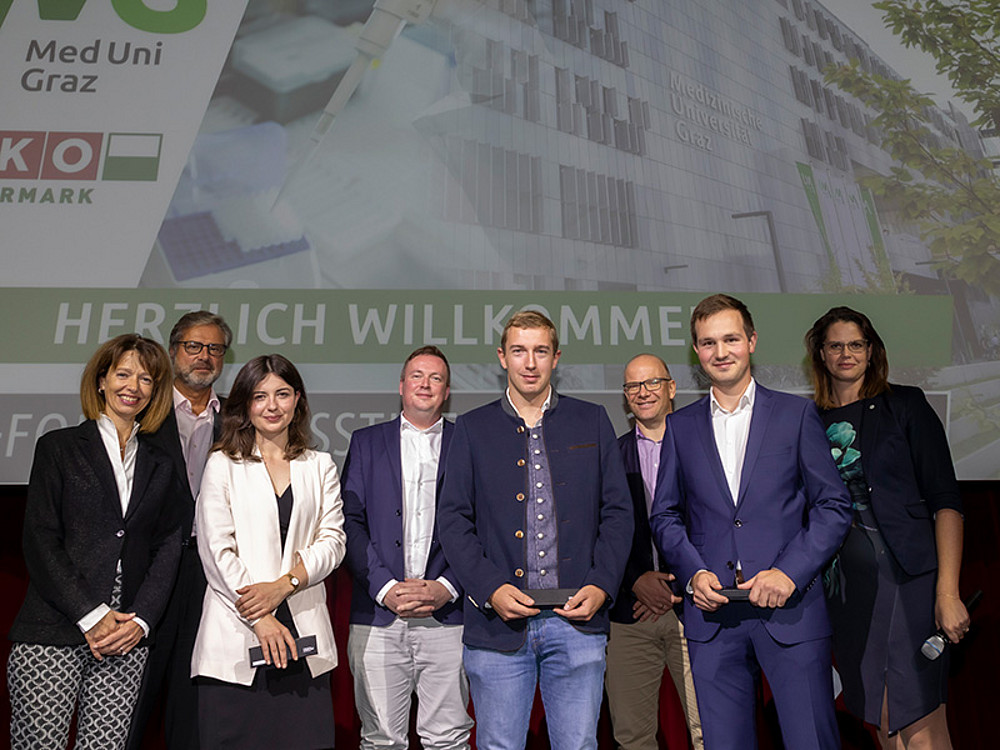
Barbara Haselsteiner-Zach (Forschungsmanagement und -service Uni Graz), Karl-Heinz Dernoscheg (WKO Steiermark), Marie-Luise Zirngast, Thomas Garber (Uni Graz), Christian Grübler, Stefan Thalmann (Uni Graz), Stefan Kernbichler und Sabine Vogl (Med Uni Graz), v.l.n.r. Foto:  Med Uni Graz/Lunghammer.

Barbara Haselsteiner-Zach (Forschungsmanagement und -service Uni Graz), Karl-Heinz Dernoscheg (WKO Steiermark), Marie-Luise Zirngast, Thomas Garber (Uni Graz), Christian Grübler, Stefan Thalmann (Uni Graz), Stefan Kernbichler und Sabine Vogl (Med Uni Graz), v.l.n.r. Foto:  Med Uni Graz/Lunghammer.

KI, Corona und Mobilität am Arbeitsmarkt: WKO-Forschungsstipendien für drei Nachwuchs-WissenschafterInnen

Die Wirtschaftskammer (WKO) Steiermark vergibt seit dem Studienjahr 2013/2014 jährlich 20 Forschungsstipendien für Diplom-/Masterarbeiten, die Fragestellung mit besonderer Relevanz für die steirische Wirtschaft behandeln. Die Stipendien sind mit je 2.100 Euro dotiert, das betreuende Institut bekommt zusätzlich 500 Euro. Somit investiert die WKO Steiermark in Summe 52.000 Euro in die wissenschaftliche Nachwuchsförderung.

Im Studienjahr 2020/21 gab es insgesamt 108 Einreichungen. Die besten 20 wurden kürzlich im Rahmen eines Festaktes an der Medizinischen Universität Graz prämiert. Von der Uni Graz befinden sich drei junge ForscherInnen unter den Ausgezeichneten. 

KI, und Corona und der Arbeitsmarkt

Arbeitskräftemangel trotz hoher Arbeitslosenzahlen. Dieses Problem kennt nicht nur die österreichische Wirtschaft. Umschulungen und Branchenwechsel sollen Abhilfe schaffen. Wie oft jemand in Österreich tatsächlich eine neue Sparte für sich erschließt und was dabei hilfreich ist, hat sich Christian Grübler (Betreuer: Jörn Kleinert) angeschaut. Sein Fazit: Für mehr Mobilität am Arbeitsmarkt braucht es veränderte Rahmenbedingungen und vor allem attraktivere Anreize dafür.

Künstliche Intelligenz unterstützt in der Arbeit immer mehr, allerdings nicht überall: Beim Finanz-Controlling gibt es bisher kaum KI-gestützte Anwendungen. Stefan Kernbichler (Betreuer: Stefan Thalmann) hat deshalb untersucht, unter welchen Bedingungen Unternehmen auch in dieser Branche auf künstliche Intelligenz setzen würden. Sein wichtigstes Ergebnis: Ethik und Moral müssten stärker in den Algorithmen abgebildet werden, damit mehr Vertrauen in die Arbeitsweise einer KI entsteht.

Die Betretungs- und Kontaktverbote in der Covid19-Pandemie haben auch die Justiz vor Herausforderungen gestellt. Aus der Not heraus entstanden verschiedene Begleitgesetze. Diese hat Marie-Luise Zirngast (Betreuer: Thomas Garber) einer Qualitätsanalyse unterzogen. Ihr Fazit: Der Gesetzgeber hat zwar prinzipiell flexibel auf die pandemiebedingten Veränderungen reagiert, in der Praxis sind daraus aber einige Probleme entstanden, etwa im Bereich der Grund- und Menschenrechte.

 

>> Mehr dazu im Video


Weitere Informationen

created by Gerhild Leljak

Related news

Complying with the norm: Why Do Standards Shape Our Lives, Elisabeth Staudegger?

Standards determine whether a sheet of paper fits in a printer or whether a charging plug can power multiple devices. These standards shape our everyday lives. But who actually sets these standards? Where are the weaknesses, and how could science help to improve them? Elisabeth Staudegger, Head of the ‘Law and IT’ Department at the Institute for Legal Foundations at the University of Graz, host the Academic Standards Day on 16 June. Here she relays how sciences can contribute to the topic of standardisation and reveals her personal favourite standard.

More body awareness than a culture war

In Italy, sex education lessons will in future only be permitted with parental consent, and will be banned entirely in nurseries and primary schools. At the same time, Pride Month highlights why knowledge about the body, relationships, boundaries and diversity is important for young people. A study by the University of Graz shows how important knowledge about the body, contraception, relationship skills and protection against violence is

Will Austria win the World Cup? Mathematician reveals calculation method

Michael Fischer uses the football tournament as a practical example for highschool lessons.

Survival strategies: How plants respond to drought

According to Geosphere Austria, this spring was the driest in Austria since records began around 170 years ago. The low rainfall put particular pressure on the agricultural sector. And climate change is set to make the situation even worse in the coming decades. We asked Johannes Liesche, a professor at the Department of Biology at the University of Graz, how plants react to water shortages and how they survive periods of drought.

Begin of page section:
Additional information:

University of Graz
Universitaetsplatz 3
8010 Graz
Austria
  • Contact
  • Web Editors
  • Moodle
  • UNIGRAZonline
  • Imprint
  • Data Protection Declaration
  • Accessibility Declaration
Weatherstation
Uni Graz

End of this page section. Go to overview of page sections

End of this page section. Go to overview of page sections

Begin of page section:

End of this page section. Go to overview of page sections

