Begin of page section:
Page sections:

  • Go to contents (Accesskey 1)
  • Go to position marker (Accesskey 2)
  • Go to main navigation (Accesskey 3)
  • Go to sub navigation (Accesskey 4)
  • Go to additional information (Accesskey 5)
  • Go to page settings (user/language) (Accesskey 8)
  • Go to search (Accesskey 9)

End of this page section. Go to overview of page sections

Begin of page section:
Page settings:

English en
Deutsch de
Search
Login

End of this page section. Go to overview of page sections

Begin of page section:
Search:

Search for details about Uni Graz
Close

End of this page section. Go to overview of page sections


Search

Begin of page section:
Main navigation:

Page navigation:

  • University

    University
    • About the University
    • Organisation
    • Faculties
    • Library
    • Working at University of Graz
    • Campus
    Developing solutions for the world of tomorrow - that is our mission. Our students and our researchers take on the great challenges of society and carry the knowledge out.
  • Research Profile

    Research Profile
    • Our Expertise
    • Research Questions
    • Research Portal
    • Promoting Research
    • Research Transfer
    • Ethics in Research
    • Commission for Scientific Integrity
    Scientific excellence and the courage to break new ground. Research at the University of Graz creates the foundations for making the future worth living.
  • Studies

    Studies
    • Prospective Students
    • Students
    • Registration for Study Programme (Winter semester 2026/27)
  • Community

    Community
    • International
    • Location
    • Research and Business
    • Alumni
    The University of Graz is a hub for international research and brings together scientists and business experts. Moreover, it fosters the exchange and cooperation in study and teaching.
Topics
  • Sustainable University
  • Researchers answer
  • Work for us
Close menu

End of this page section. Go to overview of page sections

Begin of page section:
You are here:

University of Graz News Rasante Reaktionen

End of this page section. Go to overview of page sections

Tuesday, 04 December 2018

Rasante Reaktionen

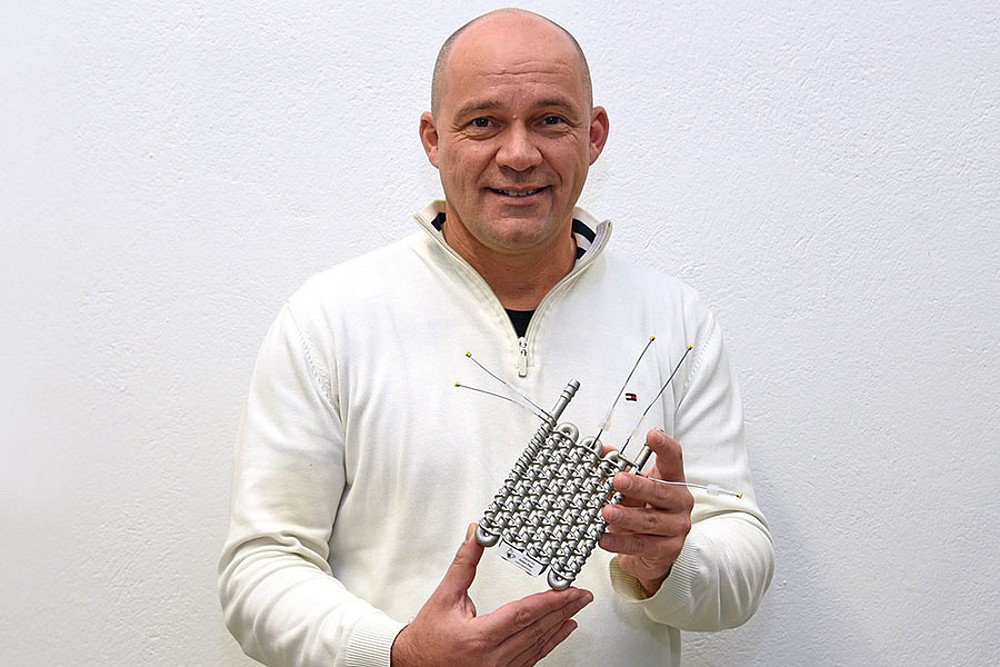
C. Oliver Kappe forschte an der Entwicklung eines neuartigen Flow-Reaktors, der von der Firma Anton Paar im 3D-Druck produziert wurde. Foto: Uni Graz/Pichler ©Uni Graz/Pichler
©Uni Graz/Pichler

C. Oliver Kappe forschte an der Entwicklung eines neuartigen Flow-Reaktors, der von der Firma Anton Paar im 3D-Druck produziert wurde. Foto: Uni Graz/Pichler

C. Oliver Kappe, Chemiker an der Universität Graz, erhält den Forschungspreis des Landes Steiermark

C. Oliver Kappe, Universitätsprofessor für Chemie an der Universität Graz und Projektleiter am Kompetenzzentrum Research Center Pharmaceutical Engineering GmbH (RCPE), zählt international zu den führenden ForscherInnen auf dem Gebiet der Flow-Chemie, eines innovativen Synthese-Verfahrens zur Herstellung pharmazeutischer Wirkstoffe. Am 3. Dezember 2018 erhielt Kappe den Forschungspreis des Landes Steiermark für Forschungen zur Entwicklung eines neuartigen Flow-Reaktors, der von der Firma Anton Paar im 3D-Druck produziert wurde. Der Mikroreaktor aus Edelstahl ermöglicht die konkurrenzlos effiziente Synthese von Substanzen, die unter anderem in der Krebsforschung zum Einsatz kommen. Landesrätin Barbara Eibinger-Miedl überreichte die Auszeichnung in der Grazer Burg.

„C. Oliver Kappe betreibt nicht nur weltweit renommierte Grundlagenforschung, durch zahlreiche Kooperationen mit international tätigen Unternehmen finden die zukunftweisenden Erkenntnisse seines Teams auch konkrete Anwendung. Damit ist die Arbeit von Professor Kappe ein hervorragendes Beispiel dafür, wie Forschung der Wirtschaft neue Impulse gibt und letztendlich der gesamten Gesellschaft zugute kommt“, unterstreicht Rektorin Christa Neuper die bedeutenden Leistungen des Chemikers der Universität Graz, der einer der meistzitierten ForscherInnen in seinem Fachbereich ist.

Bei der Flow-Chemie werden die für eine Synthese benötigten Substanzen in einem kontinuierlichen Verfahren durch Reaktionskammern im Milliliterbereich gepumpt, in denen die einzelnen Prozesse nacheinander ablaufen. Extreme Temperatur- und Druckbedingungen können Reaktionen um ein Vielfaches beschleunigen. „Dadurch spart die Flow-Chemie im Vergleich zu herkömmlichen Verfahren Zeit und Kosten und ist darüber hinaus oft umweltfreundlicher, weil zwischen den einzelnen Reaktionsschritten keine Abfallprodukte anfallen“, erklärt Kappe.


Zur Optimierung des Verfahrens braucht es maßgeschneiderte Mikroreaktoren. Der 3D-Druck bietet hier revolutionäre Möglichkeiten. Unter Federführung von C. Oliver Kappe haben Grazer ChemikerInnen mit ForscherInnen der TU Graz und des RCPE das Design eines neuartigen Flow-Reaktors entwickelt und getestet. Dabei demonstrierten sie gleichzeitig einen neuen Synthese-Weg im Flow-Verfahren: „Wir nutzten das Treibhausgas Fluoroform, ein schädliches Abfallprodukt bei der Teflon-Erzeugung, zur Herstellung von Eflornithin, eines wichtigen Arzneistoffs, der gegen die Schlafkrankheit zum Einsatz kommt.“ Die Firma Anton Paar druckte den Reaktor mittels Metall-Laser-Sintern aus Stahlpulver.

Für den Forschungspreis des Landes Steiermark eingereichte Publikation
Gutmann, B., Köckinger, M., Glotz, G., Ciaglia, T., Slama, E., Zadravec, M., Pfanner, S., Maier, M.C., Gruber-Wölfler, H., & Kappe, C. O. (2017). Design and 3D printing of a stainless steel reactor for continuous difluoromethylations using fluoroform. Reaction Chemistry & Engineering, 2(6), 919-927.
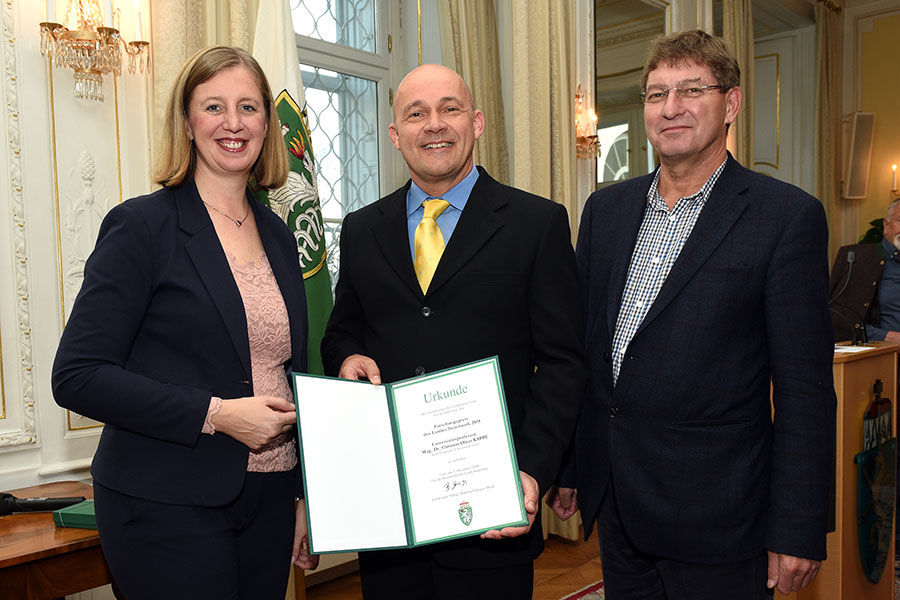
V.l.: Landesrätin Barbara Eibinger-Miedl, Preisträger C. Oliver Kappe, Peter Scherrer, Vizerektor der Universität Graz. Foto: Uni Graz/Pichler ©Uni Graz/Pichler
©Uni Graz/Pichler
V.l.: Landesrätin Barbara Eibinger-Miedl, Preisträger C. Oliver Kappe, Peter Scherrer, Vizerektor der Universität Graz. Foto: Uni Graz/Pichler
created by Gudrun Pichler

Related news

Desert sand, microplastics, cancer cells: David Clases awarded ERC grant for analytical method

Nanoparticles trapped in polar ice can reveal a great deal about the climate 100,000 years ago. Chemist David Clases is developing unique methods to analyse them in detail. He will now adapt these methods for use with larger particles in order to glean even more information about Earth’s history. The method can be used for a wide range of other purposes – for example, in medical diagnostics or the investigation of environmental pollution. Clases has been awarded a Proof-of-Concept Grant by the European Research Council (ERC) for this work.

Staying fit during the holidays: summer sports on the University of Graz campus

The Kleeblattlauf is not the end of the fitness term. Following last year’s successful launch, the University of Graz is once again offering summer sports on campus this year. From 30 June to 16 July 2026, there will be a free exercise programme in the open air. On the shady Südwiese (between the main building and Universitätsplatz 2), anyone interested can get in shape in the afternoons with body workouts, fascia training and yoga.

Getting even hotter: Researchers predict global warming of 1.7 degrees by 2027

While Europe is currently sweltering in the heat, global temperatures are also rising towards concerning record levels. In 2026, Earth’s surface air temperature is expected to reach 1.62 degrees, and in 2027 even 1.71 degrees Celsius above pre-industrial levels. The long-term temperature rise – an average over a 20-year period – is predicted to exceed the 1.5-degree threshold of the Paris Agreement as of 2026 already. For the first time, researchers at the University of Graz have been able to make such a forecast so far in advance. The intensifying El Niño climate event favors forecast skill and thereby facilitates a reliable computation.

Forest fire at Rosenhain: Volunteer fire brigade carried out an evacuation drill at the Jesuit refectory

Thick smoke in the stairwell, flames at the edge of the forest, people missing in the Jesuit refectory at the University of Graz: at Rosenhain, the Graz Volunteer Fire Brigade carried out a drill simulating a scenario that is becoming increasingly realistic given the heat and drought

Begin of page section:
Additional information:

University of Graz
Universitaetsplatz 3
8010 Graz
Austria
  • Contact
  • Web Editors
  • Moodle
  • UNIGRAZonline
  • Imprint
  • Data Protection Declaration
  • Accessibility Declaration
Weatherstation
Uni Graz

End of this page section. Go to overview of page sections

End of this page section. Go to overview of page sections

Begin of page section:

End of this page section. Go to overview of page sections