Begin of page section:
Page sections:

  • Go to contents (Accesskey 1)
  • Go to position marker (Accesskey 2)
  • Go to main navigation (Accesskey 3)
  • Go to sub navigation (Accesskey 4)
  • Go to additional information (Accesskey 5)
  • Go to page settings (user/language) (Accesskey 8)
  • Go to search (Accesskey 9)

End of this page section. Go to overview of page sections

Begin of page section:
Page settings:

English en
Deutsch de
Search
Login

End of this page section. Go to overview of page sections

Begin of page section:
Search:

Search for details about Uni Graz
Close

End of this page section. Go to overview of page sections


Search

Begin of page section:
Main navigation:

Page navigation:

  • University

    University
    • About the University
    • Organisation
    • Faculties
    • Library
    • Working at University of Graz
    • Campus
    Developing solutions for the world of tomorrow - that is our mission. Our students and our researchers take on the great challenges of society and carry the knowledge out.
  • Research Profile

    Research Profile
    • Our Expertise
    • Research Questions
    • Research Portal
    • Promoting Research
    • Research Transfer
    • Ethics in Research
    • Commission for Scientific Integrity
    Scientific excellence and the courage to break new ground. Research at the University of Graz creates the foundations for making the future worth living.
  • Studies

    Studies
    • Prospective Students
    • Students
  • Community

    Community
    • International
    • Location
    • Research and Business
    • Alumni
    The University of Graz is a hub for international research and brings together scientists and business experts. Moreover, it fosters the exchange and cooperation in study and teaching.
  • Spotlight
Topics
  • Sustainable University
  • Researchers answer
  • Work for us
Close menu

End of this page section. Go to overview of page sections

Begin of page section:
You are here:

University of Graz News Plasma und Diamanten

End of this page section. Go to overview of page sections

Thursday, 14 August 2014

Plasma und Diamanten

Nikola Knoll absolviert derzeit ein Praktikum am Institut für Physik

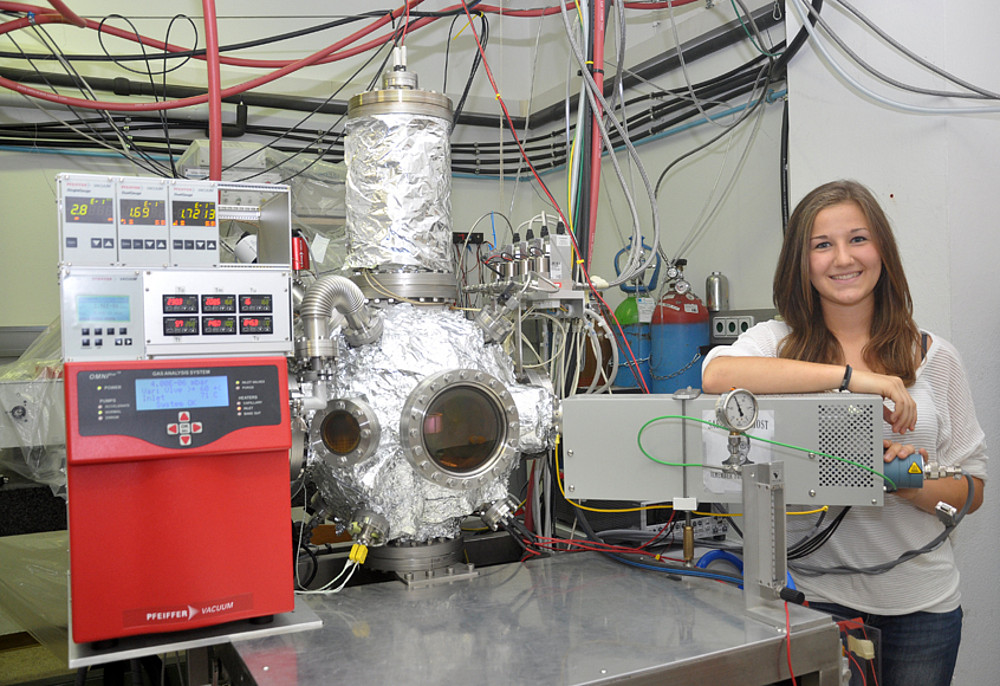
Im Inneren des kugelförmigen PECVD-Gerätes im Labor für Experimentalphysik schimmert eine Plasmakugel rosafarben. Bis zu 900 Grad heiß ist es im Prototyp, über den mit einem neuen Verfahren Beschichtungen aus Diamant erzeugt werden soll. Härter, widerstandsfähiger, dabei sehr gut verträglich und damit auch im medizinischen Bereich nutzbar – die Vorteile einer Diamantbeschichtung sind eindeutig.


Doch der Weg dahin ist lang. In sehr zeitaufwändigen Prozeduren müssen zunächst zahlreiche – Siliziumwafer-Plättchen immer wieder vorbereitet, gemessen und ausgewertet werden, bevor das neuartige Verfahren die gewünschten Ergebnisse erzielen kann. Nikola Knoll ist 16 Jahre alt und führt diese Arbeitsschritte unter Anleitung von Dr. Monika Mayer durch. Die Schülerin besucht das BG/BRG Carneri und absolviert im August 2014 ein Praktikum am Institut für Physik der Uni Graz im Rahmen eines Industrieprojekts. Rund fünf Stunden täglich verbringt sie im Labor.


Das Interesse an den Naturwissenschaften ist bei Nikola Knoll aufgrund familiärer Prägung durchaus gegeben, die ersten Tage am Institut waren für die 16-Jährige dennoch aufregend: „Es ist schon sehr anders als in der Schule, wo meistens relativ wenig Experimente gemacht werden. Hier kann ich viel praktischer an die Physik herangehen. Selbst Proben entnehmen zu dürfen oder unter Betreuung am Lasergerät zu arbeiten, ist auf jeden Fall spannender für mich als ein Ferialjob im Büro!“ Knoll wird die WissenschafterInnen noch den gesamten August unterstützen. „Sie ist eine große Hilfe“, lobt Monika Mayer, die jahrelang an der amerikanischen Elite-Kaderschmiede Massachusetts Institute of Technology (MIT) Jugendliche mit Wissenschaft in Berührung gebracht hat, die Schülerin. „Man soll junge Leute nicht unterschätzen – sie lernen unglaublich schnell mit neuen Technologien umzugehen, vorausgesetzt, das Interesse ist da“, betont die Forscherin.


Physik-begeisterte SchülerInnen absolvieren bereits seit rund fünf Jahren Sommerpraktika am Institut. Meistens läuft die Kontaktaufnahme über den Förderschwerpunkt „Talente“ des Bundesministeriums für Verkehr, Innovation und Technologie sowie der Österreichischen Forschungsgesellschaft FFG, erklärt Ao.Univ.-Prof. Dr. Günther Paltauf. Der Physiker hat bereits mehrere SchülerInnen während ihres einmonatigen Praktikums an der Universität betreut und dabei durchwegs positive Erfahrungen gemacht. „Natürlich braucht die Einschulung etwas Zeit. Ist der Anfang aber geschafft, wird dieser Monat in den allermeisten Fällen zur Win-Win-Situation für alle Beteiligten.“ Die Beantragung eines/einer PraktikantIn über die FFG kann online erledigt werden, 1000 Euro steuert die Forschungsgesellschaft bei.


Mehr Informationen dazu auf: https://www.ffg.at/talente

created by Gerhild Kastrun

Related news

Higher Education Strategy 2040: Austria’s universities on course for the future

Austria has 77 higher education institutions, which is above the EU average – but does this really make sense? The new Higher Education Strategy 2040 focuses on cooperation rather than mergers. As one of the six largest universities in Austria, the University of Graz plays a central role in this.

Climate research in Greenland: Old data provides new insights

The polar explorer and University of Graz professor Alfred Wegener left behind a unique collection of climate data from Greenland. A research team from the University of Graz is now analysing this 100-year-old treasure trove of data and comparing it with current measurements.

Diversity in nature and science: How we talk about plants and each other

Ginkgo, kiwi, hemp: they exist as male and female plants. Anyone who paid attention in biology class will confirm this. But is this categorisation, established by Carl von Linné almost 300 years ago, still valid today? An interdisciplinary team at the University of Graz is questioning these attributions and using this as a starting point to provide food for thought for gender-sensitive interaction between students, scientific and teaching staff.

Around the world in eight stops: the Long Night of Research at the University of Graz

On 24 April from 5 pm, you can take a short trip around the globe at the University of Graz, discovering pecularities of foreign countries or new local features in the entrance hall of the University Library. The itinerary takes you through introduced animal species, political attitudes and the omnipotence of algorithms. There will also be a programme in the historic reading hall, as well as at the UniGraz@Museum and the University Archive.

Begin of page section:
Additional information:

University of Graz
Universitaetsplatz 3
8010 Graz
Austria
  • Contact
  • Web Editors
  • Moodle
  • UNIGRAZonline
  • Imprint
  • Data Protection Declaration
  • Accessibility Declaration
Weatherstation
Uni Graz

End of this page section. Go to overview of page sections

End of this page section. Go to overview of page sections

Begin of page section:

End of this page section. Go to overview of page sections