Begin of page section:
Page sections:

  • Go to contents (Accesskey 1)
  • Go to position marker (Accesskey 2)
  • Go to main navigation (Accesskey 3)
  • Go to sub navigation (Accesskey 4)
  • Go to additional information (Accesskey 5)
  • Go to page settings (user/language) (Accesskey 8)
  • Go to search (Accesskey 9)

End of this page section. Go to overview of page sections

Begin of page section:
Page settings:

English en
Deutsch de
Search
Login

End of this page section. Go to overview of page sections

Begin of page section:
Search:

Search for details about Uni Graz
Close

End of this page section. Go to overview of page sections


Search

Begin of page section:
Main navigation:

Page navigation:

  • University

    University
    • About the University
    • Organisation
    • Faculties
    • Library
    • Working at University of Graz
    • Campus
    Developing solutions for the world of tomorrow - that is our mission. Our students and our researchers take on the great challenges of society and carry the knowledge out.
  • Research Profile

    Research Profile
    • Our Expertise
    • Research Questions
    • Research Portal
    • Promoting Research
    • Research Transfer
    • Ethics in Research
    Scientific excellence and the courage to break new ground. Research at the University of Graz creates the foundations for making the future worth living.
  • Studies

    Studies
    • Prospective Students
    • Students
    • Welcome Weeks for First Year Students
  • Community

    Community
    • International
    • Location
    • Research and Business
    • Alumni
    The University of Graz is a hub for international research and brings together scientists and business experts. Moreover, it fosters the exchange and cooperation in study and teaching.
  • Spotlight
Topics
  • Sustainable University
  • Researchers answer
  • Work for us
Close menu

End of this page section. Go to overview of page sections

Begin of page section:
You are here:

University of Graz News Super scattering: Physicists at the University of Graz overcome the limit of light scattering at the nanoscale

End of this page section. Go to overview of page sections

Thursday, 17 August 2023

Super scattering: Physicists at the University of Graz overcome the limit of light scattering at the nanoscale

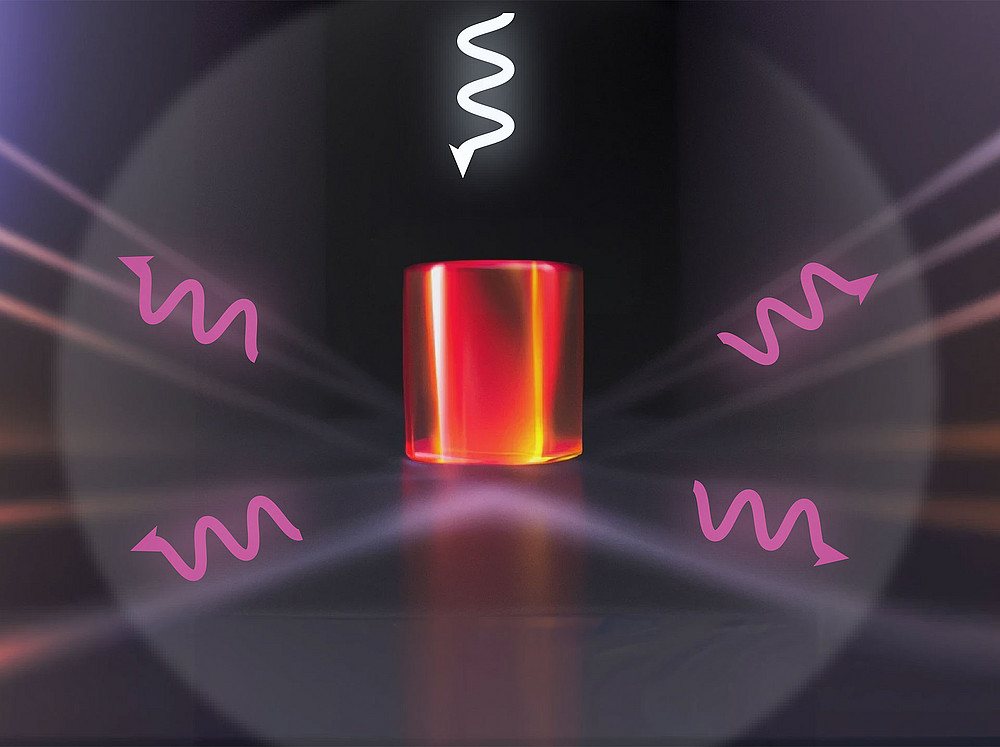
A silicon nanoparticle (red cylinder), is illuminated by laser light (purple arrow). As a result of super scattering, the nanoparticle redirects a large portion of the incoming laser across multiple directions (white arrows). ©Adrià Canós Valero

A silicon nanoparticle (red cylinder), is illuminated by laser light (purple arrow). As a result of super scattering, the nanoparticle redirects a large portion of the incoming laser across multiple directions (white arrows). Image: Adrià Canós Valero

Being able to control light at the nanoscale is a prerequisite for many technological and scientific applications in telecommunications, sensing or modern biology. In all these applications, the scattering of light by nanoparticles made of metals or semiconductors plays a decisive role. However, there is a physical limit that restricts light scattering by nanoparticles and thus the efficiency of technological devices: the so-called single-channel limit. Efforts to overcome it date back to decades ago, with very little success. Now, physicists from the University of Graz in collaboration with an international team of researchers have found out how this limit can be exceeded. This opens new technological possibilities.

“We have discovered a mechanism that turns nanoparticles into super scatterers,” reports Adrià Canós Valero, first author of the publication, which appeared in the research journal Nature Communications. “The shape and dimensions of the particles are crucial. When a laser hits a nanoparticle, part of the light is scattered. The new process we discovered allows, just by designing particles of a certain size and shape, to control the properties of the light – that is, how much is scattered, in which directions and which wavelengths.”

The inspiration for the effect came from an unexpected source. “There are also nanostructures in which light remains trapped and is not scattered. We realized that if we break such structures by changing their size and shape and release the light, a new type of resonance is created – a vibration that scatters light very strongly, even beyond the single-channel limit. We call such oscillations super-dipole resonances,” explains Thomas Weiss, head of the Theoretical Nanophysics group at the University of Graz.
In an experiment with microwaves, the researchers have already demonstrated how super-scattering nanoparticles work. Soon they should also succeed with visible light.


Publication
Superscattering Emerging from the Physics of Bound States in the Continuum
Adrià Canós Valero, Hadi K. Shamkhi, Anton S. Kupriianov, Thomas Weiss, Alexander A. Pavlov, Dmitrii Redka, Vjaceslavs Bobrovs, Yuri Kivshar and Alexander S. Shalin
Nature Communications
https://www.nature.com/articles/s41467-023-40382-y

 

created by Gudrun Pichler

Related news

Electricity consumption reduced: University of Graz well on track

This year, the University of Graz has once again received EMAS certification. Since the introduction of this environmental management system in 2016, the seal of approval has been renewed every three years after successful audits. As an EMAS-certified organisation, the university is committed to systematically improving its environmental performance and contributing to sustainable development at all levels. Progress is documented in the annual environmental statement. The statement for 2024 was recently published. Particularly pleasing: electricity consumption was the lowest since EMAS records began.

Four universities, one degree: first certificates awarded in pioneering Arqus consortium

The European University Alliance Arqus has been in existence since 2018, with the University of Graz collaborating with eight partner institutions at various levels. The first joint master's programme began in 2023. Twenty-one graduates recently celebrated their graduation in Graz.

University of Graz study shows: public money for climate adaptation pays off

In order to plug the budget gap, the state is currently pinching pennies. However, when it comes to adapting to climate change, investing helps to save money. This is shown by a recently published study by the Wegener Centre at the University of Graz. "Our analyses show that protective measures more than pay off in the medium term," summarises lead author Eva Preinfalk.

Studying at the University of Graz: Registration for admission procedures in March

Ready for a new chapter in your life with the start of your studies at the University of Graz in the winter semester 2026/27? Here you will find information on deadlines, admission procedures, registration, and everything else you need to successfully start your studies in the fall.

Begin of page section:
Additional information:

University of Graz
Universitaetsplatz 3
8010 Graz
Austria
  • Contact
  • Web Editors
  • Moodle
  • UNIGRAZonline
  • Imprint
  • Data Protection Declaration
  • Accessibility Declaration
Weatherstation
Uni Graz

End of this page section. Go to overview of page sections

End of this page section. Go to overview of page sections

Begin of page section:

End of this page section. Go to overview of page sections