



Begin of page section:
Page sections:

  • Go to contents (Accesskey 1)
  • Go to position marker (Accesskey 2)
  • Go to main navigation (Accesskey 3)
  • Go to sub navigation (Accesskey 4)
  • Go to additional information (Accesskey 5)
  • Go to page settings (user/language) (Accesskey 8)
  • Go to search (Accesskey 9)

End of this page section. Go to overview of page sections

Begin of page section:
Page settings:

English en
Deutsch de
Search
Login

End of this page section. Go to overview of page sections

Begin of page section:
Search:

Search for details about Uni Graz
Close

End of this page section. Go to overview of page sections


Search

Begin of page section:
Main navigation:

Page navigation:

  • University

    University
    • About the University
    • Organisation
    • Faculties
    • Library
    • Working at University of Graz
    • Campus
    Developing solutions for the world of tomorrow - that is our mission. Our students and our researchers take on the great challenges of society and carry the knowledge out.
  • Research Profile

    Research Profile
    • Our Expertise
    • Research Questions
    • Research Portal
    • Promoting Research
    • Research Transfer
    • Ethics in Research
    • Commission for Scientific Integrity
    Scientific excellence and the courage to break new ground. Research at the University of Graz creates the foundations for making the future worth living.
  • Studies

    Studies
    • Prospective Students
    • Students
    • Post-registration Law
  • Community

    Community
    • International
    • Location
    • Research and Business
    • Alumni
    The University of Graz is a hub for international research and brings together scientists and business experts. Moreover, it fosters the exchange and cooperation in study and teaching.
Topics
  • Sustainable University
  • Researchers answer
  • Work for us
Close menu

End of this page section. Go to overview of page sections

Begin of page section:
You are here:

University of Graz News Philosopher Julian Müller: Populism and liberal democracy do not go together

End of this page section. Go to overview of page sections

Thursday, 26 September 2024

Philosopher Julian Müller: Populism and liberal democracy do not go together

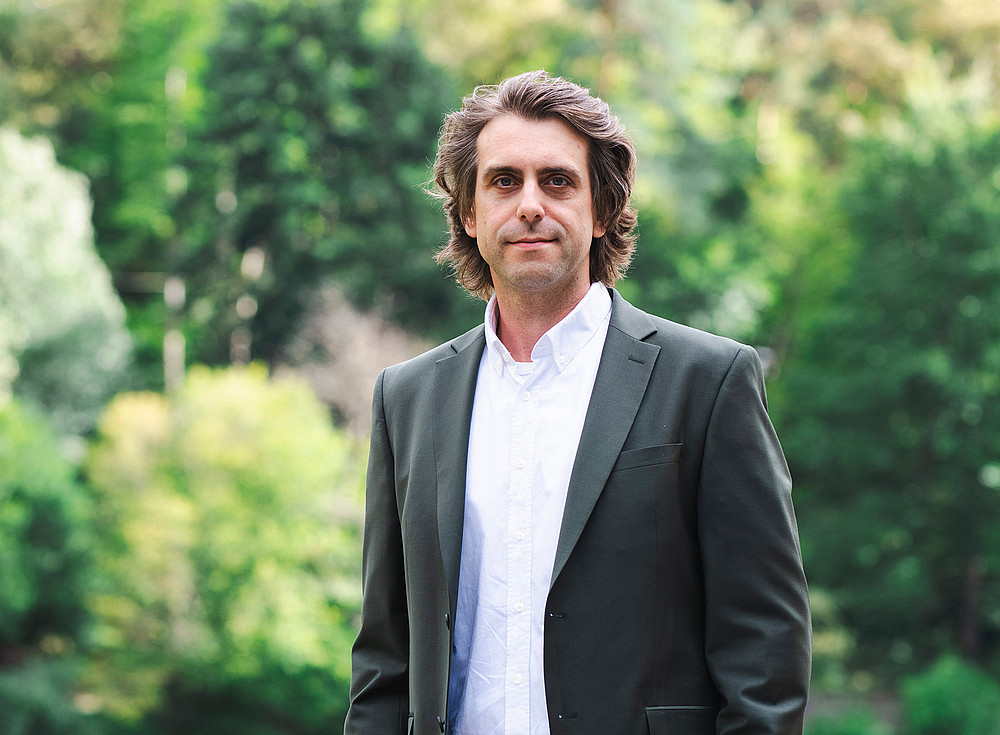
Julian Müller in front of green bushes ©Uni Graz/Tzivanopoulos

Julian Müller, Professor of Political Philosophy. Photo: Uni Graz/Tzivanopoulos

Trump, Orban, Meloni, from the AfD to the Rassemblement National - right-wing populism is on the rise in Europe and other parts of the world. That is frightening. Why? Because it pretends to know what the only right thing to do is and leaves no room for other opinions. This threatens our liberal democracy. But what does liberal actually mean? Julian F. Müller, Professor of Political Philosophy at the University of Graz since April 2024, explores the question: "What unites liberal cosmopolitans apart from Netflix, Pho Ga, Apple watches, smoothies and bouldering in bunkers?" The researcher is certain that we can only protect our society, if we understand what characterises liberal thinking.

"What is liberalism, except soon no longer in parliament?" tweeted Jan Böhmermann in mid-2020. "The liberal idea has often been declared dead. Some say it is too individualistic, too radically pro-market, others that it has died," says Julian Müller. "The competition between ideologies is entering a new round. Chinese-style communist authoritarianism is upgrading its technology and national populism is gaining ground. The question of what liberal cosmopolitans stand for has returned with a vengeance," says the philosopher, describing current developments.

Are you liberal? When Müller asks his students this question, he rarely gets a clear answer: "I don't know ... rather not ... yes, but ... Is it because many don't even know what it means? Even in academia, there is hardly any work on this question. One more reason why the Professor of Political Philosophy has made the examination of the basic principles of liberal thought patterns and thought structures a focal point of his research.

Complex instead of simple

According to Müller, the basic liberal idea can be easily defined in contrast to populism and nationalism. "At its core, populism can be summed up in the following formula: Everything is actually quite simple, you just have to do it! But if everything is so simple, why isn't it done? Well, because the elites are up to no good." If we are not aware of what makes populism tick, we might think that it can be reconciled with a liberal democracy. But this is wrong, warns the philosopher.

"Because liberal democracy is based on the insight that most social problems are complex. And that in many cases our minds are not sharp enough to know in advance what is best to do in the face of major challenges such as corona, migration or AI." This is all the more true in a globalised, interconnected world. "That's why it's so difficult to reach political agreement. In a liberal democracy, controversy is part of it. That's why one of the core tenets of liberalism is that it recognises reasonable differences of opinion," says Müller.

Truth instead of wishful thinking

One of the pillars of liberalism is the pursuit of truth, as opposed to unrealistic wishful thinking. "It's about doing what reason dictates, not what makes us feel good, what is popular," emphasises the researcher, citing an example: "In light of current political developments, refusing to modernise the military in the wishful thinking of being able to stay out of everything, would not secure peace in the long term, but would encourage authoritarian regimes to expand their sphere of influence."

Equality and human dignity

A second pillar of liberalism is universalism, the equal dignity of all people. "This is why liberalism and nationalism are not compatible. Because the latter exalts the members of one's own nation and devalues others," explains Müller. The native German, who also spent many years researching and living in China, uses a computer analogy to describe what the equality of all people is all about: "All of us had different programmes installed on us as children: A language programme, a spell-checking programme, one for solving mathematical problems, one with political thought patterns and others. These programmes are what make us different. But our operating system is the same." Some of us were lucky enough to be born in Germany or Austria. Others had the misfortune to grow up in contexts of war, hunger and natural disasters. "Keeping this basic truth – that at a certain level, we are all the same – present in our thoughts and feelings is an essential characteristic of a liberal attitude," says Julian Müller.

created by Gudrun Pichler

Related news

Record of reported species: Styria wins the global City Nature Challenge

Observers in Styria recorded 4,660 different animals, plants and fungi as part of the international City Nature Challenge between 24 and 27 April 2026. This saw the region take first place in the "species" category. Ostrava in the Czech Republic made the most observations, with just under 140,000, whilst the San Francisco Bay Area had the highest number of participants, namely 3,019.

Studying at the University of Graz: How to enrol

Ready for a new chapter in your life with the start of your studies at the University of Graz in the winter semester 2026/27? Here you will find information on deadlines, admission procedures, registration, and everything else you need to successfully start your studies in the fall.

Europe Day: Strengthening international expertise with Arqus

On 9 May, the spotlight will be on Europe. At the University of Graz, European cooperation is also a tangible part of everyday student life – not least through the Arqus university alliance. Master’s and PhD students can currently register for the Arqus micro-credential in ‘Advanced Creative Thinking and Communication’.

A substantial community: the key role of soil crusts in the earth system

They are often overshadowed by the plant world: lichens, fungi, mosses and bacteria, which form unique communities on rocks and trees or as soil crusts. Bettina Weber from the University of Graz is bringing this biological alliance into the research spotlight. Her research shows that these communities form an essential part of the Earth’s critical zone and play a key role in the interactions between land and atmosphere. Bettina Weber was honoured by the European Geosciences Union for her groundbreaking research at the beginning of May.

Begin of page section:
Additional information:

University of Graz
Universitaetsplatz 3
8010 Graz
Austria
  • Contact
  • Web Editors
  • Moodle
  • UNIGRAZonline
  • Imprint
  • Data Protection Declaration
  • Accessibility Declaration
Weatherstation
Uni Graz

End of this page section. Go to overview of page sections

End of this page section. Go to overview of page sections

Begin of page section:

End of this page section. Go to overview of page sections