


When Jews in Graz were persecuted, mistreated or arrested during the pogrom night of 9–10 November 1938, there were also a number of students amongst them. The majority of the 49 students had already left the city, having been gradually excluded from their studies in the spring on ‘racial’ grounds.
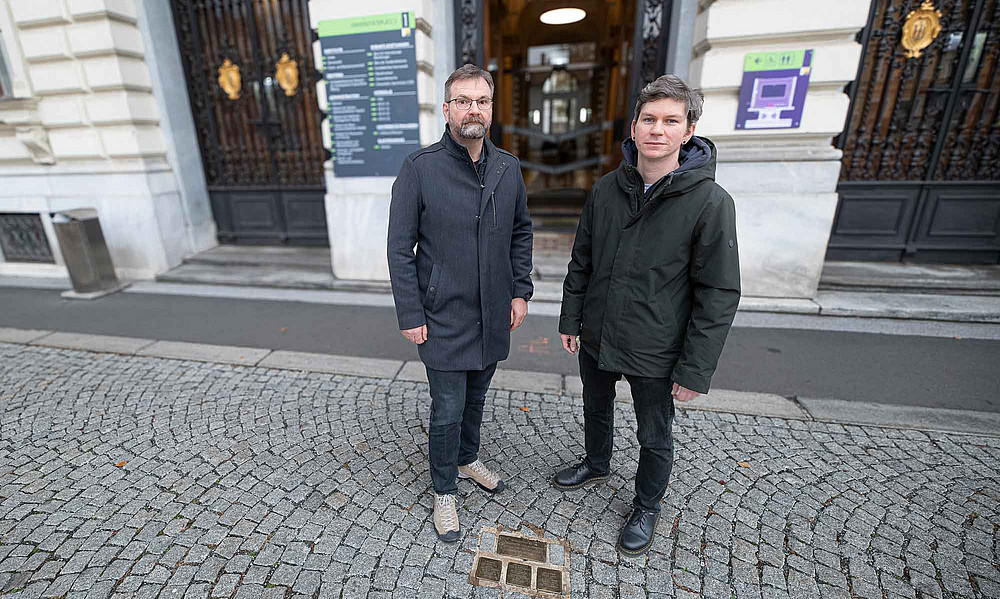
Many names were known, but little was known about the exact fates behind them. “Above all, what happened to them after their expulsion,” explains Marco Jandl, a contemporary historian at the University of Graz. Consequently, Jandl and Gerald Lamprecht, Director of the Centre for Jewish Studies, embarked on a systematic search for clues to their biographies, drawing on new sources such as digital archives and family accounts.
49 lives
Of the 49 Jewish students, four were enrolled at the Faculty of Law and six at the Faculty of Arts. The majority – 39 in total – were studying medicine. Most came from the territories of the former Austro-Hungarian Empire as well as from historical regions such as Bukovina, Transylvania, Galicia and Vojvodina. “Until the end of the summer term of 1938, they were still permitted to sit their final examinations, and some were able to obtain their doctorates ‘quietly’, that is, without an academic ceremony. At the same time, they had to sign a declaration renouncing the right to practise their profession,” explains Lamprecht.
Unlike the Jewish population as a whole, many students escaped being murdered by the Nazi regime. “They were young, mobile and often multilingual,” explains Marco Jandl. Most managed to flee, for example to Palestine, England, the USA or Shanghai in China. Only one displaced student resumed his studies at the University of Graz: Otto Pollack completed his medical degree in 1950.
A turning point in the academic landscape
Alongside the biographies of the 49 students, the 340-page commemorative book *Exclusion, Flight and a New Beginning* also summarises the life stories and escape routes of five dismissed lecturers. These include those of the Chief Rabbi and Professor of Semitic Philology, David Herzog, and the Nobel Laureate and pharmacologist, Otto Loewi. “Although the University of Graz had been characterised by a strongly German-nationalist orientation since the late 19th century, the expulsions represented a fundamental turning point in the academic landscape, from which the universities only recovered in the 1970s and 1980s”, notes Gerald Lamprecht.
The new book forms part of a comprehensive reappraisal of the University of Graz’s history under National Socialism. Alongside academic projects and artistic interventions – such as those in the former Nazi student centre on Schubertstraße – numerous ‘stumbling stones’ now commemorate the expelled members of the university community outside its buildings. Vice-Chancellor Peter Riedler emphasises the great significance of visible symbols: “It is precisely by looking back at the era of the Nazi dictatorship that we can appreciate the importance of vigilance and a pluralistic democracy.”
The book *Exclusion, Flight and a New Beginning: A Biographical Memorial Book for the Jews of the University of Graz Persecuted in 1938* will be launched at the University of Graz on 11 November 2026.