Begin of page section:
Page sections:

  • Go to contents (Accesskey 1)
  • Go to position marker (Accesskey 2)
  • Go to main navigation (Accesskey 3)
  • Go to sub navigation (Accesskey 4)
  • Go to additional information (Accesskey 5)
  • Go to page settings (user/language) (Accesskey 8)
  • Go to search (Accesskey 9)

End of this page section. Go to overview of page sections

Begin of page section:
Page settings:

English en
Deutsch de
Search
Login

End of this page section. Go to overview of page sections

Begin of page section:
Search:

Search for details about Uni Graz
Close

End of this page section. Go to overview of page sections


Search

Begin of page section:
Main navigation:

Page navigation:

  • University

    University
    • About the University
    • Organisation
    • Faculties
    • Library
    • Working at University of Graz
    • Campus
    Developing solutions for the world of tomorrow - that is our mission. Our students and our researchers take on the great challenges of society and carry the knowledge out.
  • Research Profile

    Research Profile
    • Our Expertise
    • Research Questions
    • Research Portal
    • Promoting Research
    • Research Transfer
    • Ethics in Research
    Scientific excellence and the courage to break new ground. Research at the University of Graz creates the foundations for making the future worth living.
  • Studies

    Studies
    • Prospective Students
    • Students
  • Community

    Community
    • International
    • Location
    • Research and Business
    • Alumni
    The University of Graz is a hub for international research and brings together scientists and business experts. Moreover, it fosters the exchange and cooperation in study and teaching.
  • Spotlight
Topics
  • Our digital Advent calendar
  • Sustainable University
  • Researchers answer
  • Work for us
Close menu

End of this page section. Go to overview of page sections

Begin of page section:
You are here:

University of Graz News Philosopher Julian Müller: Populism and liberal democracy do not go together

End of this page section. Go to overview of page sections

Thursday, 26 September 2024

Philosopher Julian Müller: Populism and liberal democracy do not go together

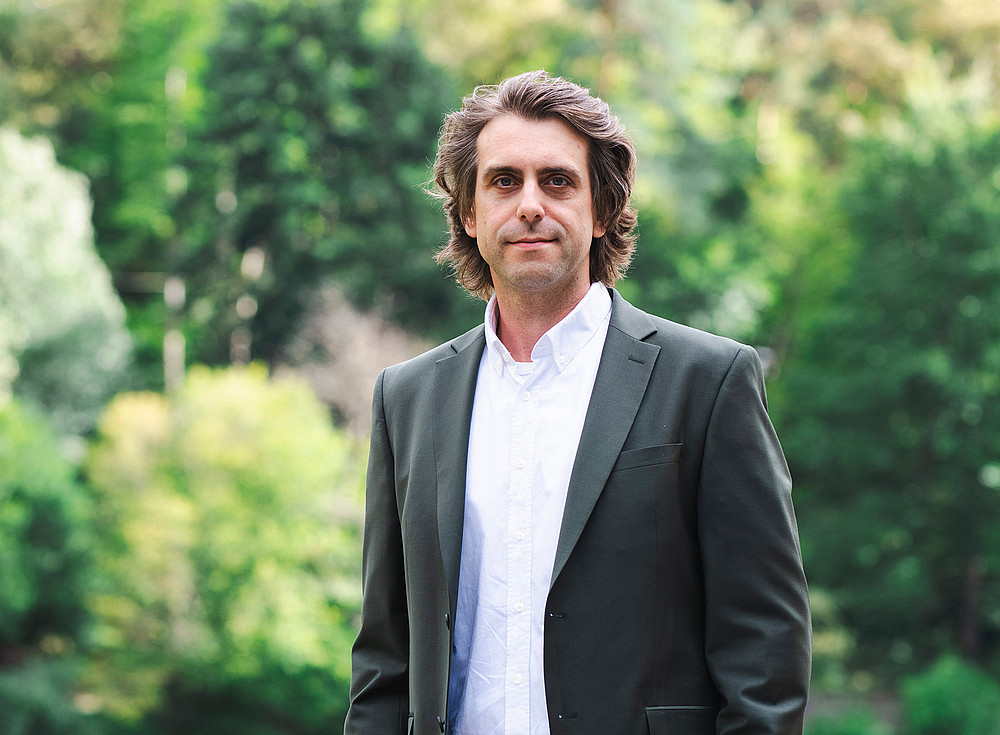
Julian Müller in front of green bushes ©Uni Graz/Tzivanopoulos

Julian Müller, Professor of Political Philosophy. Photo: Uni Graz/Tzivanopoulos

Trump, Orban, Meloni, from the AfD to the Rassemblement National - right-wing populism is on the rise in Europe and other parts of the world. That is frightening. Why? Because it pretends to know what the only right thing to do is and leaves no room for other opinions. This threatens our liberal democracy. But what does liberal actually mean? Julian F. Müller, Professor of Political Philosophy at the University of Graz since April 2024, explores the question: "What unites liberal cosmopolitans apart from Netflix, Pho Ga, Apple watches, smoothies and bouldering in bunkers?" The researcher is certain that we can only protect our society, if we understand what characterises liberal thinking.

"What is liberalism, except soon no longer in parliament?" tweeted Jan Böhmermann in mid-2020. "The liberal idea has often been declared dead. Some say it is too individualistic, too radically pro-market, others that it has died," says Julian Müller. "The competition between ideologies is entering a new round. Chinese-style communist authoritarianism is upgrading its technology and national populism is gaining ground. The question of what liberal cosmopolitans stand for has returned with a vengeance," says the philosopher, describing current developments.

Are you liberal? When Müller asks his students this question, he rarely gets a clear answer: "I don't know ... rather not ... yes, but ... Is it because many don't even know what it means? Even in academia, there is hardly any work on this question. One more reason why the Professor of Political Philosophy has made the examination of the basic principles of liberal thought patterns and thought structures a focal point of his research.

Complex instead of simple

According to Müller, the basic liberal idea can be easily defined in contrast to populism and nationalism. "At its core, populism can be summed up in the following formula: Everything is actually quite simple, you just have to do it! But if everything is so simple, why isn't it done? Well, because the elites are up to no good." If we are not aware of what makes populism tick, we might think that it can be reconciled with a liberal democracy. But this is wrong, warns the philosopher.

"Because liberal democracy is based on the insight that most social problems are complex. And that in many cases our minds are not sharp enough to know in advance what is best to do in the face of major challenges such as corona, migration or AI." This is all the more true in a globalised, interconnected world. "That's why it's so difficult to reach political agreement. In a liberal democracy, controversy is part of it. That's why one of the core tenets of liberalism is that it recognises reasonable differences of opinion," says Müller.

Truth instead of wishful thinking

One of the pillars of liberalism is the pursuit of truth, as opposed to unrealistic wishful thinking. "It's about doing what reason dictates, not what makes us feel good, what is popular," emphasises the researcher, citing an example: "In light of current political developments, refusing to modernise the military in the wishful thinking of being able to stay out of everything, would not secure peace in the long term, but would encourage authoritarian regimes to expand their sphere of influence."

Equality and human dignity

A second pillar of liberalism is universalism, the equal dignity of all people. "This is why liberalism and nationalism are not compatible. Because the latter exalts the members of one's own nation and devalues others," explains Müller. The native German, who also spent many years researching and living in China, uses a computer analogy to describe what the equality of all people is all about: "All of us had different programmes installed on us as children: A language programme, a spell-checking programme, one for solving mathematical problems, one with political thought patterns and others. These programmes are what make us different. But our operating system is the same." Some of us were lucky enough to be born in Germany or Austria. Others had the misfortune to grow up in contexts of war, hunger and natural disasters. "Keeping this basic truth – that at a certain level, we are all the same – present in our thoughts and feelings is an essential characteristic of a liberal attitude," says Julian Müller.

created by Gudrun Pichler

Related news

Chemical Christmas show at the University of Graz: An explosive evening at the Schauspielh

At the beginning of December, the University of Graz transformed the theater into a laboratory: as part of “Chemical Life,” teacher training students staged a chemical Christmas show for Styrian school classes—complete with ethanol rockets, nitrogen snow, and glowing effects. An evening designed to inspire interest in studying chemistry.

Train by train: Koralm railway accelerates exchange between the Universities

Lectures at the University of Klagenfurt in the morning, seminars at the University of Graz in the afternoon: Austria's longest tunnel and a journey time of around 45 minutes make it easy. The Koralm railway increases the speed of networking between the two university locations. The collaboration builds on existing cooperation - for example in the areas of teacher training, Slavic studies and as employers, the universities are well coordinated.

On the trail of the Big Bang: University of Graz receives 1.5 million euros for doctoral programmes

The Austrian Science Fund FWF has selected the Doctoral Programme in Theoretical Particle Physics at the University of Graz for funding from the Doc.funds. Six young scientists will be funded for 3.5 years. They will gain fundamentally new insights into the origins of the world.

From trans women and knee prostheses: sports science prizes awarded

Walking better with a prosthesis, successfully getting rid of excess weight, training more effectively, more fairness for trans people in sport: these were the topics addressed by the students at the University of Graz who were awarded the sports science prizes for their Master's theses on 3 December 2025.

Begin of page section:
Additional information:

University of Graz
Universitaetsplatz 3
8010 Graz
Austria
  • Contact
  • Web Editors
  • Moodle
  • UNIGRAZonline
  • Imprint
  • Data Protection Declaration
  • Accessibility Declaration
Weatherstation
Uni Graz

End of this page section. Go to overview of page sections

End of this page section. Go to overview of page sections

Begin of page section:

End of this page section. Go to overview of page sections