Begin of page section:
Page sections:

  • Go to contents (Accesskey 1)
  • Go to position marker (Accesskey 2)
  • Go to main navigation (Accesskey 3)
  • Go to sub navigation (Accesskey 4)
  • Go to additional information (Accesskey 5)
  • Go to page settings (user/language) (Accesskey 8)
  • Go to search (Accesskey 9)

End of this page section. Go to overview of page sections

Begin of page section:
Page settings:

English en
Deutsch de
Search
Login

End of this page section. Go to overview of page sections

Begin of page section:
Search:

Search for details about Uni Graz
Close

End of this page section. Go to overview of page sections


Search

Begin of page section:
Main navigation:

Page navigation:

  • University

    University
    • About the University
    • Organisation
    • Faculties
    • Library
    • Working at University of Graz
    • Campus
    Developing solutions for the world of tomorrow - that is our mission. Our students and our researchers take on the great challenges of society and carry the knowledge out.
  • Research Profile

    Research Profile
    • Our Expertise
    • Research Questions
    • Research Portal
    • Promoting Research
    • Research Transfer
    • Ethics in Research
    • Commission for Scientific Integrity
    Scientific excellence and the courage to break new ground. Research at the University of Graz creates the foundations for making the future worth living.
  • Studies

    Studies
    • Prospective Students
    • Students
  • Community

    Community
    • International
    • Location
    • Research and Business
    • Alumni
    The University of Graz is a hub for international research and brings together scientists and business experts. Moreover, it fosters the exchange and cooperation in study and teaching.
Topics
  • Sustainable University
  • Researchers answer
  • Work for us
Close menu

End of this page section. Go to overview of page sections

Begin of page section:
You are here:

University of Graz News Austria's economy in transition: How we are emerging from the recession

End of this page section. Go to overview of page sections

Friday, 28 November 2025

Austria's economy in transition: How we are emerging from the recession

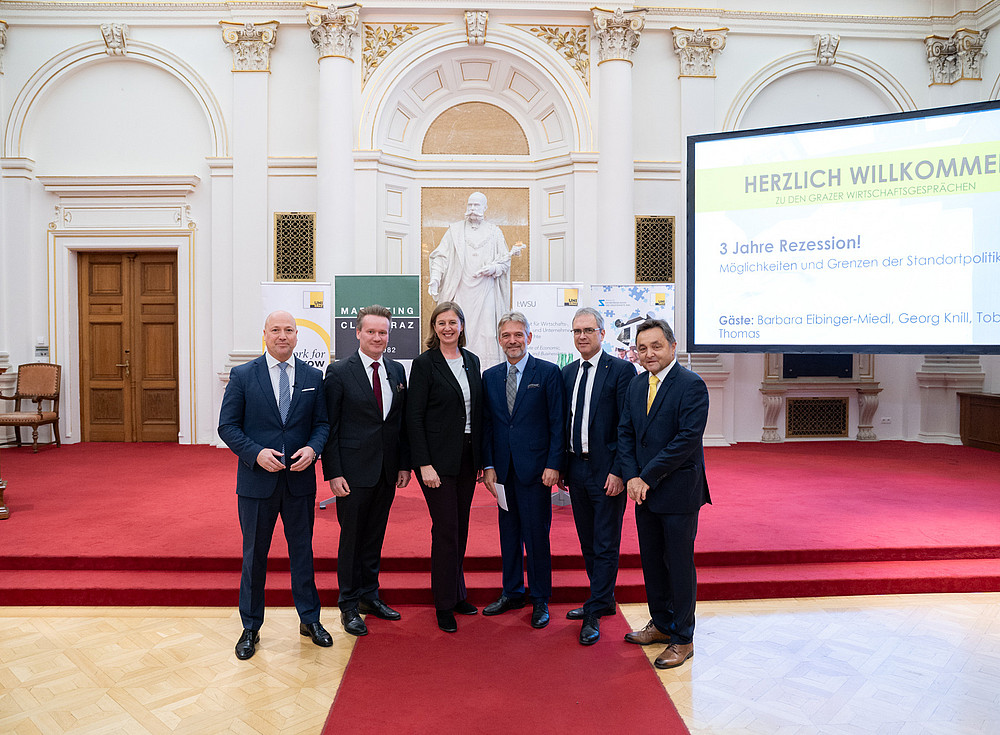
A group of people in formal attire stand on a red carpet in a magnificent hall with high, ornate walls and a statue in the background. On the right-hand side of the picture, a large screen can be seen with the words “Welcome to the Graz Economic Talks” and further information. There are also banners and a wooden door in the background.

University Professor Tobias Thomas, IV President Georg Knill, State Secretary Barbara Eibinger-Miedl, University Professor Thomas Krautzer, Rector Peter Riedler, and University Professor Alfred Gutschelhofer at the Graz Economic Talks. Photo: University of Graz/Vilgut

Austria is in the midst of its longest recession in years. At the University of Graz's economic talks on November 25, experts discussed high labor costs, bureaucracy, and the structural reforms needed to overcome the crisis and secure prosperity.

How is the Austrian economy doing after three lean years? Tobias Thomas, professor of economic policy at the University of Graz, Georg Knill, president of the Federation of Austrian Industries, and Barbara Eibinger-Miedl, state secretary in the Ministry of Finance, addressed this question. They highlighted the reasons behind Austria's prolonged recession and pointed out ways in which we can get back on track together.

Economist Thomas began by presenting concrete facts: between 2020 and 2025, wage levels in Austria rose by an average of 27 percent, while in Germany they rose by 15 percent over the same period. This makes products from Austria more expensive. With a tax burden of 47 percent of income, the country is also among the leaders in the EU, leaving people with little of their gross wages. And given the tight budget figures, this is particularly serious: 55 percent of economic output comes from the public sector. “Austria is more of a state economy than a market economy,” Thomas summed it up.

IV President Knill named three key hurdles for Austria's economy: high wage costs, expensive energy, and complex bureaucracy, because Austria itself interprets EU regulations particularly strictly. “We must not delude ourselves here: the deindustrialization of the country is already taking place.” And if Germany really introduces industrial electricity at 5 cents/kWh, the trend will accelerate.

Structural reforms

State Secretary Eibinger-Miedl also saw the energy sector as a major burden on international competition. However, she criticized the fact that companies are increasingly adopting the idea that The state will support us. She announced an end to indiscriminate subsidies. “What we need now are structural reforms, and everyone involved understands that something must be done.” She described research and development as one of Austria's greatest strengths. Her appeal: Scientific breakthroughs must be put into practice more quickly and integrated into companies.

Georg Knill cited Italy as a cautionary yet positive example: the economy there stagnated for many years and nothing was done about it. But for around five years now, tough reforms have been implemented. Today, Italy is in a better economic position than Austria. In fact, University of Graz professor Thomas also saw the current recession as an opportunity. “Major changes often happen in times of crisis and with a young government.”

State Secretary Eibinger-Miedl promised concrete steps. In the coming weeks, a major reduction in bureaucracy is to be implemented, a dedicated scale-up fund is to help start-ups in the critical growth phase, and pensions are also secured for the time being thanks to the planned reforms. However, she noted that reforms must always take care to get the population on board.

Creative destruction

Georg Schneider, Dean of the Faculty of Social Sciences, wanted to bring a different perspective to the discussion by introducing Joseph Schumpeter's concept of creative destruction. This concept states that innovation and new production processes destroy old structures. Specifically, the dean asked IV President Knill whether the disappearance of certain industries would not also create space for new, innovative companies.

Knill found the concept appealing in principle, but drew attention to an important industrial policy issue: resilience. The EU wants to become independent, for example in terms of chips, energy, and rare earths. And to achieve this, it needs the relevant industrial companies in Europe.

For former rector and University of Graz professor Alfred Gutschelhofer, who launched this format 15 years ago, these economic discussions marked the end of his active role as organizer. He is retiring. In the future, the organization will be in the hands of Rector Peter Riedler in collaboration with Thomas Krautzer, professor of economic location issues and location development.

Curious to find out how all these pieces of the puzzle, from global markets to start-ups, fit together? Then a degree in economics or business administration might be the right choice for you.


created by Roman Vilgut

Related news

A substantial community: the key role of soil crusts in the earth system

They are often overshadowed by the plant world: lichens, fungi, mosses and bacteria, which form unique communities on rocks and trees or as soil crusts. Bettina Weber from the University of Graz is bringing this biological alliance into the research spotlight. Her research shows that these communities form an essential part of the Earth’s critical zone and play a key role in the interactions between land and atmosphere. Bettina Weber was honoured by the European Geosciences Union for her groundbreaking research at the beginning of May.

The digital world of tomorrow: University of Graz works with people to shape the future

Digitalisation is supposed to make everything better: artificial intelligence that even organises travel. The car that drives itself. Robots that care for us in our old age. But what kind of future do people actually want? What role should technology play in this? The University of Graz is exploring these questions through a new research facility. At the Graz Sociodigital and Participatory Futures Studio – or GraSP Futures Studio for short – young and old work together with researchers to design visions of the future that also critically examine technical innovations.

Eurovision: Why the Song Contest is always political

The 2026 Eurovision Song Contest sits at the intersection of music, geopolitics and culture. Josef Mühlbauer from the University of Graz explains why the ESC has always been a reflection of European politics, and how this major event highlights cultural affinities and social change.

Superti-Furga will becomefounding director of the CORI Institute in Graz

The Austrian Academy of Sciences (ÖAW) is establishing a new flagship centre for research into metabolic diseases in collaboration with the three universities in Graz. This innovative research approach combines mathematics and experimental biology with artificial intelligence

Begin of page section:
Additional information:

University of Graz
Universitaetsplatz 3
8010 Graz
Austria
  • Contact
  • Web Editors
  • Moodle
  • UNIGRAZonline
  • Imprint
  • Data Protection Declaration
  • Accessibility Declaration
Weatherstation
Uni Graz

End of this page section. Go to overview of page sections

End of this page section. Go to overview of page sections

Begin of page section:

End of this page section. Go to overview of page sections