Begin of page section:
Page sections:

  • Go to contents (Accesskey 1)
  • Go to position marker (Accesskey 2)
  • Go to main navigation (Accesskey 3)
  • Go to sub navigation (Accesskey 4)
  • Go to additional information (Accesskey 5)
  • Go to page settings (user/language) (Accesskey 8)
  • Go to search (Accesskey 9)

End of this page section. Go to overview of page sections

Begin of page section:
Page settings:

English en
Deutsch de
Search
Login

End of this page section. Go to overview of page sections

Begin of page section:
Search:

Search for details about Uni Graz
Close

End of this page section. Go to overview of page sections


Search

Begin of page section:
Main navigation:

Page navigation:

  • University

    University
    • About the University
    • Organisation
    • Faculties
    • Library
    • Working at University of Graz
    • Campus
    Developing solutions for the world of tomorrow - that is our mission. Our students and our researchers take on the great challenges of society and carry the knowledge out.
  • Research Profile

    Research Profile
    • Our Expertise
    • Research Questions
    • Research Portal
    • Promoting Research
    • Research Transfer
    • Ethics in Research
    Scientific excellence and the courage to break new ground. Research at the University of Graz creates the foundations for making the future worth living.
  • Studies

    Studies
    • Prospective Students
    • Students
    • Welcome Weeks for First Year Students
  • Community

    Community
    • International
    • Location
    • Research and Business
    • Alumni
    The University of Graz is a hub for international research and brings together scientists and business experts. Moreover, it fosters the exchange and cooperation in study and teaching.
  • Spotlight
Topics
  • Sustainable University
  • Researchers answer
  • Work for us
Close menu

End of this page section. Go to overview of page sections

Begin of page section:
You are here:

University of Graz News Nobel Lecture 2025: How evolution enters chemistry

End of this page section. Go to overview of page sections

Monday, 01 December 2025

Nobel Lecture 2025: How evolution enters chemistry

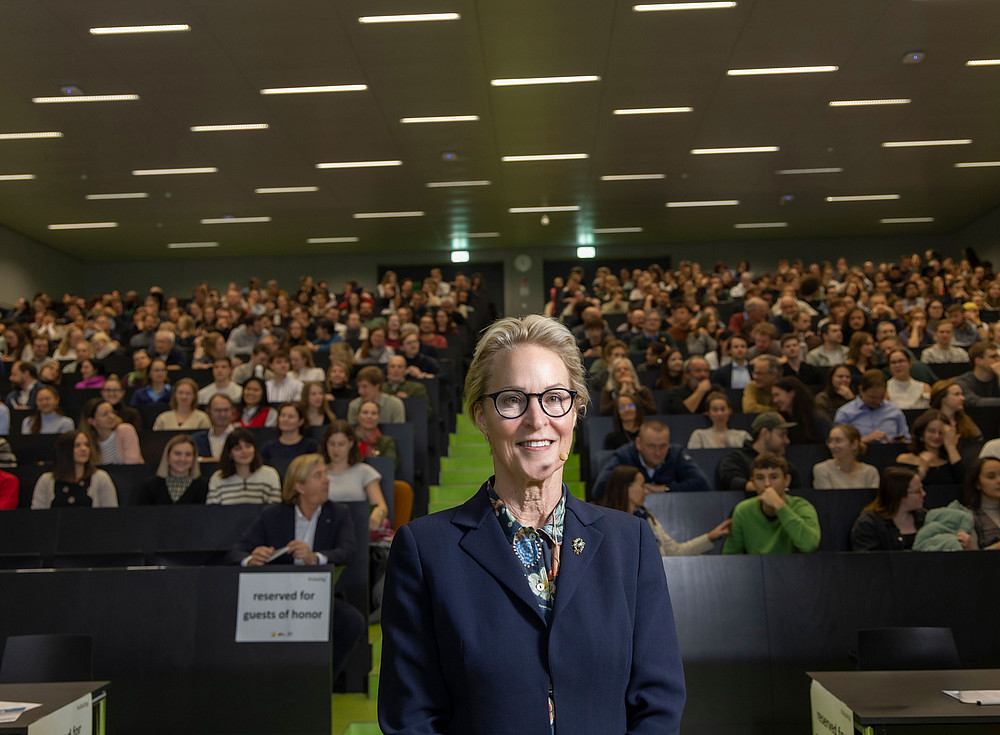
A woman in a business suit stands in front of a large lecture hall with modern lighting, filled with a large number of people. ©© Helmut Lunghammer

Frances H. Arnold during her Nobel Lecture at the Medical University of Graz

During the Nobel Lecture at BioTechMed-Graz, Nobel Prize winner in Chemistry Frances H. Arnold provided insight into her research on the directed evolution of enzymes.

On December 1, 2025, BioTechMed-Graz, a research collaboration between the University of Graz, Graz University of Technology, and the Medical University of Graz, hosted its annual Nobel Lecture, which took place this year on the campus of the Medical University of Graz. As part of this series of events, Nobel Prize winners take turns at the Medical University of Graz, the University of Graz, and Graz University of Technology to provide insights into their scientific work. The Nobel Lecture took place for the sixth time this year and has now established itself as a fixture in the academic year, attracting thousands of listeners to the lecture halls of Graz's universities.

Directed evolution as a driver of innovation

This year's guest was the 2018 Nobel Prize winner in Chemistry, Frances H. Arnold, who spoke about her groundbreaking research in the field of directed evolution of enzymes, which has fundamentally changed our understanding of biological and chemical processes.

Directed evolution allows enzymes that are tailor-made for specific tasks to be developed quickly. These can be used in medicine, chemistry, energy, and materials science. This targeted development allows processes to be made more sustainable and drugs to be manufactured with even greater precision.

Under the title “Innovation by Evolution: Bringing New Chemistry to Life,” the researcher demonstrated how the principles of natural evolution can be used to create innovative solutions to some of the greatest challenges of our time.

Interest was high: one lecture hall was not enough to accommodate the large number of interested listeners, and over 700 registrations were received within a very short time. Researchers, students, and other friends of science were able to exchange ideas after the Nobel Lecture and learn more about Frances H. Arnold's career in direct conversation.

created by Gerald Auer

Related news

Survival yesterday and today: exhibition at the University of Graz makes poverty audible

What connects Anna from Styria, who lost her job two years ago due to illness, with the blacksmith Giulio, who worked in Bologna almost 500 years ago? Both are afraid of no longer being able to pay their rent. And what does the medieval Nuremberg begging ordinance have to do with current regulations in Graz? In both cases, the aim is to prevent too many people from begging for alms in the city. How do people cope with existential worries? To what extent are such experiences the same today as they were then? From 5 to 31 March 2026, an exhibition at the University of Graz will bring poverty in the present and the Middle Ages to life.

New AI Method Revolutionises the Design of Enzymes

Researchers at TU Graz and the University of Graz can use the technology to construct artificial biocatalysts. These new enzymes are significantly faster, more stable and more versatile than previous artificial biocatalysts.

The dark side of life: new method developed to identify soil organisms

A large number of soil animals are smaller than one millimetre and are therefore difficult to study scientifically. Biologists from the University of Graz have now developed a method to determine both the shape and the DNA of the organisms. The results have been published in the journal Geoderma.

How does peace succeed? Maximilian Lakitsch drives research forward

Donald Trump is rattling his proverbial sabre ever louder, unrest in the Middle East is escalating and the war in Ukraine continues to rage. Maximilian Lakitsch knows what political measures could contribute to reconciliation. He is the coordinator of an EU-wide initiative to strengthen peace research.

Begin of page section:
Additional information:

University of Graz
Universitaetsplatz 3
8010 Graz
Austria
  • Contact
  • Web Editors
  • Moodle
  • UNIGRAZonline
  • Imprint
  • Data Protection Declaration
  • Accessibility Declaration
Weatherstation
Uni Graz

End of this page section. Go to overview of page sections

End of this page section. Go to overview of page sections

Begin of page section:

End of this page section. Go to overview of page sections