
Begin of page section:
Page sections:

  • Go to contents (Accesskey 1)
  • Go to position marker (Accesskey 2)
  • Go to main navigation (Accesskey 3)
  • Go to sub navigation (Accesskey 4)
  • Go to additional information (Accesskey 5)
  • Go to page settings (user/language) (Accesskey 8)
  • Go to search (Accesskey 9)

End of this page section. Go to overview of page sections

Begin of page section:
Page settings:

English en
Deutsch de
Search
Login

End of this page section. Go to overview of page sections

Begin of page section:
Search:

Search for details about Uni Graz
Close

End of this page section. Go to overview of page sections


Search

Begin of page section:
Main navigation:

Page navigation:

  • University

    University
    • About the University
    • Organisation
    • Faculties
    • Library
    • Working at University of Graz
    • Campus
    Developing solutions for the world of tomorrow - that is our mission. Our students and our researchers take on the great challenges of society and carry the knowledge out.
  • Research Profile

    Research Profile
    • Our Expertise
    • Research Questions
    • Research Portal
    • Promoting Research
    • Research Transfer
    • Ethics in Research
    Scientific excellence and the courage to break new ground. Research at the University of Graz creates the foundations for making the future worth living.
  • Studies

    Studies
    • Prospective Students
    • Students
  • Community

    Community
    • International
    • Location
    • Research and Business
    • Alumni
    The University of Graz is a hub for international research and brings together scientists and business experts. Moreover, it fosters the exchange and cooperation in study and teaching.
  • Spotlight
Topics
  • Our digital Advent calendar
  • Sustainable University
  • Researchers answer
  • Work for us
Close menu

End of this page section. Go to overview of page sections

Begin of page section:
You are here:

University of Graz News Neuer Bericht

End of this page section. Go to overview of page sections

Monday, 28 November 2022

Neuer Bericht

Radfahrer auf Radweg zwischen fahrenden Autos. Foto: pixabay

Damit klimafreundliches Leben attraktiv, dauerhaft möglich und auch selbstverständlich wird, braucht es weitreichende strukturelle Veränderungen in allen Lebensbereichen, hält der neue APCC-Bericht fest. Foto: pixabay

Umfassend klimafreundlich zu leben, ist in Österreich schwierig

Klimafreundliches Leben braucht geeignete Strukturen, und die sind in Österreich derzeit nur unzureichend vorhanden. Diese Bilanz zieht der neue, 700 Seiten starke Special Report des Austrian Panel of Climate Change (APCC). Am 28. November 2022 wurde er von den Mitherausgebern Karl Steininger (Universität Graz) und Andreas Novy (Wirtschaftsuniversität Wien) präsentiert und an Klimaschutzministerin Leonore Gewessler und Arbeitsminister Martin Kocher übergeben.

Für die Autor:innen ist klar: Menschen nur zu klimabewusstem Handeln aufzufordern, ist weder ausreichend noch zielführend. Denn fehlen die entsprechenden Rahmenbedingungen, ist es für Bürger:innen schwer, im Alltag nachhaltig zu agieren. Damit klimafreundliches Leben attraktiv, dauerhaft möglich und auch selbstverständlich wird, braucht es weitreichende strukturelle Veränderungen in allen Lebensbereichen, von Wohnen und Mobilität über die Ernährung bis hin zu Freizeitgestaltung und Arbeit. Und dazu seien alle gesellschaftlichen Kräfte gefordert.

„Ohne kritische wissenschaftliche Analyse, ohne Unternehmen, die sich für klimafreundliches Leben einsetzen, und ohne an Allgemeinwohl und klimafreundlichem Leben orientierte Interessenvertretungen und Politik sind die notwendigen Transformationen kaum umsetzbar“, sagt Karl Steininger vom Wegener Center der Uni Graz. „Entscheidend wird sein, in den kommenden Jahren Strukturen sehr schnell umzugestalten, damit die Klimaziele noch erreicht werden können, dabei aber stets den sozialen Zusammenhalt und die Klimagerechtigkeit im Auge zu behalten“, ergänzt Alfred Posch vom Institut für Systemwissenschaften, Innovations- und Nachhaltigkeitsforschung. Mit Steininger und Posch sind zwei der insgesamt sieben Mit-Herausgeber:innen des APCC Special Report Experten der Universität Graz.

Der vom Klima- und Energiefonds in Auftrag gegebene Bericht mit dem Titel „Strukturen für ein klimafreundliches Leben“ – dotiert aus Mitteln des Klimaschutzministeriums – wurde von mehr als 80 renommierten Wissenschaftler:innen aus unterschiedlichen Disziplinen erstellt, von mehr als 180 Expert:innen begutachtet und von einem Dialog mit Stakeholdern aus Gesellschaft und Politik begleitet.

>> Aussendung des Bundesministeriums für Klimaschutz

>> zum Bericht
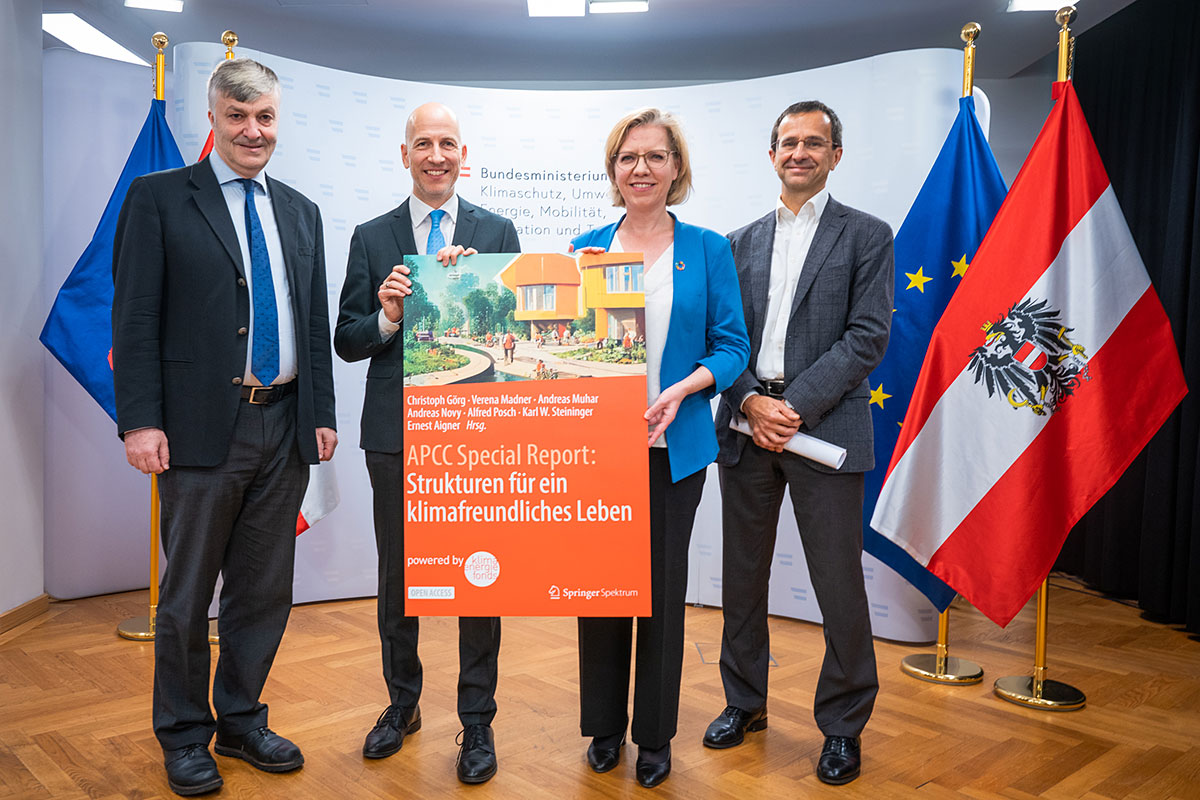
Präsentation des APCC-Berichts: Karl Steininger, Martin Kocher, Leonore Gewessler, Andreas Novy (v.l.). Foto: Cajetan Perwein/BMK
created by Gudrun Pichler

Related news

Preserving knowledge: Book sponsorship success story cracks the 100,000 euro mark

The special collections of Graz University Library comprise around 300,000 valuable objects from 25 centuries: Papyri, manuscripts, incunabula, maps and printed books. The sensational find from 2023 is also kept here: the Graz Mummy Book, the world's oldest known book fragment in codex form.

Semester abroad without barriers: University of Graz wins award for promoting inclusion

The University of Graz has been awarded the Internationalization Award for its new inclusion initiative. Students with fewer opportunities now also receive financial support for their semester abroad outside Europe.

Fair distribution: Researchers determine just greenhouse gas budgets for all EU regions

Ten years ago, on 12 December 2015, the Paris Climate Agreement was signed at the UN Climate Conference. In order to limit global warming to well below two degrees, only a certain amount of CO2 may be emitted worldwide. While the focus was originally on national emission targets, more than 200 subnational regions and almost 300 cities have now adopted their own targets. But how many emissions are they fairly entitled to? Researchers at the University of Graz have now developed transparent criteria for fair distribution at the subnational level for the first time and determined corresponding greenhouse gas budgets for all European regions. The paper was published today in the scientific journal Nature Communications.

Chemical Christmas show at the University of Graz: An explosive evening at the Schauspielh

At the beginning of December, the University of Graz transformed the theater into a laboratory: as part of “Chemical Life,” teacher training students staged a chemical Christmas show for Styrian school classes—complete with ethanol rockets, nitrogen snow, and glowing effects. An evening designed to inspire interest in studying chemistry.

Begin of page section:
Additional information:

University of Graz
Universitaetsplatz 3
8010 Graz
Austria
  • Contact
  • Web Editors
  • Moodle
  • UNIGRAZonline
  • Imprint
  • Data Protection Declaration
  • Accessibility Declaration
Weatherstation
Uni Graz

End of this page section. Go to overview of page sections

End of this page section. Go to overview of page sections

Begin of page section:

End of this page section. Go to overview of page sections