Begin of page section:
Page sections:

  • Go to contents (Accesskey 1)
  • Go to position marker (Accesskey 2)
  • Go to main navigation (Accesskey 3)
  • Go to sub navigation (Accesskey 4)
  • Go to additional information (Accesskey 5)
  • Go to page settings (user/language) (Accesskey 8)
  • Go to search (Accesskey 9)

End of this page section. Go to overview of page sections

Begin of page section:
Page settings:

English en
Deutsch de
Search
Login

End of this page section. Go to overview of page sections

Begin of page section:
Search:

Search for details about Uni Graz
Close

End of this page section. Go to overview of page sections


Search

Begin of page section:
Main navigation:

Page navigation:

  • University

    University
    • About the University
    • Organisation
    • Faculties
    • Library
    • Working at University of Graz
    • Campus
    Developing solutions for the world of tomorrow - that is our mission. Our students and our researchers take on the great challenges of society and carry the knowledge out.
  • Research Profile

    Research Profile
    • Our Expertise
    • Research Questions
    • Research Portal
    • Promoting Research
    • Research Transfer
    • Ethics in Research
    • Commission for Scientific Integrity
    Scientific excellence and the courage to break new ground. Research at the University of Graz creates the foundations for making the future worth living.
  • Studies

    Studies
    • Prospective Students
    • Students
  • Community

    Community
    • International
    • Location
    • Research and Business
    • Alumni
    The University of Graz is a hub for international research and brings together scientists and business experts. Moreover, it fosters the exchange and cooperation in study and teaching.
  • Spotlight
Topics
  • Sustainable University
  • Researchers answer
  • Work for us
Close menu

End of this page section. Go to overview of page sections

Begin of page section:
You are here:

University of Graz News New AI Method Revolutionises the Design of Enzymes

End of this page section. Go to overview of page sections

Thursday, 22 January 2026

New AI Method Revolutionises the Design of Enzymes

 Mélanie Hall

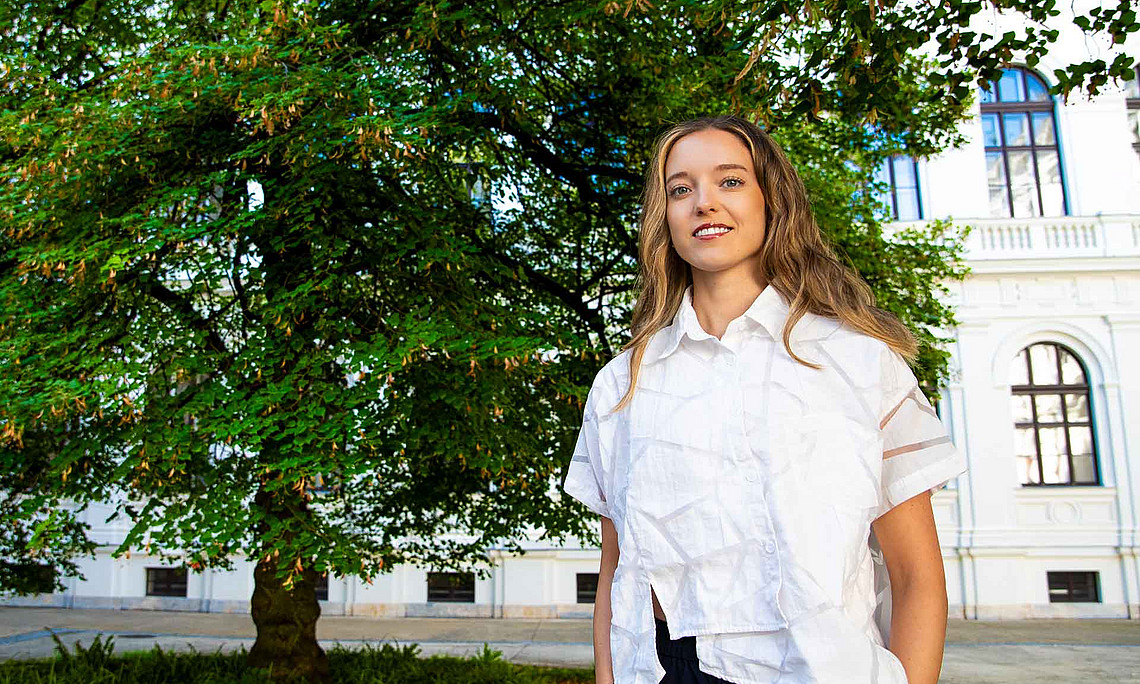
Mélanie Hall from the Department of Chemistry worked on the new biocatalysts. Photo: Uni Graz/Schaffernak

Researchers at TU Graz and the University of Graz can use the technology to construct artificial biocatalysts. These new enzymes are significantly faster, more stable and more versatile than previous artificial biocatalysts.

Enzymes with specific functions are becoming increasingly important in industry, medicine and environmental protection. For example, they make it possible to synthesise chemicals in a more environmentally friendly way, produce active ingredients in a targeted manner or break down environmentally harmful substances. Researchers from Gustav Oberdorfer’s working group at the Institute of Biochemistry at Graz University of Technology (TU Graz), together with colleagues from the University of Graz, have now published a study in the scientific journal “Nature“ describing a new method for the design of customised enzymes. The technology called Riff-Diff (Rotamer Inverted Fragment Finder–Diffusion) makes it possible to accurately and efficiently build the protein structure specifically around the active centre instead of searching for a suitable structure from existing databases. The resulting enzymes are not only significantly more active than previous artificial enzymes, but also more stable.

Highly efficient biocatalysts

“Instead of putting the cart before the horse and searching databases to see which structure matches an active centre, we can now design enzymes for chemical reactions efficiently and precisely from scratch using a one-shot process,” says Gustav Oberdorfer, whose ERC project HELIXMOLD was a key basis for this breakthrough. Lead author Markus Braun from the Institute of Biochemistry at TU Graz adds: “The enzymes that can now be produced are highly efficient biocatalysts that can also be used in industrial environments thanks to their stability. This drastically reduces the screening and optimisation effort previously required and makes enzyme design more accessible to the wider biotechnology community.”

This progress was made possible by new developments in machine learning, which allow the design of much more complex structures than previous methods. Riff-Diff combines several generative machine learning models with atomistic modelling. First, structural motifs of proteins are placed around an active centre, then a generative AI model called RFdiffusion generates the complete protein molecule structure. The researchers refine this scaffold step by step using other models so that the chemically active elements are placed in it with high precision – precision at the angstrom level (1 angstrom corresponds to 0.1 nanometres) was achieved as proven by experimentally determined high-resolution protein structures.

Evolutionary short-cut

The team successfully confirmed how well the method works in the laboratory. Active enzymes for different reaction types have already been generated from 35 tested sequences. The new catalysts were significantly faster than previous computer-aided designs. In addition, the new enzymes showed high thermal stability and almost all retained their functional shape up to 90 degrees Celsius or more, which is particularly relevant for use in industrial applications. Lead author Adrian Tripp from the Institute of Biochemistry at TU Graz adds: “Although nature itself produces a large number of enzymes through evolution, this takes time. With our approach, we can massively accelerate this process and thus contribute to making industrial processes more sustainable, developing targeted enzyme therapies and keeping the environment cleaner.”

This breakthrough was also made possible by the interdisciplinary collaboration between TU Graz and the University of Graz. Mélanie Hall from the Institute of Chemistry at the University of Graz confirms the strength of the collaboration: “The integration of different areas of expertise at the interface of protein science, biotechnology and organic chemistry shows how crucial interdisciplinary approaches are for the advancement of modern biocatalysis.”

⇒ Publication: Computational enzyme design by catalytic motif scaffolding

created by Falko Schoklitsch & Andreas Schweiger

Related news

Mild Research Night: Around 750 visitors travelled around the world at the university

Lovely weather and a wide range of research topics drew visitors to the University of Graz last Friday. Highlights included a journey around the globe in eight stops, a ‘speed-dating’ session with books, insights into Alfred Wegener’s Greenland expedition, and guided tours of the democracy exhibition at the UniGraz@Museum.

Career Booster: How the Research Careers Campus supports researchers

They are innovative, creative and productive – researchers who have not yet been appointed to a professorship make a massive contribution to a university’s research output. To provide them with even better support on their career path, the University of Graz has established the Research Careers Campus. The official launch took place on 22 April 2026 with a ‘festival’.

Greenery on the rise: over 500 new flowers, perennials and shrubs on campus

Bright blooms and fresh greenery make our hearts beat faster in spring. But it is not just us humans who delight in this colourful growth. For many animals, this splendour provides, above all, food and habitat. There has recently been an increase in this on the University of Graz campus. More than 500 native flowers, perennials and shrubs have been planted on strips of fallow land around Universitätsplatz 2.

Building biological bridges: Chemist discovers an ecological tool for the pharmaceutical industry

Building a relationship on a solid foundation is also important in chemistry. To produce medicines, disinfectants or plant protection products, stable bonds between carbon atoms must be formed. Conventional chemical methods rely on environmentally harmful reagents and solvents to carry out the desired reaction. This process also produces unusable by-products. Chemist Lilla Gal has discovered an enzyme that enables the same process to take place efficiently and sustainably. The results of her research were recently published in the prestigious journal Angewandte Chemie.

Begin of page section:
Additional information:

University of Graz
Universitaetsplatz 3
8010 Graz
Austria
  • Contact
  • Web Editors
  • Moodle
  • UNIGRAZonline
  • Imprint
  • Data Protection Declaration
  • Accessibility Declaration
Weatherstation
Uni Graz

End of this page section. Go to overview of page sections

End of this page section. Go to overview of page sections

Begin of page section:

End of this page section. Go to overview of page sections