Begin of page section:
Page sections:

  • Go to contents (Accesskey 1)
  • Go to position marker (Accesskey 2)
  • Go to main navigation (Accesskey 3)
  • Go to sub navigation (Accesskey 4)
  • Go to additional information (Accesskey 5)
  • Go to page settings (user/language) (Accesskey 8)
  • Go to search (Accesskey 9)

End of this page section. Go to overview of page sections

Begin of page section:
Page settings:

English en
Deutsch de
Search
Login

End of this page section. Go to overview of page sections

Begin of page section:
Search:

Search for details about Uni Graz
Close

End of this page section. Go to overview of page sections


Search

Begin of page section:
Main navigation:

Page navigation:

  • University

    University
    • About the University
    • Organisation
    • Faculties
    • Library
    • Working at University of Graz
    • Campus
    Developing solutions for the world of tomorrow - that is our mission. Our students and our researchers take on the great challenges of society and carry the knowledge out.
  • Research Profile

    Research Profile
    • Our Expertise
    • Research Questions
    • Research Portal
    • Promoting Research
    • Research Transfer
    • Ethics in Research
    • Commission for Scientific Integrity
    Scientific excellence and the courage to break new ground. Research at the University of Graz creates the foundations for making the future worth living.
  • Studies

    Studies
    • Prospective Students
    • Students
  • Community

    Community
    • International
    • Location
    • Research and Business
    • Alumni
    The University of Graz is a hub for international research and brings together scientists and business experts. Moreover, it fosters the exchange and cooperation in study and teaching.
Topics
  • Sustainable University
  • Researchers answer
  • Work for us
Close menu

End of this page section. Go to overview of page sections

Begin of page section:
You are here:

University of Graz News Sustainable planning and building: How to make the campus climate-neutral

End of this page section. Go to overview of page sections

Thursday, 02 October 2025

Sustainable planning and building: How to make the campus climate-neutral

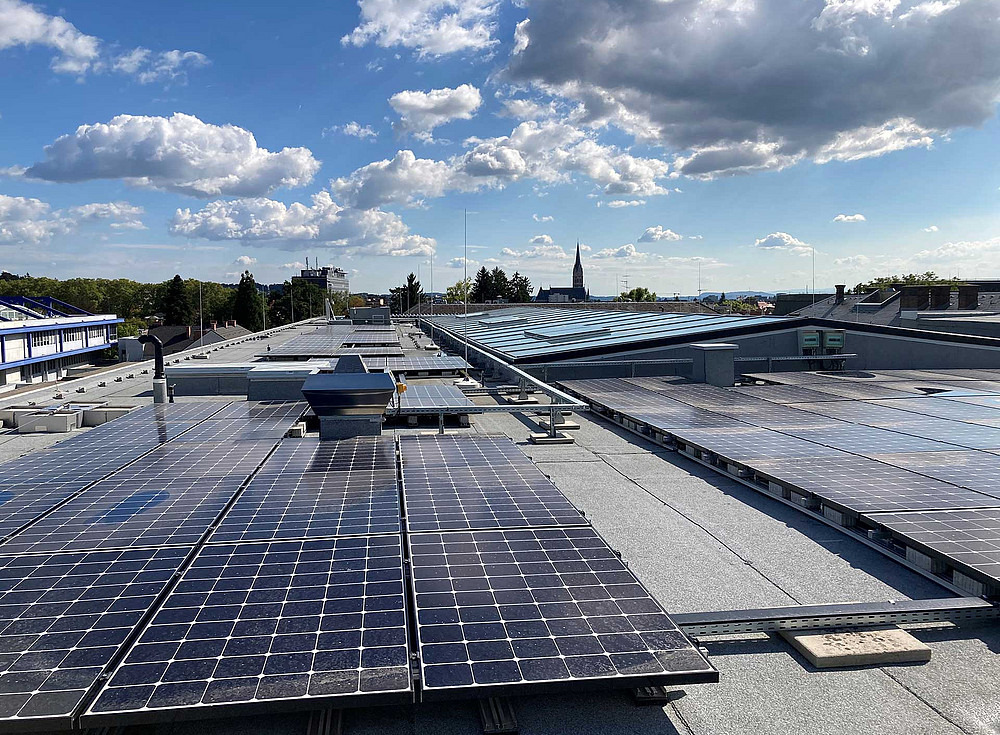
Photovoltaic system on the RESOWI roof

One of the photovoltaic systems on campus is located on the roof of the RESOWI Centre. Photo: Uni Graz/Schweiger

The University of Graz is on its way to becoming one of the first climate-neutral universities in Austria. To this end, greenhouse gas emissions are to be drastically reduced by 2030. The University of Graz aims to achieve true climate neutrality by 2040. New and revitalised buildings on campus will make their contribution.

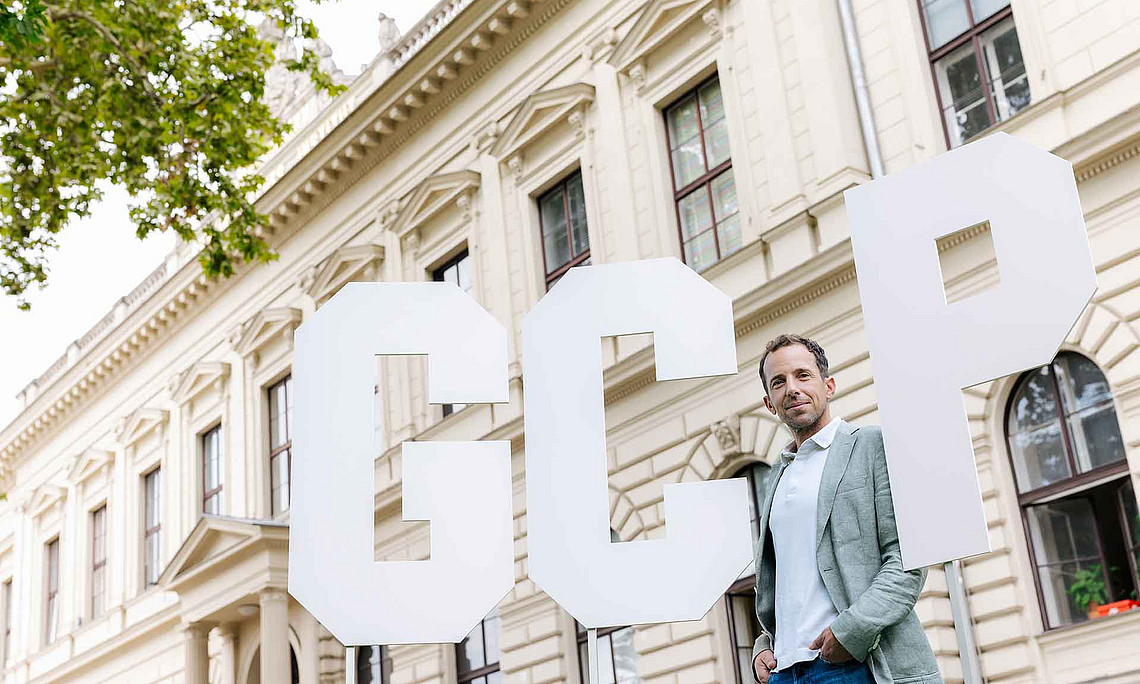
The Graz Centre of Physics, which the Bundesimmobiliengesellschaft is currently building on campus, is currently one of Austria's largest university construction projects. Special hollow core slabs reduce the amount of concrete used and also serve as thermal component activation for heating and cooling. In future, geothermal energy will be used to generate energy. This will be used to both heat and cool the rooms. More than 160 geothermal probes extend up to 150 metres deep into the ground for this purpose.

With the power of the sun

Photovoltaic systems will also generate electricity. The roofs will be intensively greened and the technical rooms will be extensively landscaped. 
New rows of trees will be planted around the new building: In Attemsgasse, Goethestraße and Harrachgasse, the centre will be surrounded by trees, with attention being paid to their "climate fitness" when selecting the tree species. A concept to strengthen biodiversity is also being developed with the involvement of scientists. All of this contributes to the Graz Center of Physics being built in accordance with a certification system for sustainable construction (ÖGNI). gcp-bau.at/de/

Garages for 1000 bicycles

The Bundesimmobiliengesellschaft is renovating the listed building at Universitätsplatz 4 until 2027, while modern technology is also moving into the historic building, which will become the House of Educational Sciences. All installations will be completely renovated. A photovoltaic system will cover the energy requirements of the equivalent of around 18 detached houses. The building will be heated by a low-temperature system that feeds the planned geothermal system of the neighbouring Graz Center of Physics. 
Great attention is also being paid to sustainable mobility. A bicycle garage with 300 parking spaces is being built in the basement of the House of Educational Sciences. The Graz Centre of Physics will have its own deck for 700 bicycles.

Modernity within historic walls

Great attention was also paid to sustainability during the revitalisation of the Jesuit refectory, where the Institute of Human Movement Sciences, Sport and Health will soon begin its research and teaching activities. This included an innovative deep probe heat pump system, which provides both heating and partial cooling.

More information

https://nachhaltig.uni-graz.at/de/

https://klimaneutral.uni-graz.at/de/

 

created by Andreas Schweiger

Related news

Complying with the norm: Why Do Standards Shape Our Lives, Elisabeth Staudegger?

Standards determine whether a sheet of paper fits in a printer or whether a charging plug can power multiple devices. These standards shape our everyday lives. But who actually sets these standards? Where are the weaknesses, and how could science help to improve them? Elisabeth Staudegger, Head of the ‘Law and IT’ Department at the Institute for Legal Foundations at the University of Graz, host the Academic Standards Day on 16 June. Here she relays how sciences can contribute to the topic of standardisation and reveals her personal favourite standard.

More body awareness than a culture war

In Italy, sex education lessons will in future only be permitted with parental consent, and will be banned entirely in nurseries and primary schools. At the same time, Pride Month highlights why knowledge about the body, relationships, boundaries and diversity is important for young people. A study by the University of Graz shows how important knowledge about the body, contraception, relationship skills and protection against violence is

Will Austria win the World Cup? Mathematician reveals calculation method

Michael Fischer uses the football tournament as a practical example for highschool lessons.

Survival strategies: How plants respond to drought

According to Geosphere Austria, this spring was the driest in Austria since records began around 170 years ago. The low rainfall put particular pressure on the agricultural sector. And climate change is set to make the situation even worse in the coming decades. We asked Johannes Liesche, a professor at the Department of Biology at the University of Graz, how plants react to water shortages and how they survive periods of drought.

Begin of page section:
Additional information:

University of Graz
Universitaetsplatz 3
8010 Graz
Austria
  • Contact
  • Web Editors
  • Moodle
  • UNIGRAZonline
  • Imprint
  • Data Protection Declaration
  • Accessibility Declaration
Weatherstation
Uni Graz

End of this page section. Go to overview of page sections

End of this page section. Go to overview of page sections

Begin of page section:

End of this page section. Go to overview of page sections