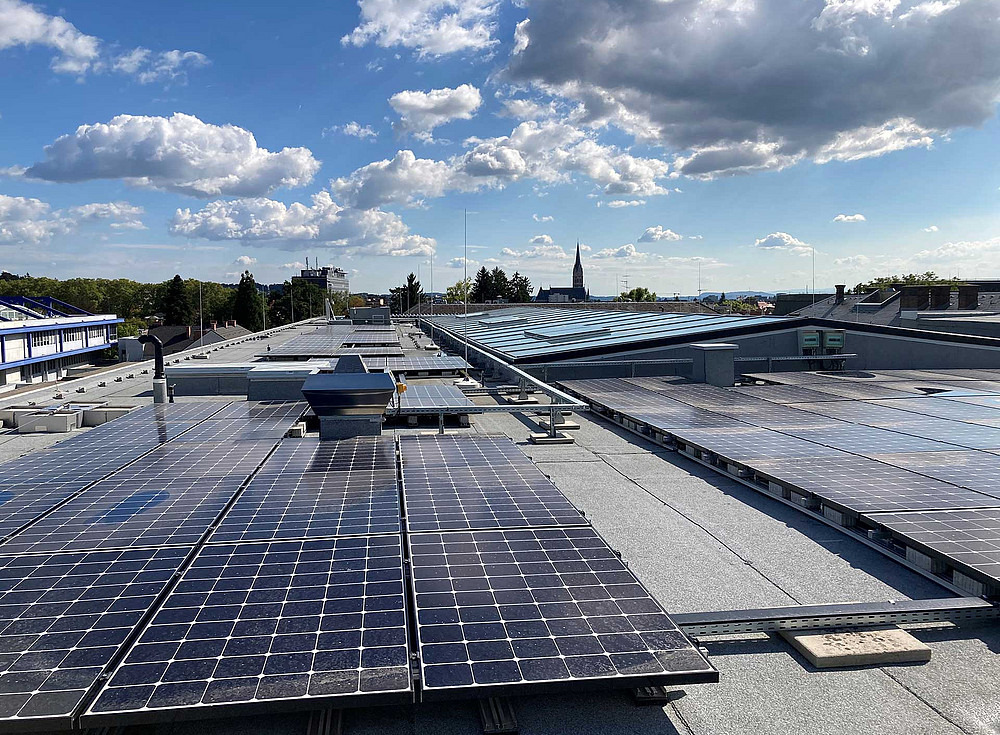
The Graz Centre of Physics, which the Bundesimmobiliengesellschaft is currently building on campus, is currently one of Austria's largest university construction projects. Special hollow core slabs reduce the amount of concrete used and also serve as thermal component activation for heating and cooling. In future, geothermal energy will be used to generate energy. This will be used to both heat and cool the rooms. More than 160 geothermal probes extend up to 150 metres deep into the ground for this purpose.
With the power of the sun
Photovoltaic systems will also generate electricity. The roofs will be intensively greened and the technical rooms will be extensively landscaped.
New rows of trees will be planted around the new building: In Attemsgasse, Goethestraße and Harrachgasse, the centre will be surrounded by trees, with attention being paid to their "climate fitness" when selecting the tree species. A concept to strengthen biodiversity is also being developed with the involvement of scientists. All of this contributes to the Graz Center of Physics being built in accordance with a certification system for sustainable construction (ÖGNI). gcp-bau.at/de/
Garages for 1000 bicycles
The Bundesimmobiliengesellschaft is renovating the listed building at Universitätsplatz 4 until 2027, while modern technology is also moving into the historic building, which will become the House of Educational Sciences. All installations will be completely renovated. A photovoltaic system will cover the energy requirements of the equivalent of around 18 detached houses. The building will be heated by a low-temperature system that feeds the planned geothermal system of the neighbouring Graz Center of Physics.
Great attention is also being paid to sustainable mobility. A bicycle garage with 300 parking spaces is being built in the basement of the House of Educational Sciences. The Graz Centre of Physics will have its own deck for 700 bicycles.
Modernity within historic walls
Great attention was also paid to sustainability during the revitalisation of the Jesuit refectory, where the Institute of Human Movement Sciences, Sport and Health will soon begin its research and teaching activities. This included an innovative deep probe heat pump system, which provides both heating and partial cooling.
More information
https://nachhaltig.uni-graz.at/de/
https://klimaneutral.uni-graz.at/de/