



Begin of page section:
Page sections:

  • Go to contents (Accesskey 1)
  • Go to position marker (Accesskey 2)
  • Go to main navigation (Accesskey 3)
  • Go to sub navigation (Accesskey 4)
  • Go to additional information (Accesskey 5)
  • Go to page settings (user/language) (Accesskey 8)
  • Go to search (Accesskey 9)

End of this page section. Go to overview of page sections

Begin of page section:
Page settings:

English en
Deutsch de
Search
Login

End of this page section. Go to overview of page sections

Begin of page section:
Search:

Search for details about Uni Graz
Close

End of this page section. Go to overview of page sections


Search

Begin of page section:
Main navigation:

Page navigation:

  • University

    University
    • About the University
    • Organisation
    • Faculties
    • Library
    • Working at University of Graz
    • Campus
    Developing solutions for the world of tomorrow - that is our mission. Our students and our researchers take on the great challenges of society and carry the knowledge out.
  • Research Profile

    Research Profile
    • Our Expertise
    • Research Questions
    • Research Portal
    • Promoting Research
    • Research Transfer
    • Ethics in Research
    • Commission for Scientific Integrity
    Scientific excellence and the courage to break new ground. Research at the University of Graz creates the foundations for making the future worth living.
  • Studies

    Studies
    • Prospective Students
    • Students
    • Welcome Weeks for First Year Students
  • Community

    Community
    • International
    • Location
    • Research and Business
    • Alumni
    The University of Graz is a hub for international research and brings together scientists and business experts. Moreover, it fosters the exchange and cooperation in study and teaching.
Topics
  • Sustainable University
  • Researchers answer
  • Work for us
Close menu

End of this page section. Go to overview of page sections

Begin of page section:
You are here:

University of Graz News Molekül-Motoren mit Licht-Antrieb

End of this page section. Go to overview of page sections

Monday, 07 November 2016

Molekül-Motoren mit Licht-Antrieb
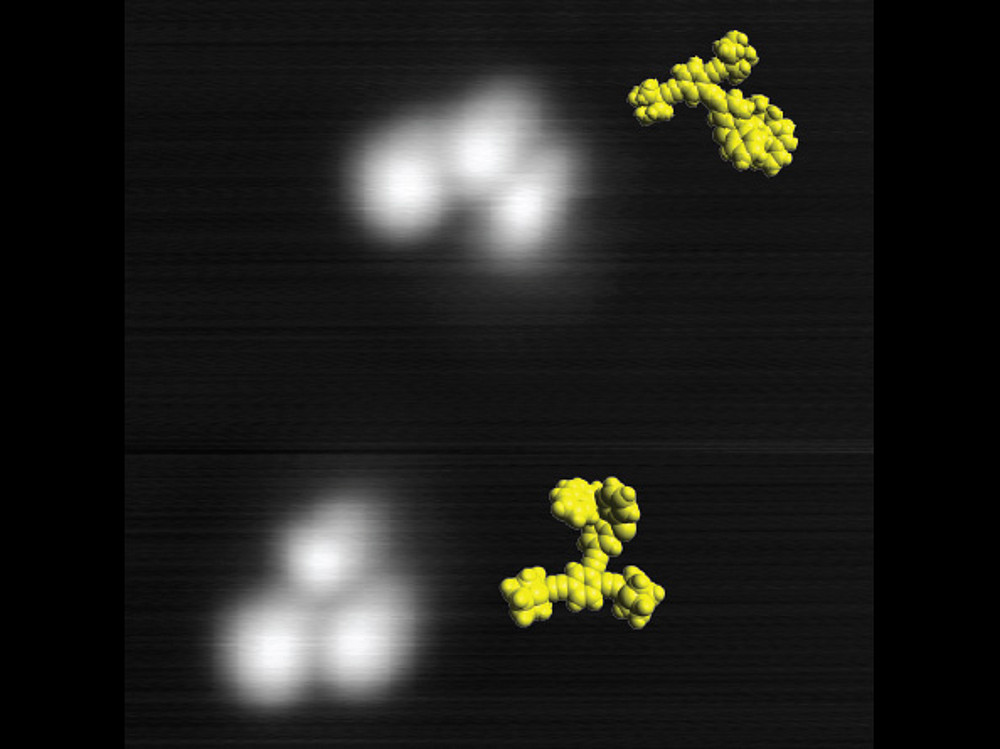
Bahnbrechende Entwicklung: Zwei Nano-Maschinen (weiß) auf einer 8x8 Nanometer großen Kupferoberfläche (grau), aufgenommen bei -267° mit einem Rastertunnelmikroskop. In Gelb die Molekül-Modelle der Maschinen. Foto: Uni Graz/Grill

Bahnbrechende Entwicklung: Zwei Nano-Maschinen (weiß) auf einer 8x8 Nanometer großen Kupferoberfläche (grau), aufgenommen bei -267° mit einem Rastertunnelmikroskop. In Gelb die Molekül-Modelle der Maschinen. Foto: Uni Graz/Grill

ForscherInnen der Uni Graz steuern Nano-Maschinen auf Oberflächen

Ferngesteuerte Nano-Maschinen, angetrieben von einem Lichtstrahl, reinigen Oberflächen, bringen spezielle Pharmazeutika im Körper an ihren Zielort oder bauen elektronische Strukturen aus einzelnen Atomen. Dieser Zukunftsvision ist die Arbeitsgruppe von Univ.-Prof. Dr. Leonhard Grill vom Institut für Chemie der Karl-Franzens-Universität Graz einen großen Schritt nähergekommen: Dem Team ist es gelungen, einzelne molekulare Maschinen durch Laserlicht gezielt auf einer Oberfläche zu bewegen und währenddessen zu beobachten. Die Ergebnisse der Studie werden in der nächsten Ausgabe des Magazins „ACS  Nano“ publiziert und sind online bereits veröffentlicht.

Eine nur zwei Millionstel Millimeter große Maschine mit eingebautem Molekül-Motor hat Leonhard Grill, Leiter der Arbeitsgruppe „Single-Molecule Chemistry“ in Zusammenarbeit mit Prof. James Tour von der Rice University in Houston, USA, entwickelt. „Die große Herausforderung war, die Moleküle anzutreiben und nachzuweisen, dass tatsächlich der interne Motor für die Bewegung verantwortlich ist“, berichtet Grill. Das haben die PhysikerInnen nun erstmals geschafft. Als „Treibstoff“ dient Licht, was gleich mehrere Vorteile bietet: „Damit können wir die Maschinen aus der Ferne aktivieren und außerdem extrem viele Moleküle gleichzeitig bewegen – in Zukunft möglicherweise zum gezielten Transport von Atomen oder Molekülen“, schildert der Wissenschafter. Müsste man die Mini-Motoren für die Energiezufuhr verkabeln, würden sie wesentliche Eigenschaften und ihre Freiheiten verlieren.
 
In den Experimenten untersuchte das Team mit höchster Präzision die Position einzelner Moleküle auf einer Metalloberfläche vor und nach der Bestrahlung mit Laserlicht. Die Mini-Maschinen legten in einer Stunde Distanzen von mehr als 20 Nanometern zurück. Außerdem konnten die Besonderheiten des Motors für eine selektive Steuerung genutzt werden. „Je nachdem, welche Farbe – also welche Wellenlänge – des Lichts wir einsetzten, konnten wir die Bewegung dirigieren“, so Grill. Diese photochemische Empfindlichkeit ist eine wesentliche Grundlage für weitere Entwicklungen: „Man könnte in Zukunft vielleicht verschiedene Motoren in ein und derselben Nano-Maschine gezielt ansteuern und damit vollkommen neue Funktionen erreichen.“ Das wäre für eine Vielzahl an Anwendungen in der Nanotechnologie und Medizin von Interesse. Molekulare Motoren sind ein äußerst zukunftsträchtiges Feld, das heuer auch mit dem Nobelpreis prämiert wurde.

Publikation:
ACS Nano: „Light-Induced Translation of Motorized Molecules on a Surface”,  Alex Saywell, Anne Bakker, Johannes Mielke, Takashi Kumagai, Martin Wolf, Víctor García-López, Pinn-Tsong Chiang, James M. Tour, Leonhard Grill
DOI: 10.1021/acsnano.6b05650
http://pubs.acs.org/doi/abs/10.1021/acsnano.6b05650

created by Dagmar Eklaude

Related news

Rescue and risks: Researchers have surveyed public perceptions of AI

The use of artificial intelligence has had to be made transparent since 2 August 2026. The EU’s AI Act, which has been in force since then, also sets out how risky an application is and which security measures apply as a result. However, the assessment of risks by the legislation differs in some cases significantly from the perceptions of the Austrian public. This is the finding of a representative study carried out by data scientist Stefan Thalmann from the University of Graz and his team.

The Healing Sea: Researchers discover new approaches to treating chronic inflammation in sponges

Chronic inflammation plays a key role in many diseases, ranging from metabolic disorders and cardiovascular diseases to tissue damage following injuries or infections. “Normally, the body is able to resolve inflammation on its own. If this process becomes unbalanced, immune cells remain permanently active and continue to drive negative changes in the tissue,” explains Andreas Koeberle, a pharmacist at the University of Graz.

Well prepared: start your studies with the Welcome Weeks

A new academic year, new degree programmes, new students. The University of Graz is kicking off the 2026 winter semester with a modern range of courses. Several new programmes are being launched this year, including the Bachelor’s degree in Early Years Education, which combines vocational training with academic research. Three newly designed degree programmes in art history offer contemporary perspectives on artistic production – from the Old Masters to AI art. First-year students in particular can immerse themselves in university life and gather all the essential information even before the semester begins: during the Welcome Weeks starting on 1 September.

Chemical crash: Researchers at the University of Graz are investigating the reactions in detail for the first time

Matthew Timm and Leonhard Grill have, for the first time, succeeded in unravelling how fundamental chemical processes take place and how new molecules are formed. The findings of this study have just been published in the journal Science.

Begin of page section:
Additional information:

University of Graz
Universitaetsplatz 3
8010 Graz
Austria
  • Contact
  • Web Editors
  • Moodle
  • UNIGRAZonline
  • Imprint
  • Data Protection Declaration
  • Accessibility Declaration
Weatherstation
Uni Graz

End of this page section. Go to overview of page sections

End of this page section. Go to overview of page sections

Begin of page section:

End of this page section. Go to overview of page sections