



Begin of page section:
Page sections:

  • Go to contents (Accesskey 1)
  • Go to position marker (Accesskey 2)
  • Go to main navigation (Accesskey 3)
  • Go to sub navigation (Accesskey 4)
  • Go to additional information (Accesskey 5)
  • Go to page settings (user/language) (Accesskey 8)
  • Go to search (Accesskey 9)

End of this page section. Go to overview of page sections

Begin of page section:
Page settings:

English en
Deutsch de
Search
Login

End of this page section. Go to overview of page sections

Begin of page section:
Search:

Search for details about Uni Graz
Close

End of this page section. Go to overview of page sections


Search

Begin of page section:
Main navigation:

Page navigation:

  • University

    University
    • About the University
    • Organisation
    • Faculties
    • Library
    • Working at University of Graz
    • Campus
    Developing solutions for the world of tomorrow - that is our mission. Our students and our researchers take on the great challenges of society and carry the knowledge out.
  • Research Profile

    Research Profile
    • Our Expertise
    • Research Questions
    • Research Portal
    • Promoting Research
    • Research Transfer
    • Ethics in Research
    Scientific excellence and the courage to break new ground. Research at the University of Graz creates the foundations for making the future worth living.
  • Studies

    Studies
    • Prospective Students
    • Students
    • Welcome Weeks for First Year Students
  • Community

    Community
    • International
    • Location
    • Research and Business
    • Alumni
    The University of Graz is a hub for international research and brings together scientists and business experts. Moreover, it fosters the exchange and cooperation in study and teaching.
  • Spotlight
Topics
  • Sustainable University
  • Researchers answer
  • Work for us
Close menu

End of this page section. Go to overview of page sections

Begin of page section:
You are here:

University of Graz News Milestone for medical research

End of this page section. Go to overview of page sections

Monday, 11 August 2025

Milestone for medical research

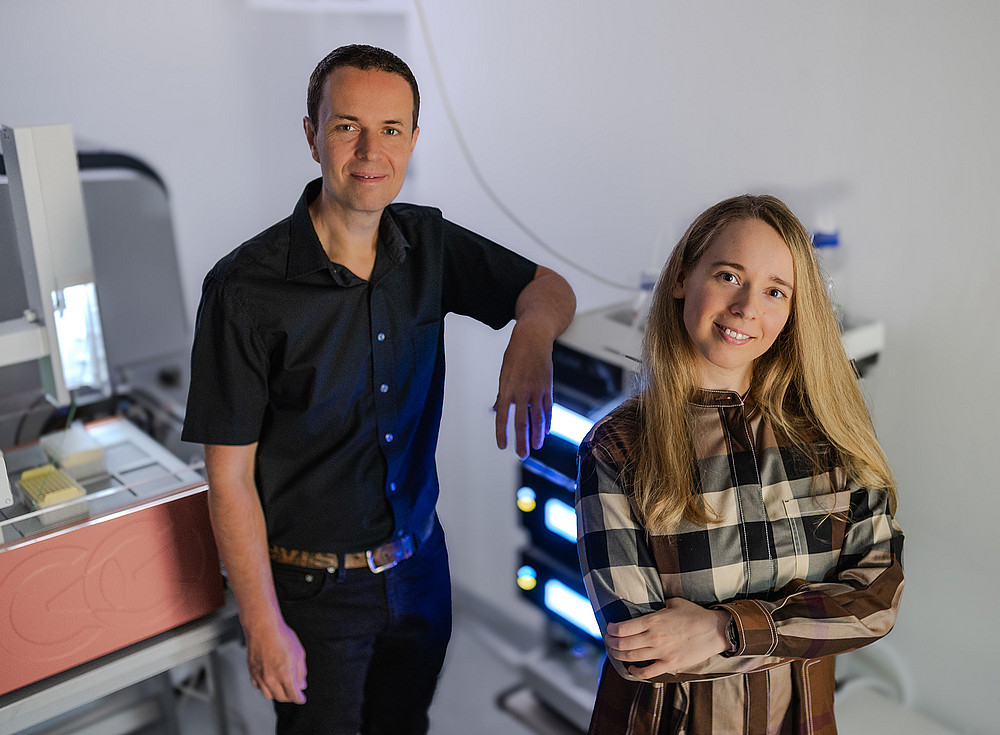
Jürgen Hartler and Leonida Lamp in front of research equipment ©University of Graz / Tzivanopoulos

Jürgen Hartler, head of the Computational Pharmacology research group at the University of Graz, and postdoctoral researcher Leonida Lamp, present a new method for the comprehensive identification of omega fatty acids, in collaboration with researchers from the US and Vienna. Photo: University of Graz / Tzivanopoulos

Omega-3 fatty acids are known to be an essential part of a healthy diet. As humans cannot produce them, they have to be consumed in sufficient amounts. However, omega-6, -7, -9, and -10 fatty acids also play important roles in the metabolism of fats. These numbers indicate the position of the first double bond in a fatty acid chain. Deviations in the omega position can signal enzyme malfunctions or pathological metabolic processes, such as those occurring in cancer. Now, researchers at the University of Graz and the University of California, San Diego present in Nature Communications a novel, effective method to determine omega positions of lipids – the scientific term for fats – in complex biological samples including human tissues and blood.


For omega-3 lipids, the first double bond is located at the third carbon atom from the end of the fatty acid chain, hence the number in the name. “Many enzymes in our bodies can utilize only fatty acids with specific double bond positions. Aberrant metabolic processes, such as those occurring in cancer, cardiovascular diseases, or autoimmune disorders, frequently entail alterations in omega positions of lipids,” explains Jürgen Hartler, head of the Computational Pharmacology research group at the University of Graz. Therefore, taking a closer look at this structural feature is highly relevant. “Among the enzymes that act specifically on fatty acids with certain double bond positions, phospholipases stand out for their key role in inflammation. This new method now enables the study of these biological mechanisms in unprecedented detail,” adds Edward Dennis, Professor of Chemistry, Biochemistry, and Pharmacology at the University of California, San Diego. 

New Computer-Based Method
Until now, the identification of omega positions of intact lipids has been challenging in complex biological samples. Only a few research groups worldwide had access to the required specialized analytical tools such as Evelyn Rampler’s group at the University of Vienna. Hartler, Dennis and their teams, in collaboration with Rampler, are now introducing a new computational method. “Our database in concert with the developed software LC=CL makes omega positions of lipids available in routine chromatography-coupled mass spectrometry methods,” Leonida Lamp, first author of the publication, summarizes this innovation. In this way, researchers worldwide will get access to this crucial information, which will significantly advance lipid research. Lamp adds: “Moreover, our method has proven to be far more sensitive than prior approaches, making omega position information accessible even for lipids in very low concentrations.” Gosia Murawska, co-first author of the publication, gives an example: “A key enzyme among the phospholipases is cPLA2. It has been studied for decades. Now, LC=CL enabled us to prove that cPLA2 specifically converts mead acid, an omega-9 fatty acid. This demonstrates that our method is an essential milestone to advance precise therapeutic strategies, such as for inflammation-related diseases.”

Publication
Computationally unmasking each fatty acyl C=C position in complex lipids by routine LC-MS/MS lipidomics
Leonida M. Lamp, Gosia M. Murawska, Joseph P. Argus, Aaron M. Armando, Radu A. Talmazan, Marlene Pühringer, Evelyn Rampler, Oswald Quehenberger, Edward A. Dennis, Jürgen Hartler
Nature Communications, DOI: 10.1038/s41467-025-61911-x

created by Gudrun Pichler

Related news

New AI Method Revolutionises the Design of Enzymes

Researchers at TU Graz and the University of Graz can use the technology to construct artificial biocatalysts. These new enzymes are significantly faster, more stable and more versatile than previous artificial biocatalysts.

The dark side of life: new method developed to identify soil organisms

A large number of soil animals are smaller than one millimetre and are therefore difficult to study scientifically. Biologists from the University of Graz have now developed a method to determine both the shape and the DNA of the organisms. The results have been published in the journal Geoderma.

How does peace succeed? Maximilian Lakitsch drives research forward

Donald Trump is rattling his proverbial sabre ever louder, unrest in the Middle East is escalating and the war in Ukraine continues to rage. Maximilian Lakitsch knows what political measures could contribute to reconciliation. He is the coordinator of an EU-wide initiative to strengthen peace research.

Simon Benal completes a voluntary environmental year at the University of Graz

Committing to the planet, getting to know exciting fields of activity and discovering possible paths for your own future – these are the opportunities offered by the Freiwilliges Umweltjahr (FUJ), a voluntary environmental year. One person who has chosen this option is Simon Benal. He has been working in the environmental management team at the University of Graz since September 2025.

Begin of page section:
Additional information:

University of Graz
Universitaetsplatz 3
8010 Graz
Austria
  • Contact
  • Web Editors
  • Moodle
  • UNIGRAZonline
  • Imprint
  • Data Protection Declaration
  • Accessibility Declaration
Weatherstation
Uni Graz

End of this page section. Go to overview of page sections

End of this page section. Go to overview of page sections

Begin of page section:

End of this page section. Go to overview of page sections