Begin of page section:
Page sections:

  • Go to contents (Accesskey 1)
  • Go to position marker (Accesskey 2)
  • Go to main navigation (Accesskey 3)
  • Go to sub navigation (Accesskey 4)
  • Go to additional information (Accesskey 5)
  • Go to page settings (user/language) (Accesskey 8)
  • Go to search (Accesskey 9)

End of this page section. Go to overview of page sections

Begin of page section:
Page settings:

English en
Deutsch de
Search
Login

End of this page section. Go to overview of page sections

Begin of page section:
Search:

Search for details about Uni Graz
Close

End of this page section. Go to overview of page sections


Search

Begin of page section:
Main navigation:

Page navigation:

  • University

    University
    • About the University
    • Organisation
    • Faculties
    • Library
    • Working at University of Graz
    • Campus
    Developing solutions for the world of tomorrow - that is our mission. Our students and our researchers take on the great challenges of society and carry the knowledge out.
  • Research Profile

    Research Profile
    • Our Expertise
    • Research Questions
    • Research Portal
    • Promoting Research
    • Research Transfer
    • Ethics in Research
    Scientific excellence and the courage to break new ground. Research at the University of Graz creates the foundations for making the future worth living.
  • Studies

    Studies
    • Prospective Students
    • Students
  • Community

    Community
    • International
    • Location
    • Research and Business
    • Alumni
    The University of Graz is a hub for international research and brings together scientists and business experts. Moreover, it fosters the exchange and cooperation in study and teaching.
  • Spotlight
Topics
  • Our digital Advent calendar
  • Sustainable University
  • Researchers answer
  • Work for us
Close menu

End of this page section. Go to overview of page sections

Begin of page section:
You are here:

University of Graz News Mikroplastik

End of this page section. Go to overview of page sections

Thursday, 24 June 2021

Mikroplastik

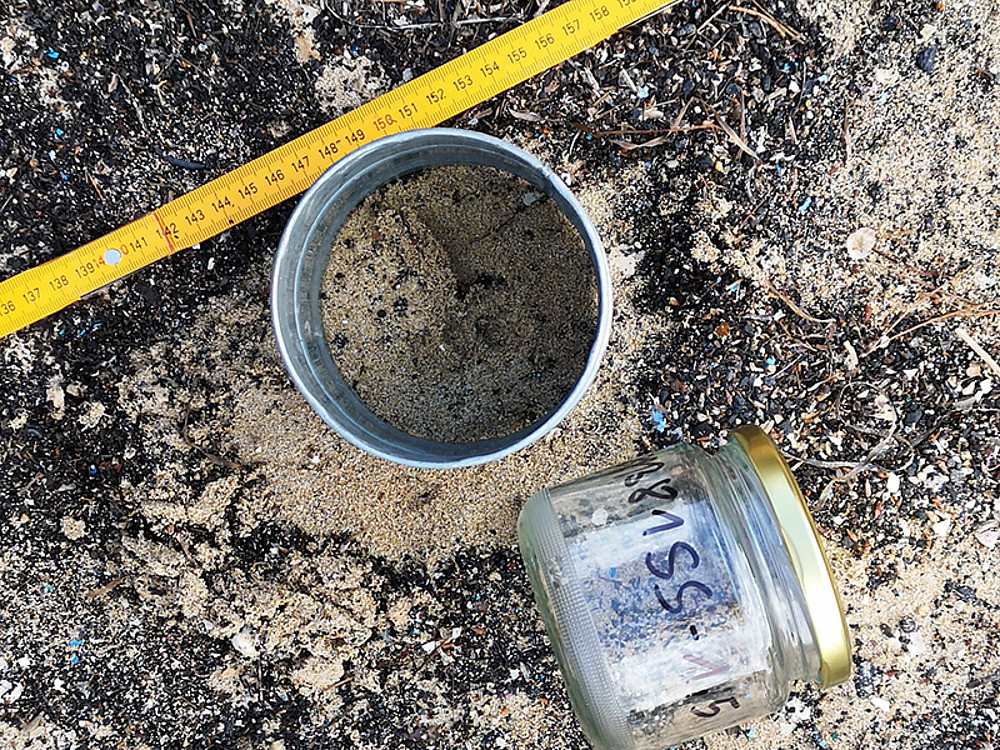
Mikroplastik ist fast überall - auch am Strand. ForscherInnen stellen jetzt eine Methode vor, mit der man den Grad der Verschmutzung messen kann. Ein genaues Monitoring – sowohl zeitlich als auch räumlich – ist wichtig, um Maßnahmen zur Reduzierung und Vermeidung von Plastikmüll in Angriff zu nehmen. Foto: Koblmüller.

Mikroplastik ist fast überall - auch am Strand. ForscherInnen der Uni Graz stellen jetzt eine Methode vor, mit der man den Grad der Verschmutzung messen kann. Ein genaues Monitoring – sowohl zeitlich als auch räumlich – ist wichtig, um Maßnahmen zur Reduzierung und Vermeidung von Plastikmüll in Angriff zu nehmen. Foto: Koblmüller.

ForscherInnen entwickeln neue Methode, um Verschmutzung am Strand zu untersuchen

Sommer, Sonne, Strand – klingt perfekt! Aber das ist es nicht: Mikroplastik ist fast überall – auch im Meer. Bis zu 30 Millionen Tonnen weltweit landen pro Jahr weltweit in den Ozeanen. Damit sind die winzigen Partikel für 92 Prozent des Plastikmülls im Meer verantwortlich. ForscherInnen aus Graz und Pula haben nun eine Methode vorgestellt, mit der man die Mikroplastikverschmutzung einfach, schnell, umweltfreundlich, kostengünstig messen kann. „Daten, die bislang auf verschiedene Weise erhoben wurden, können damit endlich vergleichbar dargestellt werden. Ein genaues Monitoring – sowohl zeitlich als auch räumlich – ist wichtig, um Maßnahmen zur Reduzierung und Vermeidung von Plastikmüll in Angriff zu nehmen“, schildert Stephan Koblmüller vom Institut für Biologie der Universität Graz. 

Trotz ihrer Größe von höchstens fünf Millimetern ziehen Mikroplastikpartikel riesige Probleme nach sich, beschreiben Sandra Bračun und Christian Pacher von der Universität Graz: „Weil sie so winzig sind, können es selbst kleinste Organismen aufnehmen. Über die Nahrungskette verbreitet es sich weiter. Tiere leiden dadurch an inneren Verletzungen, Tumoren, Fruchtbarkeitsstörungen und Fehlentwicklungen. Und auch im Menschen wurde Mikroplastik bereits nachgewiesen.“ Der Strand ist ein Spiegelbild der Verschmutzung in den angrenzenden Gewässern. Bisher waren Untersuchungen zur Mikroplastikbelastung dort aber entweder nur Momentaufnahmen oder aufgrund unterschiedlicher Herangehensweisen nicht miteinander vergleichbar. „Die Methoden des Herausfilterns von Mikroplastik zu Messzwecken waren kompliziert und teilweise selbst umweltbelastend“, weiß Sandra Bračun. Die Partikel können teilweise durch eine Kochsalzlösung aus dem Sand extrahiert werden. Aber PVC oder PET, die in großen Mengen in Textilfasern oder Getränkeflaschen verwendet werden, lassen sich nur mit teuren oder stark ätzenden Substanzen herauslösen. 

Als günstige und ungiftige Alternative dazu hat das Forschungsteam nun Kaliumcarbonat getestet. Der alkalische pH-Wert gewährleistet, dass organische Verbindungen an- bzw. aufgelöst werden. „Mit Kaliumcarbonat können außerdem Lösungen mit Dichten größer 1,5 Gramm pro Kubikzentimeter hergestellt werden. Das garantiert, dass wirklich alle Kunststoffsorten erfasst werden“, resümieren die ForscherInnen. Sie stellen aber auch klar: „Es gibt keine Methode, Mikroplastik aus dem Strand zu entfernen, ohne dabei auch alle Lebewesen darin zu vernichten.“ Die Messdaten sollen vielmehr dabei unterstützen, das Bewusstsein der Bevölkerung und der Politik für das Mikroplastik-Problem zu schärfen. Die WissenschafterInnen appellieren: „Jede Plastikflasche, die nicht am Strand oder im Meer landet, zählt.“ 

>> Ökologin Sandra Bračun im AirCampus-Interview zur Mikroplastikverschmutzung im Meer


Publikation: Gohla J, Bračun S, Gretschel G, Koblmüller S, Wagner M, Pacher C. 2021. Potassium carbonate (K2CO3) – A cheap, non-toxic and high-density floating solution for microplastic isolation from beach sediments. Marine Pollution Bulletin 170, 112618. https://doi.org/10.1016/j.marpolbul.2021.112618 

created by Gerhild Leljak

Related news

Semester abroad without barriers: University of Graz wins award for promoting inclusion

The University of Graz has been awarded the Internationalization Award for its new inclusion initiative. Students with fewer opportunities now also receive financial support for their semester abroad outside Europe.

Fair distribution: Researchers determine just greenhouse gas budgets for all EU regions

Ten years ago, on 12 December 2015, the Paris Climate Agreement was signed at the UN Climate Conference. In order to limit global warming to well below two degrees, only a certain amount of CO2 may be emitted worldwide. While the focus was originally on national emission targets, more than 200 subnational regions and almost 300 cities have now adopted their own targets. But how many emissions are they fairly entitled to? Researchers at the University of Graz have now developed transparent criteria for fair distribution at the subnational level for the first time and determined corresponding greenhouse gas budgets for all European regions. The paper was published today in the scientific journal Nature Communications.

Chemical Christmas show at the University of Graz: An explosive evening at the Schauspielh

At the beginning of December, the University of Graz transformed the theater into a laboratory: as part of “Chemical Life,” teacher training students staged a chemical Christmas show for Styrian school classes—complete with ethanol rockets, nitrogen snow, and glowing effects. An evening designed to inspire interest in studying chemistry.

Train by train: Koralm railway accelerates exchange between the Universities

Lectures at the University of Klagenfurt in the morning, seminars at the University of Graz in the afternoon: Austria's longest tunnel and a journey time of around 45 minutes make it easy. The Koralm railway increases the speed of networking between the two university locations. The collaboration builds on existing cooperation - for example in the areas of teacher training, Slavic studies and as employers, the universities are well coordinated.

Begin of page section:
Additional information:

University of Graz
Universitaetsplatz 3
8010 Graz
Austria
  • Contact
  • Web Editors
  • Moodle
  • UNIGRAZonline
  • Imprint
  • Data Protection Declaration
  • Accessibility Declaration
Weatherstation
Uni Graz

End of this page section. Go to overview of page sections

End of this page section. Go to overview of page sections

Begin of page section:

End of this page section. Go to overview of page sections