



Begin of page section:
Page sections:

  • Go to contents (Accesskey 1)
  • Go to position marker (Accesskey 2)
  • Go to main navigation (Accesskey 3)
  • Go to sub navigation (Accesskey 4)
  • Go to additional information (Accesskey 5)
  • Go to page settings (user/language) (Accesskey 8)
  • Go to search (Accesskey 9)

End of this page section. Go to overview of page sections

Begin of page section:
Page settings:

English en
Deutsch de
Search
Login

End of this page section. Go to overview of page sections

Begin of page section:
Search:

Search for details about Uni Graz
Close

End of this page section. Go to overview of page sections


Search

Begin of page section:
Main navigation:

Page navigation:

  • University

    University
    • About the University
    • Organisation
    • Faculties
    • Library
    • Working at University of Graz
    • Campus
    Developing solutions for the world of tomorrow - that is our mission. Our students and our researchers take on the great challenges of society and carry the knowledge out.
  • Research Profile

    Research Profile
    • Our Expertise
    • Research Questions
    • Research Portal
    • Promoting Research
    • Research Transfer
    • Ethics in Research
    • Commission for Scientific Integrity
    Scientific excellence and the courage to break new ground. Research at the University of Graz creates the foundations for making the future worth living.
  • Studies

    Studies
    • Prospective Students
    • Students
    • Registration for Study Programme (Winter semester 2026/27)
    • Study Days 22-26 June 2026
  • Community

    Community
    • International
    • Location
    • Research and Business
    • Alumni
    The University of Graz is a hub for international research and brings together scientists and business experts. Moreover, it fosters the exchange and cooperation in study and teaching.
Topics
  • Sustainable University
  • Researchers answer
  • Work for us
Close menu

End of this page section. Go to overview of page sections

Begin of page section:
You are here:

University of Graz News Mikroplastik

End of this page section. Go to overview of page sections

Thursday, 24 June 2021

Mikroplastik

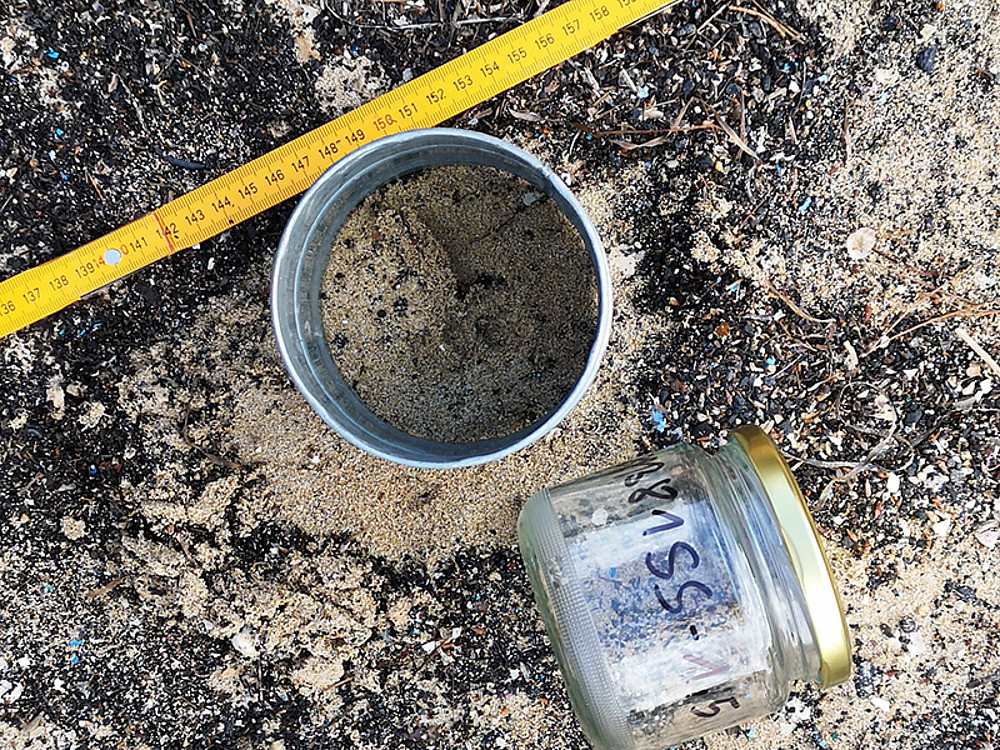
Mikroplastik ist fast überall - auch am Strand. ForscherInnen stellen jetzt eine Methode vor, mit der man den Grad der Verschmutzung messen kann. Ein genaues Monitoring – sowohl zeitlich als auch räumlich – ist wichtig, um Maßnahmen zur Reduzierung und Vermeidung von Plastikmüll in Angriff zu nehmen. Foto: Koblmüller.

Mikroplastik ist fast überall - auch am Strand. ForscherInnen der Uni Graz stellen jetzt eine Methode vor, mit der man den Grad der Verschmutzung messen kann. Ein genaues Monitoring – sowohl zeitlich als auch räumlich – ist wichtig, um Maßnahmen zur Reduzierung und Vermeidung von Plastikmüll in Angriff zu nehmen. Foto: Koblmüller.

ForscherInnen entwickeln neue Methode, um Verschmutzung am Strand zu untersuchen

Sommer, Sonne, Strand – klingt perfekt! Aber das ist es nicht: Mikroplastik ist fast überall – auch im Meer. Bis zu 30 Millionen Tonnen weltweit landen pro Jahr weltweit in den Ozeanen. Damit sind die winzigen Partikel für 92 Prozent des Plastikmülls im Meer verantwortlich. ForscherInnen aus Graz und Pula haben nun eine Methode vorgestellt, mit der man die Mikroplastikverschmutzung einfach, schnell, umweltfreundlich, kostengünstig messen kann. „Daten, die bislang auf verschiedene Weise erhoben wurden, können damit endlich vergleichbar dargestellt werden. Ein genaues Monitoring – sowohl zeitlich als auch räumlich – ist wichtig, um Maßnahmen zur Reduzierung und Vermeidung von Plastikmüll in Angriff zu nehmen“, schildert Stephan Koblmüller vom Institut für Biologie der Universität Graz. 

Trotz ihrer Größe von höchstens fünf Millimetern ziehen Mikroplastikpartikel riesige Probleme nach sich, beschreiben Sandra Bračun und Christian Pacher von der Universität Graz: „Weil sie so winzig sind, können es selbst kleinste Organismen aufnehmen. Über die Nahrungskette verbreitet es sich weiter. Tiere leiden dadurch an inneren Verletzungen, Tumoren, Fruchtbarkeitsstörungen und Fehlentwicklungen. Und auch im Menschen wurde Mikroplastik bereits nachgewiesen.“ Der Strand ist ein Spiegelbild der Verschmutzung in den angrenzenden Gewässern. Bisher waren Untersuchungen zur Mikroplastikbelastung dort aber entweder nur Momentaufnahmen oder aufgrund unterschiedlicher Herangehensweisen nicht miteinander vergleichbar. „Die Methoden des Herausfilterns von Mikroplastik zu Messzwecken waren kompliziert und teilweise selbst umweltbelastend“, weiß Sandra Bračun. Die Partikel können teilweise durch eine Kochsalzlösung aus dem Sand extrahiert werden. Aber PVC oder PET, die in großen Mengen in Textilfasern oder Getränkeflaschen verwendet werden, lassen sich nur mit teuren oder stark ätzenden Substanzen herauslösen. 

Als günstige und ungiftige Alternative dazu hat das Forschungsteam nun Kaliumcarbonat getestet. Der alkalische pH-Wert gewährleistet, dass organische Verbindungen an- bzw. aufgelöst werden. „Mit Kaliumcarbonat können außerdem Lösungen mit Dichten größer 1,5 Gramm pro Kubikzentimeter hergestellt werden. Das garantiert, dass wirklich alle Kunststoffsorten erfasst werden“, resümieren die ForscherInnen. Sie stellen aber auch klar: „Es gibt keine Methode, Mikroplastik aus dem Strand zu entfernen, ohne dabei auch alle Lebewesen darin zu vernichten.“ Die Messdaten sollen vielmehr dabei unterstützen, das Bewusstsein der Bevölkerung und der Politik für das Mikroplastik-Problem zu schärfen. Die WissenschafterInnen appellieren: „Jede Plastikflasche, die nicht am Strand oder im Meer landet, zählt.“ 

>> Ökologin Sandra Bračun im AirCampus-Interview zur Mikroplastikverschmutzung im Meer


Publikation: Gohla J, Bračun S, Gretschel G, Koblmüller S, Wagner M, Pacher C. 2021. Potassium carbonate (K2CO3) – A cheap, non-toxic and high-density floating solution for microplastic isolation from beach sediments. Marine Pollution Bulletin 170, 112618. https://doi.org/10.1016/j.marpolbul.2021.112618 
created by Gerhild Leljak

Related news

Getting even hotter: Researchers predict global warming of 1.7 degrees by 2027

While Europe is currently sweltering in the heat, global temperatures are also rising towards concerning record levels. In 2026, Earth’s surface air temperature is expected to reach 1.62 degrees, and in 2027 even 1.71 degrees Celsius above pre-industrial levels. The long-term temperature rise – an average over a 20-year period – is predicted to exceed the 1.5-degree threshold of the Paris Agreement as of 2026 already. For the first time, researchers at the University of Graz have been able to make such a forecast so far in advance. The intensifying El Niño climate event favors forecast skill and thereby facilitates a reliable computation.

Forest fire at Rosenhain: Volunteer fire brigade carried out an evacuation drill at the Jesuit refectory

Thick smoke in the stairwell, flames at the edge of the forest, people missing in the Jesuit refectory at the University of Graz: at Rosenhain, the Graz Volunteer Fire Brigade carried out a drill simulating a scenario that is becoming increasingly realistic given the heat and drought

Full effort in the heat: the Sports Centre was in full swing at the Kleeblattlauf

On 19 June 2026, 2,000 runners and hundreds of supporters made their way to the Rosenhain for a sporting end-of-term event.

Save, invest or guarantee: What Austrians expect from the state

Austria needs to make savings. But where? And what should the Republic actually be spending its money on? The answers are provided by the initial findings of a major study involving the University of Graz. 99 per cent of those surveyed are in favour of the state ensuring healthcare provision. Almost three-quarters would like to see more public funding for education, whilst only around three per cent are in favour of cuts in this sector.

Begin of page section:
Additional information:

University of Graz
Universitaetsplatz 3
8010 Graz
Austria
  • Contact
  • Web Editors
  • Moodle
  • UNIGRAZonline
  • Imprint
  • Data Protection Declaration
  • Accessibility Declaration
Weatherstation
Uni Graz

End of this page section. Go to overview of page sections

End of this page section. Go to overview of page sections

Begin of page section:

End of this page section. Go to overview of page sections


