Begin of page section:
Page sections:

  • Go to contents (Accesskey 1)
  • Go to position marker (Accesskey 2)
  • Go to main navigation (Accesskey 3)
  • Go to sub navigation (Accesskey 4)
  • Go to additional information (Accesskey 5)
  • Go to page settings (user/language) (Accesskey 8)
  • Go to search (Accesskey 9)

End of this page section. Go to overview of page sections

Begin of page section:
Page settings:

English en
Deutsch de
Search
Login

End of this page section. Go to overview of page sections

Begin of page section:
Search:

Search for details about Uni Graz
Close

End of this page section. Go to overview of page sections


Search

Begin of page section:
Main navigation:

Page navigation:

  • University

    University
    • About the University
    • Organisation
    • Faculties
    • Library
    • Working at University of Graz
    • Campus
    Developing solutions for the world of tomorrow - that is our mission. Our students and our researchers take on the great challenges of society and carry the knowledge out.
  • Research Profile

    Research Profile
    • Our Expertise
    • Research Questions
    • Research Portal
    • Promoting Research
    • Research Transfer
    • Ethics in Research
    Scientific excellence and the courage to break new ground. Research at the University of Graz creates the foundations for making the future worth living.
  • Studies

    Studies
    • Prospective Students
    • Students
  • Community

    Community
    • International
    • Location
    • Research and Business
    • Alumni
    The University of Graz is a hub for international research and brings together scientists and business experts. Moreover, it fosters the exchange and cooperation in study and teaching.
  • Spotlight
Topics
  • Our digital Advent calendar
  • Sustainable University
  • Researchers answer
  • Work for us
Close menu

End of this page section. Go to overview of page sections

Begin of page section:
You are here:

University of Graz News Menschenrechte schützen

End of this page section. Go to overview of page sections

Wednesday, 01 October 2014

Menschenrechte schützen

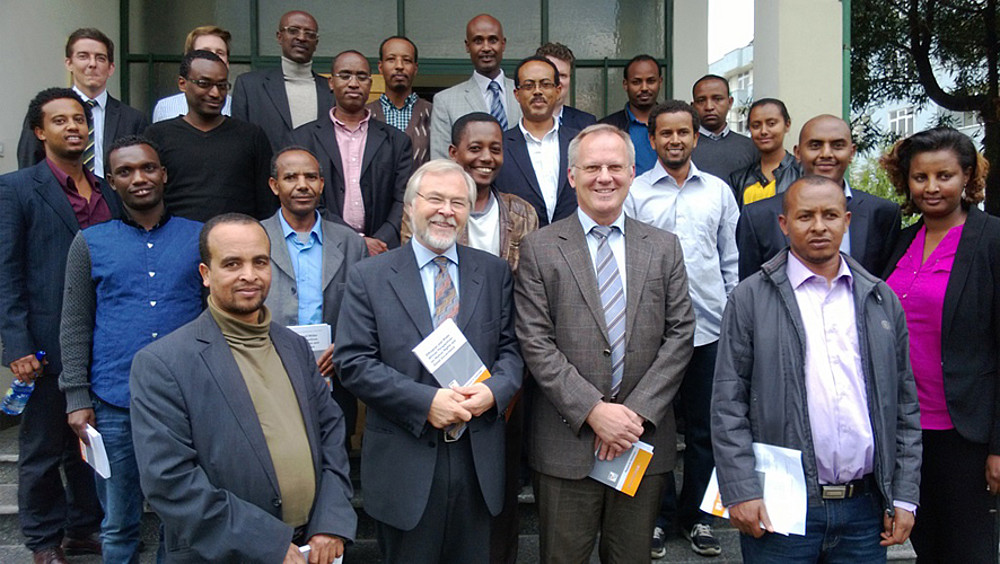
Drei der vier Herausgeber mit Österreichs Botschafter in Äthiopien: Solomon Abay Yimer, Wolfgang Benedek, Botschafter Andreas Melan, Tadesse Kassa Woldetsadik (vordere Reihe, v.l.) mit den AutorInnen sowie TeilnehmerInnen der Buchpräsentation vor dem M

Drei der vier Herausgeber mit Österreichs Botschafter in Äthiopien: Solomon Abay Yimer, Wolfgang Benedek, Botschafter Andreas Melan, Tadesse Kassa Woldetsadik (vordere Reihe, v.l.) mit den AutorInnen sowie TeilnehmerInnen der Buchpräsentation vor dem Menschenrechtszentrum in Addis Abeba. Foto: Pippan.

Lehr- und Forschungsprogramm mit äthiopischen Partneruniversitäten erfolgreich abgeschlossen

Wie können Menschenrechte geschützt, wie ein Staat verantwortungsvoll geführt werden? Und wie kann dies in Äthiopien im Speziellen und in Afrika im Allgemeinen geschehen? Diese Fragen behandelt eine aktuelle Publikation von Univ.-Prof. Dr. Wolfgang Benedek und Dr. Christian Pippan vom Institut für Völkerrecht und internationale Beziehungen der Uni Graz. Das Buch ist das Ergebnis einer dreijährigen Kooperation des Instituts mit der Addis Ababa University (AAU) und der Ethiopian Civil Service University (ECSU). Am 24. September 2014 wurde es in Addis Abeba, der Hauptstadt Äthiopiens, offiziell präsentiert. 


In dem von Benedek und Pippan mitherausgegebenen Sammelband "Ethiopian and Wider African Perspectives on Human Rights and Good Governance" setzen sich sechszehn AutorInnen vornehmlich äthiopischer Herkunft mit Fragen des Menschenrechtsschutzes in ihrer Heimat auseinander. An der Präsentation des Buches am Zentrum für Menschenrechte der Addis Ababa University nahm auch der Botschafter Österreichs in Äthiopien, Dr. Andreas Melan, teil.


Das dem soeben veröffentlichten Band zugrunde liegende Partnerschaftsprojekt "Academic Partnership on Legal and Human Rights Education", kurz APLHRE, wurde aus Mitteln des so genannten APPEAR-Programms der österreichischen Agentur für internationale Mobilität und Kooperation in Bildung, Wissenschaft und Forschung (OeAD) unterstützt. Unter der Leitung des  Instituts für Völkerrecht der Uni Graz hatte es die Förderung und Stärkung der rechtlichen, insbesondere der menschenrechtlichen, Bildungskapazitäten an den beteiligten Partnerinstitutionen zum Ziel und umfasste – neben der Erstellung und Herausgabe der Publikation – wiederholte Lehraufenthalte von MitarbeiterInnen der Rechtswissenschaftlichen Fakultät der Uni Graz in Äthiopien, die Veranstaltung von Sommerakademien und Forschungsworkshops in Addis Abeba, wechselseitige Forschungs- und Lehraufenthalte sowie Hilfestellung seitens der Grazer ProjektteilnehmerInnen beim Aufbau neuer Curricula und Literaturresourcen an den äthiopischen Partneruniversitäten.

Die Menschenrechte begleiten die Grazer WissenschafterInnen auch nach ihrer Rückkehr nach Österreich: Am 2. Oktober stellt Wolfgang Benedek im Bundesministerium für Wissenschaft, Forschung und Wirtschaft die Forschungsplattform "Menschenrechte und Demokratie" vor. Diese hat es sich zum Ziel gemacht, bestehenden Forschungskompetenzen in den Bereichen Menschenrechte, Demokratie und Gender zu vernetzen und neue Kooperationen anzustoßen.


created by Christian Pippan & Gerhild Kastrun

Related news

Chemical Christmas show at the University of Graz: An explosive evening at the Schauspielh

At the beginning of December, the University of Graz transformed the theater into a laboratory: as part of “Chemical Life,” teacher training students staged a chemical Christmas show for Styrian school classes—complete with ethanol rockets, nitrogen snow, and glowing effects. An evening designed to inspire interest in studying chemistry.

Train by train: Koralm railway accelerates exchange between the Universities

Lectures at the University of Klagenfurt in the morning, seminars at the University of Graz in the afternoon: Austria's longest tunnel and a journey time of around 45 minutes make it easy. The Koralm railway increases the speed of networking between the two university locations. The collaboration builds on existing cooperation - for example in the areas of teacher training, Slavic studies and as employers, the universities are well coordinated.

On the trail of the Big Bang: University of Graz receives 1.5 million euros for doctoral programmes

The Austrian Science Fund FWF has selected the Doctoral Programme in Theoretical Particle Physics at the University of Graz for funding from the Doc.funds. Six young scientists will be funded for 3.5 years. They will gain fundamentally new insights into the origins of the world.

From trans women and knee prostheses: sports science prizes awarded

Walking better with a prosthesis, successfully getting rid of excess weight, training more effectively, more fairness for trans people in sport: these were the topics addressed by the students at the University of Graz who were awarded the sports science prizes for their Master's theses on 3 December 2025.

Begin of page section:
Additional information:

University of Graz
Universitaetsplatz 3
8010 Graz
Austria
  • Contact
  • Web Editors
  • Moodle
  • UNIGRAZonline
  • Imprint
  • Data Protection Declaration
  • Accessibility Declaration
Weatherstation
Uni Graz

End of this page section. Go to overview of page sections

End of this page section. Go to overview of page sections

Begin of page section:

End of this page section. Go to overview of page sections