



Begin of page section:
Page sections:

  • Go to contents (Accesskey 1)
  • Go to position marker (Accesskey 2)
  • Go to main navigation (Accesskey 3)
  • Go to sub navigation (Accesskey 4)
  • Go to additional information (Accesskey 5)
  • Go to page settings (user/language) (Accesskey 8)
  • Go to search (Accesskey 9)

End of this page section. Go to overview of page sections

Begin of page section:
Page settings:

English en
Deutsch de
Search
Login

End of this page section. Go to overview of page sections

Begin of page section:
Search:

Search for details about Uni Graz
Close

End of this page section. Go to overview of page sections


Search

Begin of page section:
Main navigation:

Page navigation:

  • University

    University
    • About the University
    • Organisation
    • Faculties
    • Library
    • Working at University of Graz
    • Campus
    Developing solutions for the world of tomorrow - that is our mission. Our students and our researchers take on the great challenges of society and carry the knowledge out.
  • Research Profile

    Research Profile
    • Our Expertise
    • Research Questions
    • Research Portal
    • Promoting Research
    • Research Transfer
    • Ethics in Research
    • Commission for Scientific Integrity
    Scientific excellence and the courage to break new ground. Research at the University of Graz creates the foundations for making the future worth living.
  • Studies

    Studies
    • Prospective Students
    • Students
    • Post-registration Law
  • Community

    Community
    • International
    • Location
    • Research and Business
    • Alumni
    The University of Graz is a hub for international research and brings together scientists and business experts. Moreover, it fosters the exchange and cooperation in study and teaching.
Topics
  • Sustainable University
  • Researchers answer
  • Work for us
Close menu

End of this page section. Go to overview of page sections

Begin of page section:
You are here:

University of Graz News Menschenrechte schützen

End of this page section. Go to overview of page sections

Wednesday, 01 October 2014

Menschenrechte schützen

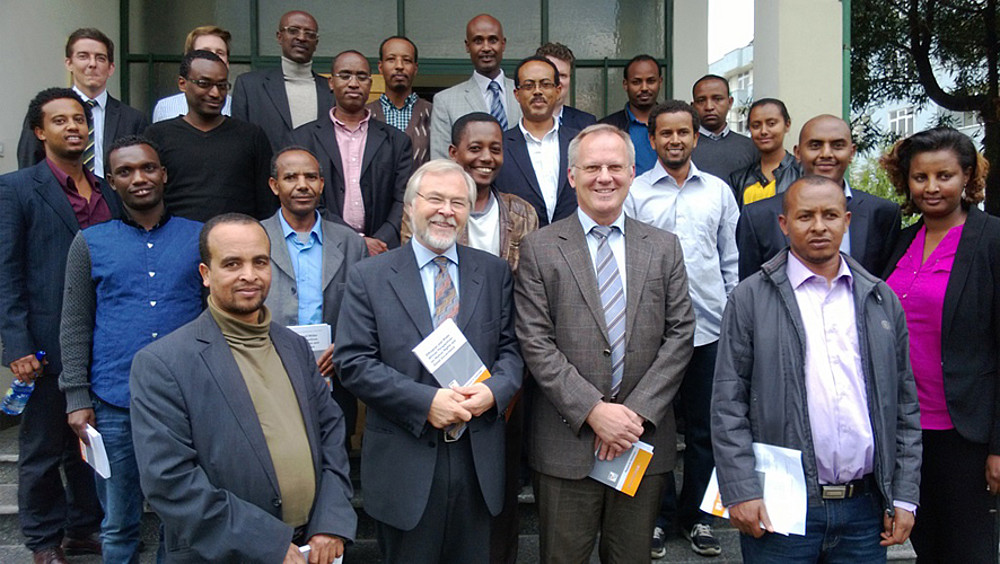
Drei der vier Herausgeber mit Österreichs Botschafter in Äthiopien: Solomon Abay Yimer, Wolfgang Benedek, Botschafter Andreas Melan, Tadesse Kassa Woldetsadik (vordere Reihe, v.l.) mit den AutorInnen sowie TeilnehmerInnen der Buchpräsentation vor dem M

Drei der vier Herausgeber mit Österreichs Botschafter in Äthiopien: Solomon Abay Yimer, Wolfgang Benedek, Botschafter Andreas Melan, Tadesse Kassa Woldetsadik (vordere Reihe, v.l.) mit den AutorInnen sowie TeilnehmerInnen der Buchpräsentation vor dem Menschenrechtszentrum in Addis Abeba. Foto: Pippan.

Lehr- und Forschungsprogramm mit äthiopischen Partneruniversitäten erfolgreich abgeschlossen

Wie können Menschenrechte geschützt, wie ein Staat verantwortungsvoll geführt werden? Und wie kann dies in Äthiopien im Speziellen und in Afrika im Allgemeinen geschehen? Diese Fragen behandelt eine aktuelle Publikation von Univ.-Prof. Dr. Wolfgang Benedek und Dr. Christian Pippan vom Institut für Völkerrecht und internationale Beziehungen der Uni Graz. Das Buch ist das Ergebnis einer dreijährigen Kooperation des Instituts mit der Addis Ababa University (AAU) und der Ethiopian Civil Service University (ECSU). Am 24. September 2014 wurde es in Addis Abeba, der Hauptstadt Äthiopiens, offiziell präsentiert. 


In dem von Benedek und Pippan mitherausgegebenen Sammelband "Ethiopian and Wider African Perspectives on Human Rights and Good Governance" setzen sich sechszehn AutorInnen vornehmlich äthiopischer Herkunft mit Fragen des Menschenrechtsschutzes in ihrer Heimat auseinander. An der Präsentation des Buches am Zentrum für Menschenrechte der Addis Ababa University nahm auch der Botschafter Österreichs in Äthiopien, Dr. Andreas Melan, teil.


Das dem soeben veröffentlichten Band zugrunde liegende Partnerschaftsprojekt "Academic Partnership on Legal and Human Rights Education", kurz APLHRE, wurde aus Mitteln des so genannten APPEAR-Programms der österreichischen Agentur für internationale Mobilität und Kooperation in Bildung, Wissenschaft und Forschung (OeAD) unterstützt. Unter der Leitung des  Instituts für Völkerrecht der Uni Graz hatte es die Förderung und Stärkung der rechtlichen, insbesondere der menschenrechtlichen, Bildungskapazitäten an den beteiligten Partnerinstitutionen zum Ziel und umfasste – neben der Erstellung und Herausgabe der Publikation – wiederholte Lehraufenthalte von MitarbeiterInnen der Rechtswissenschaftlichen Fakultät der Uni Graz in Äthiopien, die Veranstaltung von Sommerakademien und Forschungsworkshops in Addis Abeba, wechselseitige Forschungs- und Lehraufenthalte sowie Hilfestellung seitens der Grazer ProjektteilnehmerInnen beim Aufbau neuer Curricula und Literaturresourcen an den äthiopischen Partneruniversitäten.

Die Menschenrechte begleiten die Grazer WissenschafterInnen auch nach ihrer Rückkehr nach Österreich: Am 2. Oktober stellt Wolfgang Benedek im Bundesministerium für Wissenschaft, Forschung und Wirtschaft die Forschungsplattform "Menschenrechte und Demokratie" vor. Diese hat es sich zum Ziel gemacht, bestehenden Forschungskompetenzen in den Bereichen Menschenrechte, Demokratie und Gender zu vernetzen und neue Kooperationen anzustoßen.


created by Christian Pippan & Gerhild Kastrun

Related news

The future of Styria as a knowledge region is at risk

It is reported that 500 million euros are to be cut from Styrian universities. University vice-chancellors fear that this will sacrifice the development and competitiveness of the region as a centre for science, culture and business in favour of short-term cost-cutting targets.

A good winter for honeybees: mortality rate in Austria below ten per cent

20 May is World Bee Day. Local beekeepers can celebrate it with confidence this year, as their colonies have come through the winter relatively well.

Whistles against division: Rivka Saltiel experienced both unrest and solidarity in the US

Rivka Saltiel, a geographer from the University of Graz, has been working as a visiting professor in Minneapolis for the past five months and has witnessed first-hand the state of emergency and the deadly raids carried out by the immigration agency ICE. She reports on the collective solidarity of the population, the resistance to the President’s attempts to divide the community, and the power of informal social networks that ensure day-to-day provision and safety. These practices of solidarity are also relevant for Europe.

Record of reported species: Styria wins the global City Nature Challenge

Observers in Styria recorded 5,158 different animals, plants and fungi as part of the international City Nature Challenge between 24 and 27 April 2026. This saw the region take first place in the "species" category. Ostrava in the Czech Republic made the most observations, with just under 140,000, whilst the San Francisco Bay Area had the highest number of participants, namely 3,019.

Begin of page section:
Additional information:

University of Graz
Universitaetsplatz 3
8010 Graz
Austria
  • Contact
  • Web Editors
  • Moodle
  • UNIGRAZonline
  • Imprint
  • Data Protection Declaration
  • Accessibility Declaration
Weatherstation
Uni Graz

End of this page section. Go to overview of page sections

End of this page section. Go to overview of page sections

Begin of page section:

End of this page section. Go to overview of page sections