



Begin of page section:
Page sections:

  • Go to contents (Accesskey 1)
  • Go to position marker (Accesskey 2)
  • Go to main navigation (Accesskey 3)
  • Go to sub navigation (Accesskey 4)
  • Go to additional information (Accesskey 5)
  • Go to page settings (user/language) (Accesskey 8)
  • Go to search (Accesskey 9)

End of this page section. Go to overview of page sections

Begin of page section:
Page settings:

English en
Deutsch de
Search
Login

End of this page section. Go to overview of page sections

Begin of page section:
Search:

Search for details about Uni Graz
Close

End of this page section. Go to overview of page sections


Search

Begin of page section:
Main navigation:

Page navigation:

  • University

    University
    • About the University
    • Organisation
    • Faculties
    • Library
    • Working at University of Graz
    • Campus
    Developing solutions for the world of tomorrow - that is our mission. Our students and our researchers take on the great challenges of society and carry the knowledge out.
  • Research Profile

    Research Profile
    • Our Expertise
    • Research Questions
    • Research Portal
    • Promoting Research
    • Research Transfer
    • Ethics in Research
    • Commission for Scientific Integrity
    Scientific excellence and the courage to break new ground. Research at the University of Graz creates the foundations for making the future worth living.
  • Studies

    Studies
    • Prospective Students
    • Students
    • Registration for Study Programme (Winter semester 2026/27)
    • Welcome Weeks for First Year Students
  • Community

    Community
    • International
    • Location
    • Research and Business
    • Alumni
    The University of Graz is a hub for international research and brings together scientists and business experts. Moreover, it fosters the exchange and cooperation in study and teaching.
Topics
  • Sustainable University
  • Researchers answer
  • Work for us
Close menu

End of this page section. Go to overview of page sections

Begin of page section:
You are here:

University of Graz News Mehr als nur Maki

End of this page section. Go to overview of page sections

Friday, 28 March 2014

Mehr als nur Maki

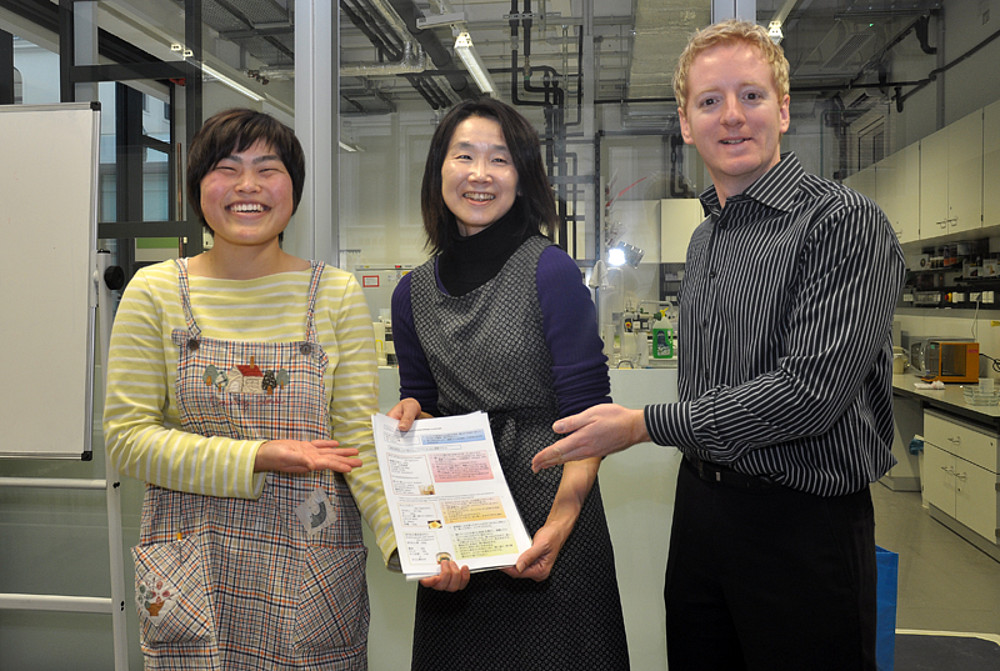
Fritz Treiber vom Offenen Labor (r.) begrüßte Mihoko Tominaga von der Universität Nagasaki (Mitte) gemeinsam mit einer Kursteilnehmerin.

Fritz Treiber vom Offenen Labor (r.) begrüßte Mihoko Tominaga von der Universität Nagasaki (Mitte) gemeinsam mit einer Kursteilnehmerin.

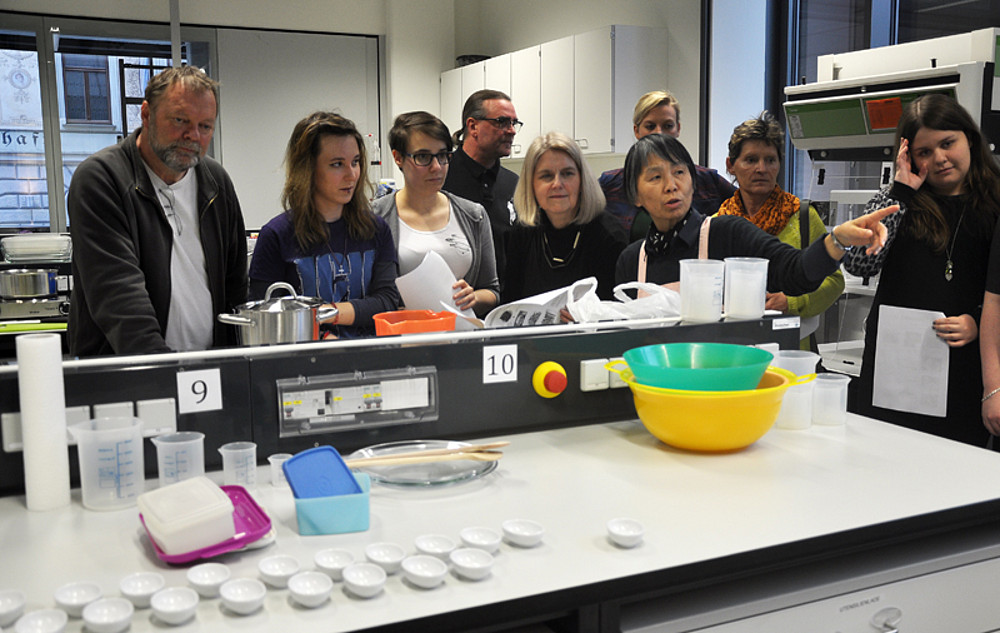
Mariko Fellner (3.v.r.) vom SOWI-Zentrum für Wirtschaftssprachen nahm mit ihren Studierneden am Kurs teil.

Mariko Fellner (3.v.r.) vom SOWI-Zentrum für Wirtschaftssprachen nahm mit ihren Studierneden am Kurs teil.

Umami verleiht der Nudelsuppe einen herzhaften Geschmack. Klicken Sie auf den Pfeil rechts für weitere Bilder!

Umami verleiht der Nudelsuppe einen herzhaften Geschmack. Klicken Sie auf den Pfeil rechts für weitere Bilder!

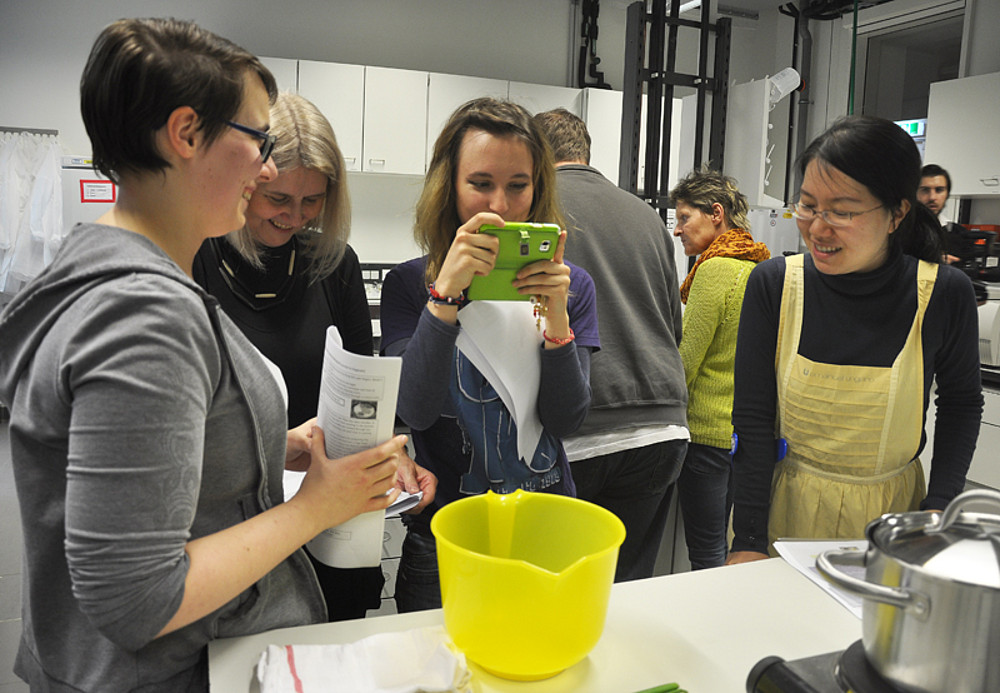
Die TeilnehmerInnen des Kurses kochten unterschiedliche japanische Menüs.

Die TeilnehmerInnen des Kurses kochten unterschiedliche japanische Menüs.

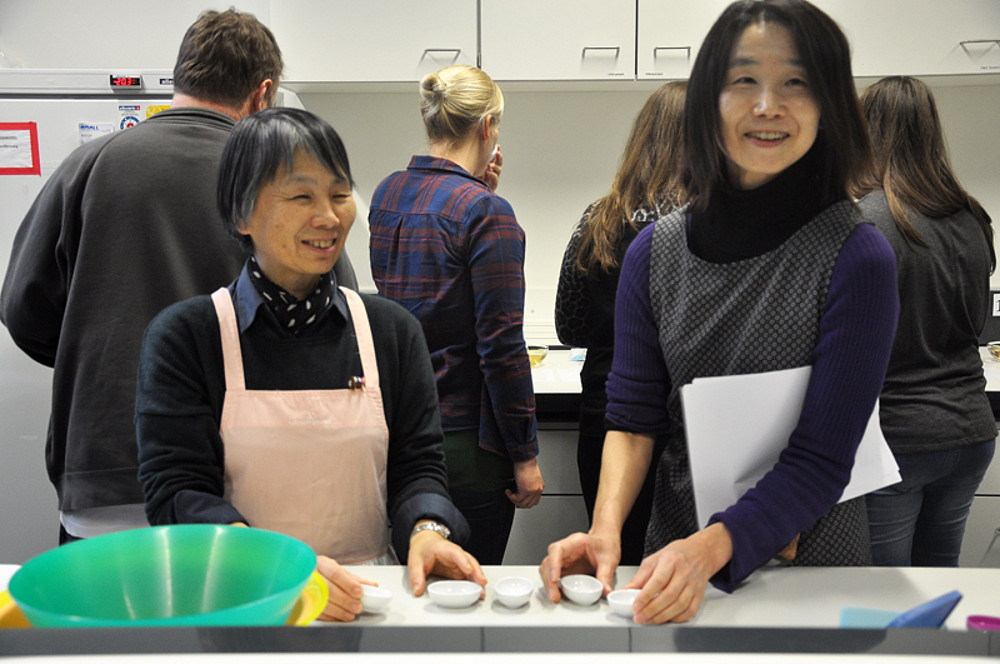
Mariko Fellner (l.) und Mihoko Tominaga: Die erfolgreiche Kooperation zwischen Graz und Nagasaki soll im Offenen Labor fortgesetzt werden.

Mariko Fellner (l.) und Mihoko Tominaga: Die erfolgreiche Kooperation zwischen Graz und Nagasaki soll im Offenen Labor fortgesetzt werden.

Japanisch-Kochkurs jenseits von Sushi und co. im Offenen Labor

Wissenschaft selbst erleben - und zwar mit allen Sinnen! Das ist das Motto des Offenen Labors der Uni Graz. Eine Reise nach Fernost unternahmen dort die 18 TeilnehmerInnen des gestrigen "Umami-Workshops", der im Zuge des Projekts "Wissenschaft mit Geschmack" stattfand. "Umami heißt so viel wie 'herzhaft' oder 'würzig'", erklärte Dr. Fritz Treiber, der den Workshop auf die Beine gestellt hatte, die Bedeutung der Geschmacksrichtung. Seiner Einladung war Prof. Mihoko Tominaga von der Universität Nagasaki gefolgt, die die TeilnehmerInnen in die Geheimnisse japanischer Küche einführte. Die hierzulande bekannten Sushi-Gerichte oder Maki genannten Reisröllchen kamen dabei jedoch nicht vor: "Mir ist es wichtig zu zeigen, dass unsere traditionelle Küche breit aufgestellt ist", erklärte Tominaga.


Der Umami-Geschmack wurde aus getrockneten Thunfischflocken, dem Shiitake Pilz oder aus aus Yakiago (fliegenden Fischen), einer Spezialität aus Nagasaki, auf molekularbiologischer Ebene gewonnen. Die herzhaft-würzige Geschmacksrichtung bildete dann die Grundlage für eine herzhafte Nudelsuppe. Auch die Nachspeise durfte natürlich nicht fehlen - hier kamen die beliebtesten Geliermittel der japanischen Küche zum Einsatz: Godofu (Sojamilchgele), Mizduyokan (Bohnenpastengele) und Kanten (Agar Agar).

Workshop-Organisator Fritz Treiber zeigte sich mit dem Erfolg des Workshops mehr als zufrieden: "Weitere Kooperationen mit dem Institut für Ernährungswissenschaften der Universität Nagasaki sind bereits in Planung", verriet er.

created by Gerhild Kastrun

Related news

Commissioned by NATO: University of Graz tests high-tech textiles

As part of an international project, antimicrobial and fire-resistant fabrics with UV protection are being developed in Zagreb. Pharmacists from the University of Graz are ensuring that these fabrics are skin-friendly.

The Arctic up close: ORF special feature on the University of Graz’s research station in S

Students from the University of Graz are spending two weeks conducting research at the Univerisity of Graz research station at the Sermilik Fjord in Greenland, which has been operational for three years. They are measuring glacial runoff, tracking ice melt in real time and installing weather stations. ORF is following the expedition and will be reporting on the special feature ‘Arctic Adventure’ across its various channels from 20 July.

Medicine for ants: Caffeine prolongs the life of infected insects

Black coffee stimulates us and acts against bacteria. So, can caffeine also be good for insects? Yes, confirm biologists of the University of Graz. When ants suffer from a fungal disease, they consume more caffeine and remain active for longer.

How formulas are making medicine more personalised

When Federica Caforio talks about the heart, it doesn’t sound like an operating theatre, but rather like equations, parameters and simulations. Yet this is precisely where the medical promise of her research lies: one day, clinical data will be used to create a digital twin of the heart – a virtual model that will enable a better understanding of diseases and allow for more personalised treatment plans. She will be presenting her research at the ‘ECMTB 2026’ mathematics conference.

Begin of page section:
Additional information:

University of Graz
Universitaetsplatz 3
8010 Graz
Austria
  • Contact
  • Web Editors
  • Moodle
  • UNIGRAZonline
  • Imprint
  • Data Protection Declaration
  • Accessibility Declaration
Weatherstation
Uni Graz

End of this page section. Go to overview of page sections

End of this page section. Go to overview of page sections

Begin of page section:

End of this page section. Go to overview of page sections

