Begin of page section:
Page sections:

  • Go to contents (Accesskey 1)
  • Go to position marker (Accesskey 2)
  • Go to main navigation (Accesskey 3)
  • Go to sub navigation (Accesskey 4)
  • Go to additional information (Accesskey 5)
  • Go to page settings (user/language) (Accesskey 8)
  • Go to search (Accesskey 9)

End of this page section. Go to overview of page sections

Begin of page section:
Page settings:

English en
Deutsch de
Search
Login

End of this page section. Go to overview of page sections

Begin of page section:
Search:

Search for details about Uni Graz
Close

End of this page section. Go to overview of page sections


Search

Begin of page section:
Main navigation:

Page navigation:

  • University

    University
    • About the University
    • Organisation
    • Faculties
    • Library
    • Working at University of Graz
    • Campus
    Developing solutions for the world of tomorrow - that is our mission. Our students and our researchers take on the great challenges of society and carry the knowledge out.
  • Research Profile

    Research Profile
    • Our Expertise
    • Research Questions
    • Research Portal
    • Promoting Research
    • Research Transfer
    • Ethics in Research
    • Commission for Scientific Integrity
    Scientific excellence and the courage to break new ground. Research at the University of Graz creates the foundations for making the future worth living.
  • Studies

    Studies
    • Prospective Students
    • Students
  • Community

    Community
    • International
    • Location
    • Research and Business
    • Alumni
    The University of Graz is a hub for international research and brings together scientists and business experts. Moreover, it fosters the exchange and cooperation in study and teaching.
  • Spotlight
Topics
  • Sustainable University
  • Researchers answer
  • Work for us
Close menu

End of this page section. Go to overview of page sections

Begin of page section:
You are here:

University of Graz News März 1933

End of this page section. Go to overview of page sections

Wednesday, 22 March 2023

März 1933

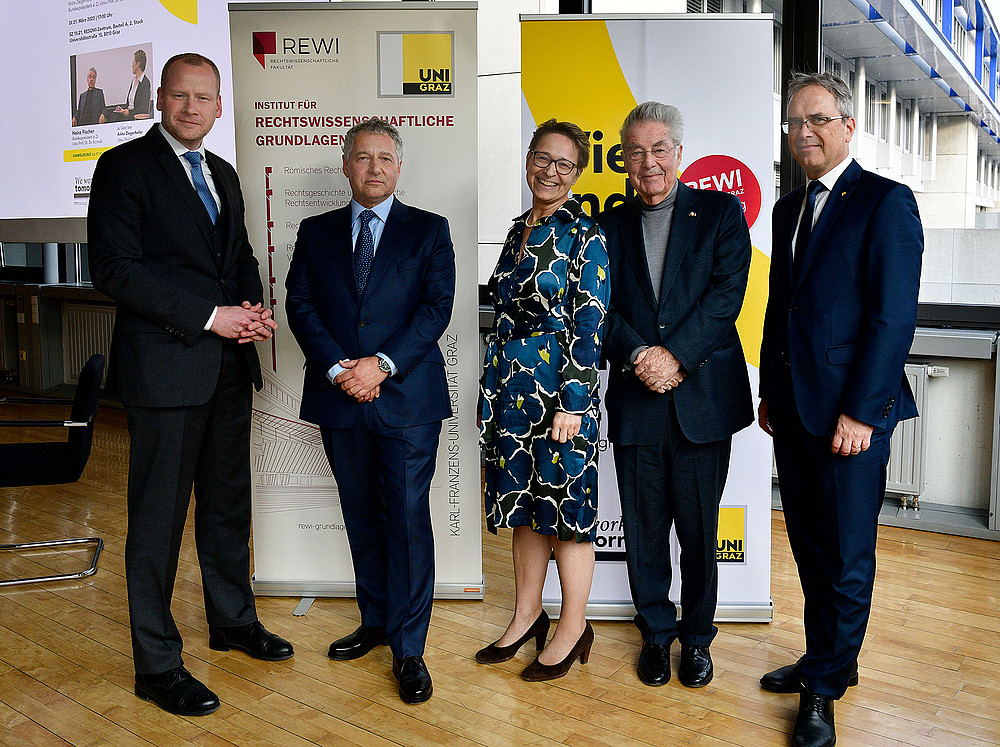
Dekan Christoph Bezemek, Markus Steppan, Leiter des Instituts für Rechtswissenschaftliche Grundlagen, Rechtshistorikerin Anita Ziegerhofer, Bundespräsident a.D. Heinz Fischer, Rektor Peter Riedler (v.l.) vor zwei Roll-ups der Rechtswissenschaftlichen Fakultät der Uni Graz

V.l.: Dekan Christoph Bezemek, Markus Steppan, Leiter des Instituts für Rechtswissenschaftliche Grundlagen, Rechtshistorikerin Anita Ziegerhofer, Bundespräsident a.D. Heinz Fischer und Rektor Peter Riedler. Foto: Uni Graz / Pichler

Heinz Fischer war Gast im Rechtshistorischen Dialog über das Ende des Parlamentarismus in Österreich

Im März 1933 schaltete Bundeskanzler Engelbert Dollfuß den Nationalrat und den Verfassungsgerichtshof aus und regierte per Notverordnung diktatorisch, bis er im Juli 1934 von den österreichischen Nationalsozialisten ermordet wurde. Über dieses Ereignis und seine Folgen sowie über die Situation und Bedeutung des Parlamentarismus heute diskutierte Rechtshistorikerin Anita Ziegerhofer am 21. März 2023 mit Bundespräsident a.D. Heinz Fischer an der Uni Graz.

Kaum jemand kennt die österreichische Republik und Politik so gut wie Heinz Fischer. Der gebürtige Grazer bekleidete als Bundespräsident nicht nur das höchste Amt im Staat (2004–2016). Nach dem Studium der Rechtswissenschaften an der Uni Wien, wurde er 1962 Sekretär der sozialdemokratischen Parlamentsfraktion und 1971 in den Nationalrat gewählt. Später war er unter anderem Wissenschaftsminister (1983–1987) und Nationalratspräsident.

In der Reihe „Rechtshistorischer Dialog“ im Veranstaltungsformat „REWI im Gespräch“ beleuchtet Anita Ziegerhofer seit 2017 mit renommierten Persönlichkeiten bedeutende geschichtliche Ereignisse in ihrer rechtlichen Dimension im Zusammenhang mit aktuellen politischen und gesellschaftlichen Entwicklungen.


created by Gudrun Pichler

Related news

Dual role: Researchers show that platelets can worsen disease

Platelets are best known as rapid responders in the event of injury. They stop bleeding and are indispensable for wound healing. “However, thrombocytes can also aggravate diseases, especially when inflammatory processes are involved,” explains Marion Mußbacher, a pharmacist at the University of Graz. She investigated the “dual role” of platelets in relation to fatty liver disease, a condition closely linked to obesity and type 2 diabetes.

Forscher:innen entdecken natürlichen Wirkstoff zum Schutz vor Lebererkrankungen

Die Leber leidet still. „Fetteinlagerungen, strukturelle Zerstörung des Gewebes oder mutierende Tumorzellen – all das fliegt eine Weile unter dem Radar. Begleitet werden diese Veränderungen oft von leichten, jedoch chronischen Entzündungen“, erklärt Andreas Koeberle, Pharmazeut an der Universität Graz. Er hat mit seinem Team und Kolleg:innen der Universität Innsbruck den Wirkstoff Mitrephoron B untersucht, der neue Behandlungsansätze ermöglicht. Die Ergebnisse der Studie wurden kürzlich in der Open-Access-Fachzeitschrift „Theranostics“ veröffentlicht.

Climate at the cliffs: Researchers unravel the evolution of the Greenland ice margin

Vertical ice walls, up to 40 metres high: in "Game of Thrones" they were dramatised as fortifications; during the Cold War, they were studied with great interest. How these imposing walls along Greenland’s 80,000-kilometre-long ice margin formed, how they are evolving, and what impact they have on the climate is not yet fully understood. Researchers from the Universities of Graz and Innsbruck have come one step closer to solving the mystery. The results of their latest study have been published in the journal The Cryosphere.

Achieving climate goals: Researchers highlight need for fair country shares in CO2

As the war in the Middle East is currently reminding us once again, many countries around the world are heavily reliant on oil and gas. Lax climate policy and limited options for removing CO₂ from the atmosphere could cement this dependence for future generations. Scientists at the University of Graz highlight this danger in a new study published in the journal Global Environmental Change. They find that rights to carbon dioxide removal should be distributed across countries just as fairly as emission budgets in order to halt global warming.

Begin of page section:
Additional information:

University of Graz
Universitaetsplatz 3
8010 Graz
Austria
  • Contact
  • Web Editors
  • Moodle
  • UNIGRAZonline
  • Imprint
  • Data Protection Declaration
  • Accessibility Declaration
Weatherstation
Uni Graz

End of this page section. Go to overview of page sections

End of this page section. Go to overview of page sections

Begin of page section:

End of this page section. Go to overview of page sections