Begin of page section:
Page sections:

  • Go to contents (Accesskey 1)
  • Go to position marker (Accesskey 2)
  • Go to main navigation (Accesskey 3)
  • Go to sub navigation (Accesskey 4)
  • Go to additional information (Accesskey 5)
  • Go to page settings (user/language) (Accesskey 8)
  • Go to search (Accesskey 9)

End of this page section. Go to overview of page sections

Begin of page section:
Page settings:

English en
Deutsch de
Search
Login

End of this page section. Go to overview of page sections

Begin of page section:
Search:

Search for details about Uni Graz
Close

End of this page section. Go to overview of page sections


Search

Begin of page section:
Main navigation:

Page navigation:

  • University

    University
    • About the University
    • Organisation
    • Faculties
    • Library
    • Working at University of Graz
    • Campus
    Developing solutions for the world of tomorrow - that is our mission. Our students and our researchers take on the great challenges of society and carry the knowledge out.
  • Research Profile

    Research Profile
    • Our Expertise
    • Research Questions
    • Research Portal
    • Promoting Research
    • Research Transfer
    • Ethics in Research
    • Commission for Scientific Integrity
    Scientific excellence and the courage to break new ground. Research at the University of Graz creates the foundations for making the future worth living.
  • Studies

    Studies
    • Prospective Students
    • Students
    • Registration for Study Programme (Winter semester 2026/27)
  • Community

    Community
    • International
    • Location
    • Research and Business
    • Alumni
    The University of Graz is a hub for international research and brings together scientists and business experts. Moreover, it fosters the exchange and cooperation in study and teaching.
Topics
  • Sustainable University
  • Researchers answer
  • Work for us
Close menu

End of this page section. Go to overview of page sections

Begin of page section:
You are here:

University of Graz News Forscher:innen entdecken natürlichen Wirkstoff zum Schutz vor Lebererkrankungen

End of this page section. Go to overview of page sections

Monday, 30 March 2026

Forscher:innen entdecken natürlichen Wirkstoff zum Schutz vor Lebererkrankungen

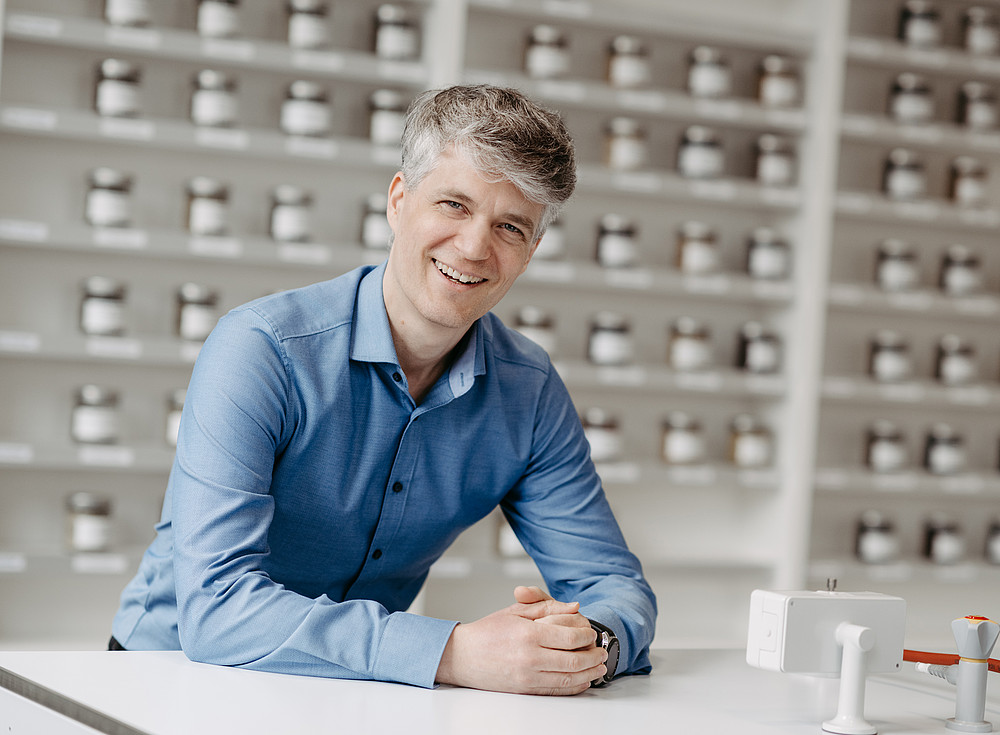
Ein Mann sitzt in einem Labor ©MICHAELA BEGSTEIGER
©MICHAELA BEGSTEIGER

Andreas Koeberle hat mit seinem Team und Kolleg:innen der Uni Innsbruck den natürlichen Wirkstoff Mitrephoron B untersucht, der neue Behandlungsansätze für Lebererkrankungen ermöglicht. Foto: Uni Graz/Begsteiger.

Die Leber leidet still. „Fetteinlagerungen, strukturelle Zerstörung des Gewebes oder mutierende Tumorzellen – all das fliegt eine Weile unter dem Radar. Begleitet werden diese Veränderungen oft von leichten, jedoch chronischen Entzündungen“, erklärt Andreas Koeberle, Pharmazeut an der Universität Graz. Er hat mit seinem Team und Kolleg:innen der Universität Innsbruck den Wirkstoff Mitrephoron B untersucht, der neue Behandlungsansätze ermöglicht. Die Ergebnisse der Studie wurden kürzlich in der Open-Access-Fachzeitschrift „Theranostics“ veröffentlicht.

Mitrephoron B wird aus dem auf Borneo beheimateten Busch Mitrephora glabra gewonnen und hat mehrere positive Wirkungen auf die Leber, schildert Koeberle. „Zum einen greift der Wirkstoff in die Arbeit der Lipidtropfen ein. Das sind Organellen, die Energie für magere Zeiten speichern. Mitrephoron B verändert die Zusammensetzung der Fettsäuren in den Lipidtropfen und macht die Zellhaut dadurch widerstandsfähiger gegen oxidativen Stress.“ Zum anderen verlangsamt der Wirkstoff die Produktion von mehreren Botenstoffen, die Entzündungen fördern. „Gleichzeitig hilft Mitrephoron B dem Körper, selbst Substanzen zu bilden, die Inflammationen hemmen und so Zellen vor dem Tod schützen“, resümiert der Forscher. 

Auch in den Fettstoffwechsel greift der Wirkstoff ein: Er senkt die Spiegel von gespeichertem Cholesterol in Immunzellen. „Das Überangebot an Lipiden ist einer der Faktoren, die häufig eine niedrig-gradige Dauerentzündung auslösen, die wiederum zu Leberzirrhose, Fettleber oder Krebs führen kann“, beschreibt der Forscher. Wird der Cholesterol-Spiegel in Immunzellen gesenkt, kann das dazu beitragen, dass Krankheiten langsamer voranschreiten. 

Mitrephoron B ist also ein vielversprechender Kandidat für die Entwicklung neuer Medikamente. „Weitere Untersuchungen sind allerdings notwendig, um die Wirksamkeit und Sicherheit des Wirkstoffs zu bestätigen“, betont Koeberle. 


Publikationsdaten: Waltl, L., Wein, L.A., Bereuter, L., Su, F., Barta, H., Le Xuan, L., Holubek, D., Mahmoudi, Z., Puskac, K., Siller, A., Schlenke, P., Schennach, H., Pferschy-Wenzig, E.M., Schött, H., Racedo, S., Koeberle, S.C., Magauer, T., Koeberle, A. (2026) Context-dependent activities of mitrephorone link lipid redirection, anti-inflammatory action, and ferroptosis control to hepatocyte protection (2026). Theranostics. https://doi.org/10.7150/thno.127100. 

created by Gerhild Leljak

Related news

Baby health: University of Graz is seeking study participants to investigate early risk factors

Why does the body composition of babies vary so much? Some children gain a significant amount of fat mass within a few weeks, whilst others show hardly any change over the same period. “At the same time, initial observations suggest that fat distribution in all babies may follow a similar pattern, regardless of their total body fat,” explains Marco Höfler from the Institute of Movement Sciences, Sport and Health at the University of Graz. He is coordinating the research project ‘Small Bodies – Big Questions’, for which participants are currently still being sought: pregnant women and babies up to four weeks old.

In hot water: New Report reveals record losses in glaciers, permafrost and snow cover

Climate change is driving up temperatures not only in summer. Winters are also getting warmer – with dramatic consequences for glaciers, permafrost, snow cover and the freezing of lakes. The recently published cryosphere report provides specific figures for Austria. “Our monitoring shows a clear trend with record losses of ice and snow,” says project leader Wolfgang Schöner from the University of Graz.

Theologian at the University of Graz: What the excommunication of the Society of St Pius X

Following the schism involving the Society of St Pius X, there is a need for discussion. Bernd Hillebrand from the University of Graz explains why the Vatican took this step, what role anti-democratic tendencies play, and why the Society’s sacraments are no longer recognised as valid under canon law for Catholics with immediate effect.

“HeinrichBiCool”: University of Graz demonstrates the effects of green facades and roofs

The University of Graz has launched a pioneering project at the University Centre for Theology. Its name, “HeinrichBiCool”, says it all: a comprehensive system of green facades and roof will cool the building at Heinrichstraße 80 during the summer. At the same time, this will create a new habitat for plants and animals, helping to increase biodiversity. The accompanying monitoring programme will provide detailed data on the impact of the measures on indoor climate, energy consumption and biodiversity. The findings will lay a scientifically sound foundation for further projects aimed at making cities sustainable, climate-resilient and liveable. The partners in this project, funded by the Austrian Research Promotion Agency (FFG), are AEE INTEC – Institute for Sustainable Technologies, Technisches Büro Siegfried Stark, the landscape architecture and urban planning firm “studio boden”, and Ökoteam Graz.

Begin of page section:
Additional information:

University of Graz
Universitaetsplatz 3
8010 Graz
Austria
  • Contact
  • Web Editors
  • Moodle
  • UNIGRAZonline
  • Imprint
  • Data Protection Declaration
  • Accessibility Declaration
Weatherstation
Uni Graz

End of this page section. Go to overview of page sections

End of this page section. Go to overview of page sections

Begin of page section:

End of this page section. Go to overview of page sections