For over a decade, historian Tanja Skambraks has been researching poverty and poverty reduction in the Middle Ages. “Research suggests that 50 to 70 per cent of all people at that time were affected by economic poverty. Wars, epidemics and famines following crop failures repeatedly led to supply shortages,” says the professor at the University of Graz. The scholar is particularly interested in people's personal perspectives. Medieval sources provide a wealth of information that opens up this perspective.
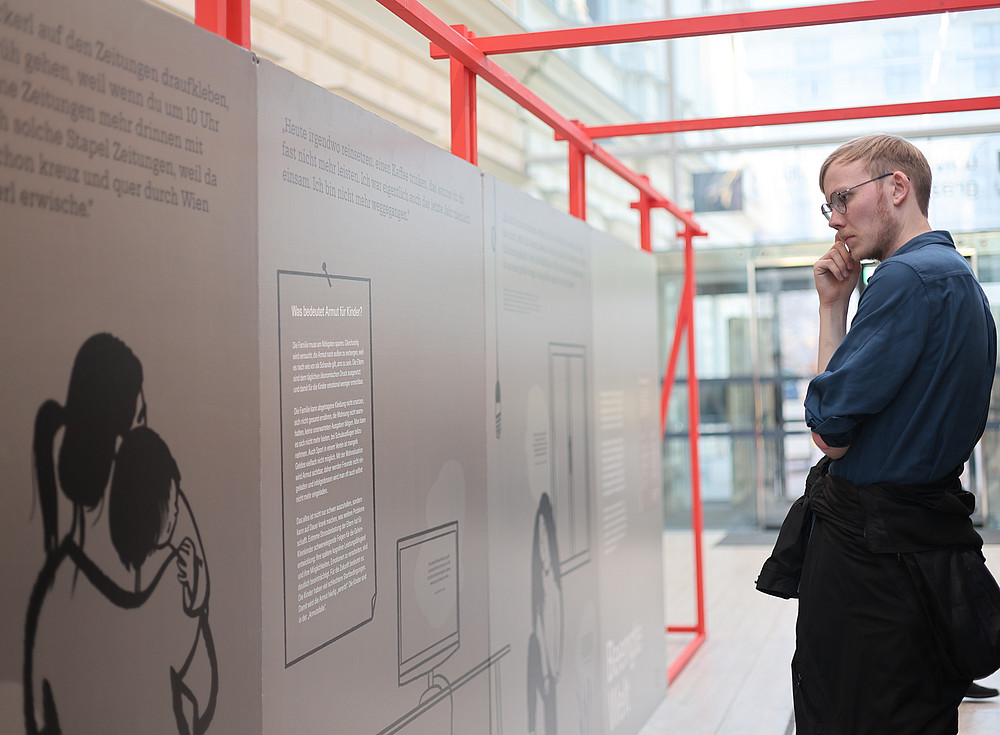
As part of a seminar led by Skambraks, history students have now created audio stations based on various historical texts, giving a voice to those affected in the Middle Ages. At the same time, they convey interesting facts about the everyday life of the poor, how beggars were treated, the experiences of sex workers, social advancement and decline, as well as poverty reduction and voluntary poverty as a Christian ideal.
These listening stations are part of the exhibition “(Leben und) Überleben in Armut in Mittelalter und Gegenwart”, a collaborative project between the University of Graz, Caritas Styria, Akademie Graz, and La Strada.
The exhibition can be seen until the end of March in the foyer of the University Library Graz. Guided tours are also offered for school classes, and on 24 March, the organisers are hosting a panel discussion on the topic of experiencing poverty and knowledge of poverty with perspectives from the past and present.
Ein gutes Leben für alle: (Leben und) Überleben in Armut in Mittelalter und Gegenwart
Exhibition duration: until 31 March 2026
Opening hours: Monday to Friday 8 a.m. to 10 p.m., Saturday 9 a.m. to 10 p.m.
Guided tours for school classes: 12 and 17 March 2026; for further information and registration, please contact tanja.skambraks(at)uni-graz.at
Panel discussion: ‘Armutserfahrung und Armutswissen. Perspektiven aus Vergangenheit und Gegenwart’: 24 March 2026, 6.30 p.m., reading room of the University Library of Graz
The Master's programme Historical Science opens doors to interesting fields of work in the communication of historical knowledge.