Begin of page section:
Page sections:

  • Go to contents (Accesskey 1)
  • Go to position marker (Accesskey 2)
  • Go to main navigation (Accesskey 3)
  • Go to sub navigation (Accesskey 4)
  • Go to additional information (Accesskey 5)
  • Go to page settings (user/language) (Accesskey 8)
  • Go to search (Accesskey 9)

End of this page section. Go to overview of page sections

Begin of page section:
Page settings:

English en
Deutsch de
Search
Login

End of this page section. Go to overview of page sections

Begin of page section:
Search:

Search for details about Uni Graz
Close

End of this page section. Go to overview of page sections


Search

Begin of page section:
Main navigation:

Page navigation:

  • University

    University
    • About the University
    • Organisation
    • Faculties
    • Library
    • Working at University of Graz
    • Campus
    Developing solutions for the world of tomorrow - that is our mission. Our students and our researchers take on the great challenges of society and carry the knowledge out.
  • Research Profile

    Research Profile
    • Our Expertise
    • Research Questions
    • Research Portal
    • Promoting Research
    • Research Transfer
    • Ethics in Research
    Scientific excellence and the courage to break new ground. Research at the University of Graz creates the foundations for making the future worth living.
  • Studies

    Studies
    • Prospective Students
    • Students
  • Community

    Community
    • International
    • Location
    • Research and Business
    • Alumni
    The University of Graz is a hub for international research and brings together scientists and business experts. Moreover, it fosters the exchange and cooperation in study and teaching.
  • Spotlight
Topics
  • Sustainable University
  • Researchers answer
  • Work for us
Close menu

End of this page section. Go to overview of page sections

Begin of page section:
You are here:

University of Graz News Kuhle Zeit

End of this page section. Go to overview of page sections

Tuesday, 09 August 2022

Kuhle Zeit

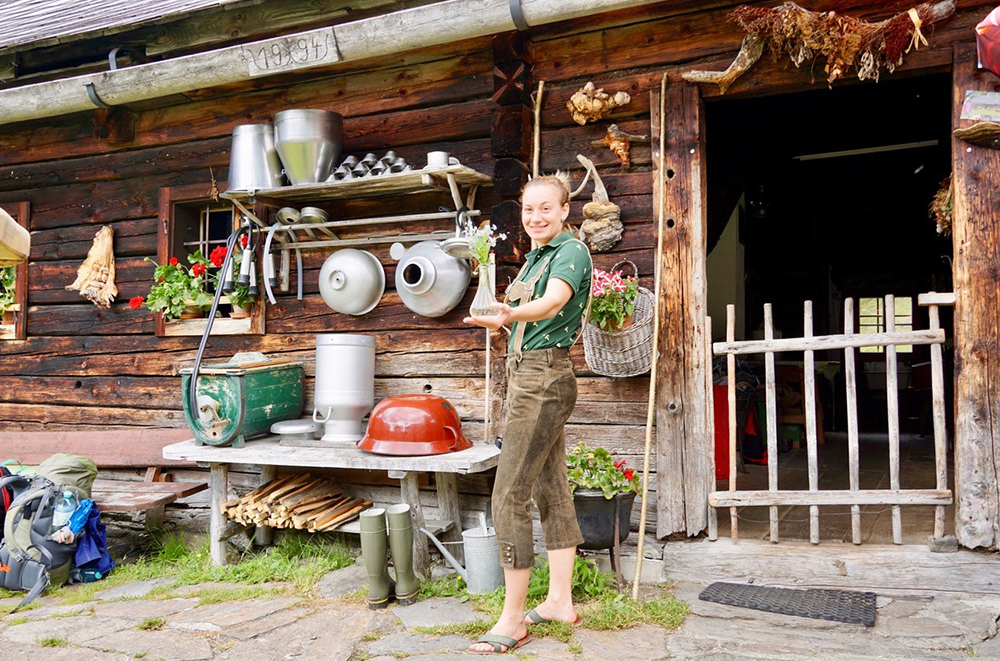
Valerie Taus hat für ihre Dissertation selbst drei Monate lang auf einer obersteirischen Alm verbracht. Foto: Markus Brunner

Valerie Taus hat für ihre Dissertation selbst drei Monate lang auf einer obersteirischen Alm verbracht. Foto: Markus Brunner

Plötzlich Sennerin: Kulturanthropologin untersucht, warum Aussteigen auf der Alm so beliebt ist

Saftig grüne Almen, umgeben von Berggipfeln und Kühen, entschleunigt ohne Handyempfang, einen Sommer lang. Junge Frauen begeistern sich immer öfter für die Tätigkeit als Sennerin. Deren Motive, die Beziehung zum Tier und das veränderte Bild dieser bäuerlichen Arbeit untersucht Valerie Taus in ihrer Dissertation an der Universität Graz.

Von der Idylle der Sommerfrische müssen sich Interessierte schnell verabschieden. Die Kulturwissenschafterin weiß, wovon sie spricht. Sie hat selbst von Juni bis September auf einer Alm im Ennstal verbracht. Mit drei Milchkühen, einem Stier, Schweinen und Kaninchen. Zusätzlich zur Vieh- und Milchwirtschaft hatte sie Gäste der Hütte bewirtet. Knochenarbeit, 14 Stunden-Tage. Erfahrungen, die in ihre Doktorarbeit am Institut für Kulturanthropologie und Europäische Ethnologie einfließen. Dazu kommen weitere Interviews mit „Sennerinnen auf Zeit“. Denn für junge Städterinnen liegt diese Form des Aussteigens stark im Trend. „Es herrscht mehr Nachfrage als Angebot“, bestätigt Valerie Taus. Warum das so ist, das will sie beantworten. Gründe dafür gibt es viele. „Für die einen spielt das Abenteuer eine Rolle, für andere ist eine Auszeit vom Alltag. Manche wollen zurück zu den Wurzeln, weg von Kopf- hin zur körperlichen Beschäftigung, suchen das Erlebnis in und mit der Natur“, zählt Taus nur ein paar Motive auf.

Während in der Steiermark die meist unbezahlte Alm-Arbeit vorrangig von Frauen erledigt wird, ist es in den westlichen Bundesländern eine Männerdomäne. Einen weiteren Fokus legt die Jungforscherin auf das Verhältnis zwischen Tier und Mensch, auch die prägt das dreimonatige Dasein abseits vom gewohnten Trubel. Sie erinnert sich: „Zu Beginn hatte ich großen Respekt vor den Kühen, mit der Zeit ist eine Art Beziehung entstanden. Die Kühe reagieren auf Namen und fordern sehr vehement ein, wenn sie gemolken werden wollen.“

created by Andreas Schweiger

Related news

Cosmetics in the environment: University of Graz proves danger to ants

Titanium dioxide, which is found in cosmetics, for example, is increasingly entering the environment in the form of nanoparticles. This could also put insects at risk. If ants ingest the substance in combination with the pesticide glyphosate, it disturbs the development of their offspring. Scientists at the University of Graz are drawing attention to the negative consequences of this toxic cocktail.

How are tech companies changing democracy? Uni Graz designs exhibition for schools

Filtered information, conspiracy theories, fake news – certain groups and corporations are using social media and algorithms to try to influence public opinion in their favour. Their goal: to weaken fundamental rights and diversity of opinion and seize power. In a new exhibition, researchers at the University of Graz are working with pupils to explore the impact of social media and AI on democracy. In accompanying workshops, the scientists want to encourage young people to develop their own ideas for a socially and ecologically viable future and to actively help shape it. The exhibition, designed as a travelling exhibition for schools, will open on 9 March 2026 at the Dreihackengasse Gymnasium in Graz.

Step by step: What motivates Mireille van Poppel as a scientist and vice-rector

Improving people's health and eliminating inequalities: Mireille van Poppel pursues these goals both as a public health researcher and as vice-rector for Internationalisation and Equality. In both roles, she pays particular attention to individual needs.

Master's degree in psychotherapy in Graz: registration opens in March

Graz is becoming a hotspot for psychotherapy: from 2026, the University of Graz and the Medical University of Graz will jointly offer the new master's programme. Registration for the admission procedure for the 140 study places will start in March.

Begin of page section:
Additional information:

University of Graz
Universitaetsplatz 3
8010 Graz
Austria
  • Contact
  • Web Editors
  • Moodle
  • UNIGRAZonline
  • Imprint
  • Data Protection Declaration
  • Accessibility Declaration
Weatherstation
Uni Graz

End of this page section. Go to overview of page sections

End of this page section. Go to overview of page sections

Begin of page section:

End of this page section. Go to overview of page sections