Begin of page section:
Page sections:

  • Go to contents (Accesskey 1)
  • Go to position marker (Accesskey 2)
  • Go to main navigation (Accesskey 3)
  • Go to sub navigation (Accesskey 4)
  • Go to additional information (Accesskey 5)
  • Go to page settings (user/language) (Accesskey 8)
  • Go to search (Accesskey 9)

End of this page section. Go to overview of page sections

Begin of page section:
Page settings:

English en
Deutsch de
Search
Login

End of this page section. Go to overview of page sections

Begin of page section:
Search:

Search for details about Uni Graz
Close

End of this page section. Go to overview of page sections


Search

Begin of page section:
Main navigation:

Page navigation:

  • University

    University
    • About the University
    • Organisation
    • Faculties
    • Library
    • Working at University of Graz
    • Campus
    Developing solutions for the world of tomorrow - that is our mission. Our students and our researchers take on the great challenges of society and carry the knowledge out.
  • Research Profile

    Research Profile
    • Our Expertise
    • Research Questions
    • Research Portal
    • Promoting Research
    • Research Transfer
    • Ethics in Research
    Scientific excellence and the courage to break new ground. Research at the University of Graz creates the foundations for making the future worth living.
  • Studies

    Studies
    • Prospective Students
    • Students
  • Community

    Community
    • International
    • Location
    • Research and Business
    • Alumni
    The University of Graz is a hub for international research and brings together scientists and business experts. Moreover, it fosters the exchange and cooperation in study and teaching.
  • Spotlight
Topics
  • Sustainable University
  • Researchers answer
  • Work for us
Close menu

End of this page section. Go to overview of page sections

Begin of page section:
You are here:

University of Graz News Kümmernde Kinder

End of this page section. Go to overview of page sections

Monday, 22 November 2021

Kümmernde Kinder

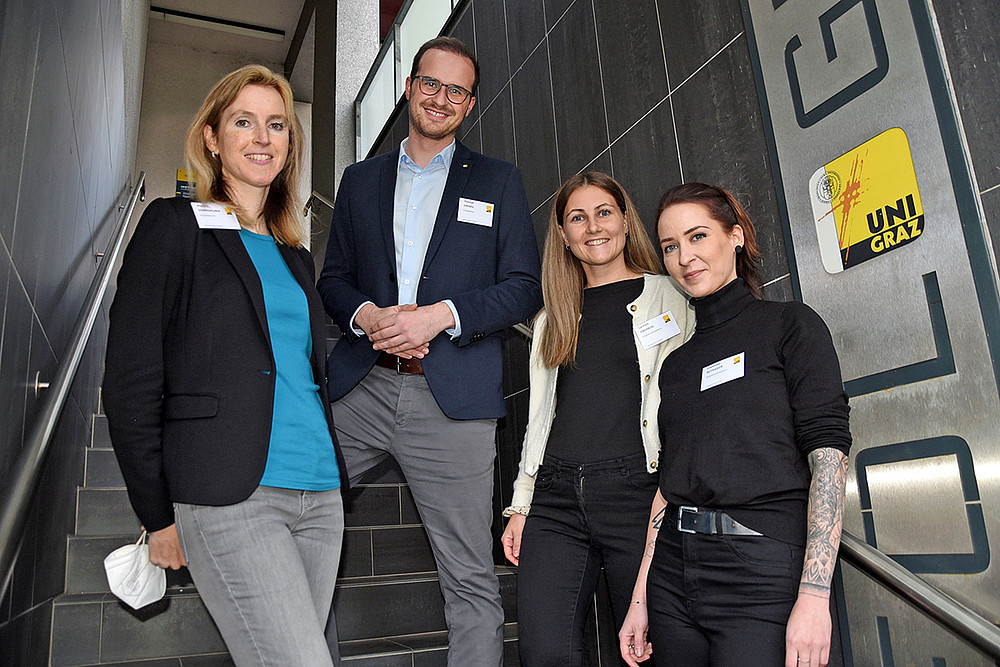
Martina Schmidhuber, Thomas Gremsl, Carmen Oberreßl und Franziska Reitegger erheben Bedürfnisse pflegender Minderjähriger, um bessere Unterstützung zu ermöglichen. Foto: Uni Graz/Pichler

Martina Schmidhuber, Thomas Gremsl, Carmen Oberreßl und Franziska Reitegger erheben Bedürfnisse pflegender Minderjähriger, um bessere Unterstützung zu ermöglichen. Foto: Uni Graz/Pichler

"Young carers", Minderjährige, die ihre Angehörigen pflegen, werden meist übersehen. EthikerInnen der Universität Graz zeigen auf, was sie brauchen.

Rund 43.000 Kinder pflegen in Österreich einen Elternteil. Sie werden allerdings selten wahrgenommen, geschweige denn, unterstützt, und müssen ihr Leben lang mit den Folgen umgehen. Ihre Bedürfnisse hat das Projektteam um die Medizinethikerin Martina Schmidhuber erhoben und wichtige Forderungen an Politik, Pädagogik und Therapie zusammengefasst.

"Das größte Problem ist, überhaupt Young Carers zu erreichen, weil sie sich entweder ihrer Ausnahemsituation nicht bewusst sind oder aus Scham nicht darüber sprechen wollen", berichtet Schmidhuber. Hilfe in vielerlei Hinsicht hätten sie aber bitter nötig, wie ihr Team in Interviews mit aktuellen und ehemaligen Betroffenen herausgefunden hat. "Sie haben oft keine Hobbys, keine Freunde, und viele entwickeln psychische Probleme", fasst die Wissenschafterin zusammen. Abgesehen davon bräuchten sie auch fachliche Unterstützung in der Pflege. Relevante Informationen suchen sie sich lückenhaft aus dem Internet zusammen.

"Eine Online-Plattform mit gesicherten gesundheitlichen Informationen, die Möglichkeit des Austauschs mit anderen Young Carers und professionellen HelferInnen sowie eine kostenlose psychische Betreuung und Beratung wären drei ganz wichtige Maßnahmen, die möglichst schnell zur Verfügung gestellt werden sollten", richtet sich Schmidhuber an die Politik.

Das Projekt "Young Carers in Graz - Digitale Transformation als Fluch oder Segen?" wird von Martina Schmidhuber und dem Sozialethiker Thomas Gremsl geleitet und von der Stadt Graz gefördert. Am Freitag präsentierte das Team erste Ergebnisse der Öffentlichkeit.

created by Dagmar Eklaude

Related news

Cosmetics in the environment: University of Graz proves danger to ants

Titanium dioxide, which is found in cosmetics, for example, is increasingly entering the environment in the form of nanoparticles. This could also put insects at risk. If ants ingest the substance in combination with the pesticide glyphosate, it disturbs the development of their offspring. Scientists at the University of Graz are drawing attention to the negative consequences of this toxic cocktail.

How are tech companies changing democracy? Uni Graz designs exhibition for schools

Filtered information, conspiracy theories, fake news – certain groups and corporations are using social media and algorithms to try to influence public opinion in their favour. Their goal: to weaken fundamental rights and diversity of opinion and seize power. In a new exhibition, researchers at the University of Graz are working with pupils to explore the impact of social media and AI on democracy. In accompanying workshops, the scientists want to encourage young people to develop their own ideas for a socially and ecologically viable future and to actively help shape it. The exhibition, designed as a travelling exhibition for schools, will open on 9 March 2026 at the Dreihackengasse Gymnasium in Graz.

Step by step: What motivates Mireille van Poppel as a scientist and vice-rector

Improving people's health and eliminating inequalities: Mireille van Poppel pursues these goals both as a public health researcher and as vice-rector for Internationalisation and Equality. In both roles, she pays particular attention to individual needs.

Unsichtbare Kinder

Uni Graz erhebt Bedürfnisse pflegender Minderjähriger

Begin of page section:
Additional information:

University of Graz
Universitaetsplatz 3
8010 Graz
Austria
  • Contact
  • Web Editors
  • Moodle
  • UNIGRAZonline
  • Imprint
  • Data Protection Declaration
  • Accessibility Declaration
Weatherstation
Uni Graz

End of this page section. Go to overview of page sections

End of this page section. Go to overview of page sections

Begin of page section:

End of this page section. Go to overview of page sections