Begin of page section:
Page sections:

  • Go to contents (Accesskey 1)
  • Go to position marker (Accesskey 2)
  • Go to main navigation (Accesskey 3)
  • Go to sub navigation (Accesskey 4)
  • Go to additional information (Accesskey 5)
  • Go to page settings (user/language) (Accesskey 8)
  • Go to search (Accesskey 9)

End of this page section. Go to overview of page sections

Begin of page section:
Page settings:

English en
Deutsch de
Search
Login

End of this page section. Go to overview of page sections

Begin of page section:
Search:

Search for details about Uni Graz
Close

End of this page section. Go to overview of page sections


Search

Begin of page section:
Main navigation:

Page navigation:

  • University

    University
    • About the University
    • Organisation
    • Faculties
    • Library
    • Working at University of Graz
    • Campus
    Developing solutions for the world of tomorrow - that is our mission. Our students and our researchers take on the great challenges of society and carry the knowledge out.
  • Research Profile

    Research Profile
    • Our Expertise
    • Research Questions
    • Research Portal
    • Promoting Research
    • Research Transfer
    • Ethics in Research
    Scientific excellence and the courage to break new ground. Research at the University of Graz creates the foundations for making the future worth living.
  • Studies

    Studies
    • Prospective Students
    • Students
  • Community

    Community
    • International
    • Location
    • Research and Business
    • Alumni
    The University of Graz is a hub for international research and brings together scientists and business experts. Moreover, it fosters the exchange and cooperation in study and teaching.
  • Spotlight
Topics
  • Our digital Advent calendar
  • Sustainable University
  • Researchers answer
  • Work for us
Close menu

End of this page section. Go to overview of page sections

Begin of page section:
You are here:

University of Graz News Kink in the curve: Eleonore Faber researches the "fuzzy" parts of algebra

End of this page section. Go to overview of page sections

Thursday, 18 December 2025

Kink in the curve: Eleonore Faber researches the "fuzzy" parts of algebra

Eine Frau steht vor einer grünen Schultafel

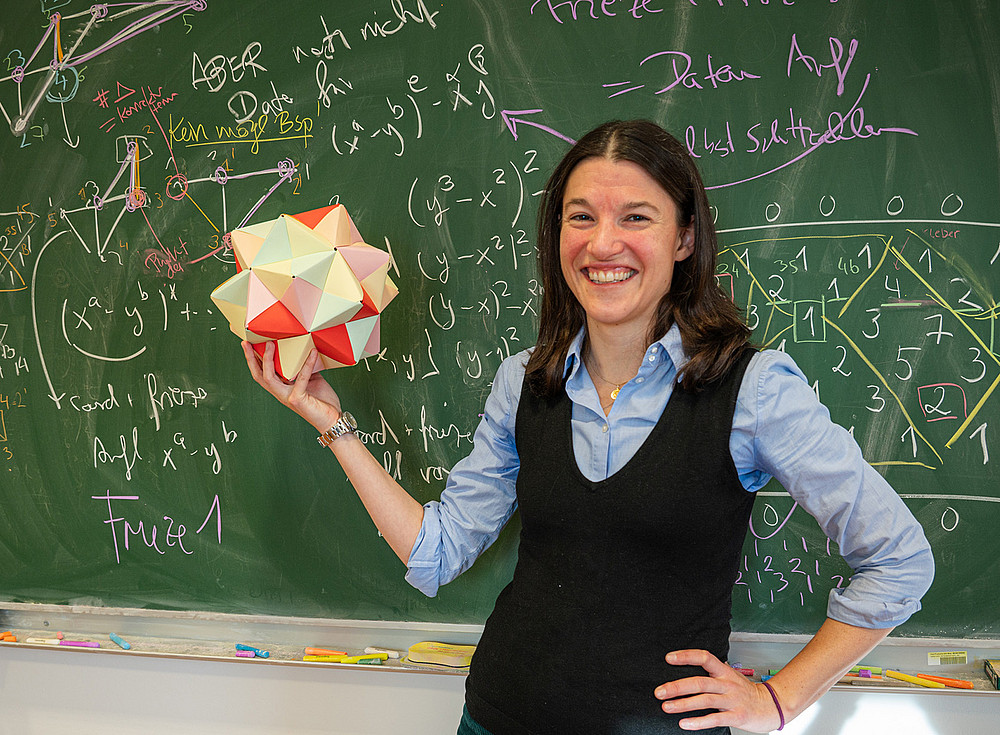
Algebra zum Anfassen: Eleonore Faber verwendet anschauliche Beispiele - wie etwa einen selbst gebastelten Ikosaederstern - um zu erklären, wie man geometrische Strukturen mit algebraischen Methoden beschreibt. Foto: Uni Graz/Leljak.

How can the movements of robotic arms be described using maths? And what does a computer need to understand in order to function? The magic word to answer these questions is algebra. Eleonore Faber has been a professor of this branch of mathematics at the University of Graz for two years. She is particularly interested in complex phenomena that cannot be fully understood using conventional rules or laws - where algebra becomes "fuzzy".

Algebra uses letters, symbols and rules to describe states, processes and objects, for example in the form of equations. However, these do not always provide clear solutions. "It can happen, for example, that an algebraic curve has a 'kink', corners, peaks or intersections. Then there is more than one tangent at some points," says Faber, referring to one of her specialisms - singularities.

It is precisely this process - categorising and describing exceptional cases - that she finds exciting about her field of research: "When we see a singularity, we try to present it in a comprehensible way. But to do this, we first have to build up the vocabulary and develop the appropriate methods. It often feels like we're learning a new language," she explains

From the Olympics to science

Faber heads the Algebra and Number Theory research group at the University of Graz. After studying in Vienna, she returned to Austria two years ago after spending time in Canada, the USA, Sweden and the UK. She believes it is particularly important to teach students early on that university mathematics has little to do with the arithmetic they are familiar with from school. "I wasn't very good at maths at school at first. I wasn't interested in the subject at all," says Faber. It wasn't until the Maths Olympiad that the spark was ignited: "Suddenly it was all about working out and proving things together. I was much more interested in that than pure text problems," smiles the researcher.

Arithmetic = computer, thinking = human

It is precisely these skills that she wants to pass on to her students: "At university, we deal with definitions, structures and the question of what can be considered a mathematical proof. The computer does the arithmetic anyway. It is crucial to understand how and why methods work." And because everything has two (or more) sides, Eleonore Faber loves to visualise algebraic forms - in 2D on her Instagram account or, when time allows, in 3D paper models for her courses.

>> If you want to immerse yourself in the world of scientific computing, you can do so on the Bachelor's degree programme in Mathematics.

created by Gerhild Leljak

Related news

Jurist Jürgen Pirker erhält den Wissenschaftspreises der Margaretha Lupac-Stiftung

Wie kann der Staat nationale Minderheiten schützen? Wie kann er darauf achten, dass Mitglieder einer bestimmten ethnischen oder religiösen Gruppe nicht gezwungen werden, ihre persönlichen Freiheiten aufgrund dieser Zugehörigkeit aufzugeben? Und wie ging Österreich in den vergangenen 180 Jahren mit dieser Frage um?

Preserving knowledge: Book sponsorship success story cracks the 100,000 euro mark

The special collections of Graz University Library comprise around 300,000 valuable objects from 25 centuries: Papyri, manuscripts, incunabula, maps and printed books. The sensational find from 2023 is also kept here: the Graz Mummy Book, the world's oldest known book fragment in codex form.

Semester abroad without barriers: University of Graz wins award for promoting inclusion

The University of Graz has been awarded the Internationalization Award for its new inclusion initiative. Students with fewer opportunities now also receive financial support for their semester abroad outside Europe.

Fair distribution: Researchers determine just greenhouse gas budgets for all EU regions

Ten years ago, on 12 December 2015, the Paris Climate Agreement was signed at the UN Climate Conference. In order to limit global warming to well below two degrees, only a certain amount of CO2 may be emitted worldwide. While the focus was originally on national emission targets, more than 200 subnational regions and almost 300 cities have now adopted their own targets. But how many emissions are they fairly entitled to? Researchers at the University of Graz have now developed transparent criteria for fair distribution at the subnational level for the first time and determined corresponding greenhouse gas budgets for all European regions. The paper was published today in the scientific journal Nature Communications.

Begin of page section:
Additional information:

University of Graz
Universitaetsplatz 3
8010 Graz
Austria
  • Contact
  • Web Editors
  • Moodle
  • UNIGRAZonline
  • Imprint
  • Data Protection Declaration
  • Accessibility Declaration
Weatherstation
Uni Graz

End of this page section. Go to overview of page sections

End of this page section. Go to overview of page sections

Begin of page section:

End of this page section. Go to overview of page sections