



Begin of page section:
Page sections:

  • Go to contents (Accesskey 1)
  • Go to position marker (Accesskey 2)
  • Go to main navigation (Accesskey 3)
  • Go to sub navigation (Accesskey 4)
  • Go to additional information (Accesskey 5)
  • Go to page settings (user/language) (Accesskey 8)
  • Go to search (Accesskey 9)

End of this page section. Go to overview of page sections

Begin of page section:
Page settings:

English en
Deutsch de
Search
Login

End of this page section. Go to overview of page sections

Begin of page section:
Search:

Search for details about Uni Graz
Close

End of this page section. Go to overview of page sections


Search

Begin of page section:
Main navigation:

Page navigation:

  • University

    University
    • About the University
    • Organisation
    • Faculties
    • Library
    • Working at University of Graz
    • Campus
    Developing solutions for the world of tomorrow - that is our mission. Our students and our researchers take on the great challenges of society and carry the knowledge out.
  • Research Profile

    Research Profile
    • Our Expertise
    • Research Questions
    • Research Portal
    • Promoting Research
    • Research Transfer
    • Ethics in Research
    • Commission for Scientific Integrity
    Scientific excellence and the courage to break new ground. Research at the University of Graz creates the foundations for making the future worth living.
  • Studies

    Studies
    • Prospective Students
    • Students
  • Community

    Community
    • International
    • Location
    • Research and Business
    • Alumni
    The University of Graz is a hub for international research and brings together scientists and business experts. Moreover, it fosters the exchange and cooperation in study and teaching.
Topics
  • Sustainable University
  • Researchers answer
  • Work for us
Close menu

End of this page section. Go to overview of page sections

Begin of page section:
You are here:

University of Graz News Kink in the curve: Eleonore Faber researches the "fuzzy" parts of algebra

End of this page section. Go to overview of page sections

Thursday, 18 December 2025

Kink in the curve: Eleonore Faber researches the "fuzzy" parts of algebra

Eine Frau steht vor einer grünen Schultafel

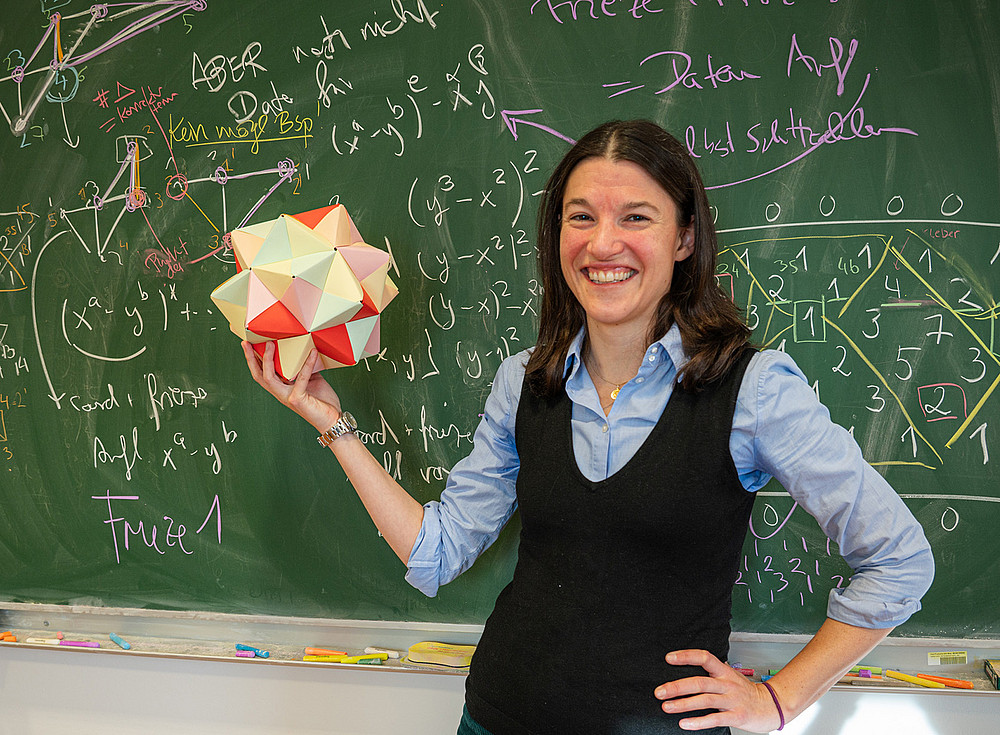
Algebra zum Anfassen: Eleonore Faber verwendet anschauliche Beispiele - wie etwa einen selbst gebastelten Ikosaederstern - um zu erklären, wie man geometrische Strukturen mit algebraischen Methoden beschreibt. Foto: Uni Graz/Leljak.

How can the movements of robotic arms be described using maths? And what does a computer need to understand in order to function? The magic word to answer these questions is algebra. Eleonore Faber has been a professor of this branch of mathematics at the University of Graz for two years. She is particularly interested in complex phenomena that cannot be fully understood using conventional rules or laws - where algebra becomes "fuzzy".

Algebra uses letters, symbols and rules to describe states, processes and objects, for example in the form of equations. However, these do not always provide clear solutions. "It can happen, for example, that an algebraic curve has a 'kink', corners, peaks or intersections. Then there is more than one tangent at some points," says Faber, referring to one of her specialisms - singularities.

It is precisely this process - categorising and describing exceptional cases - that she finds exciting about her field of research: "When we see a singularity, we try to present it in a comprehensible way. But to do this, we first have to build up the vocabulary and develop the appropriate methods. It often feels like we're learning a new language," she explains

From the Olympics to science

Faber heads the Algebra and Number Theory research group at the University of Graz. After studying in Vienna, she returned to Austria two years ago after spending time in Canada, the USA, Sweden and the UK. She believes it is particularly important to teach students early on that university mathematics has little to do with the arithmetic they are familiar with from school. "I wasn't very good at maths at school at first. I wasn't interested in the subject at all," says Faber. It wasn't until the Maths Olympiad that the spark was ignited: "Suddenly it was all about working out and proving things together. I was much more interested in that than pure text problems," smiles the researcher.

Arithmetic = computer, thinking = human

It is precisely these skills that she wants to pass on to her students: "At university, we deal with definitions, structures and the question of what can be considered a mathematical proof. The computer does the arithmetic anyway. It is crucial to understand how and why methods work." And because everything has two (or more) sides, Eleonore Faber loves to visualise algebraic forms - in 2D on her Instagram account or, when time allows, in 3D paper models for her courses.

>> If you want to immerse yourself in the world of scientific computing, you can do so on the Bachelor's degree programme in Mathematics.

created by Gerhild Leljak

Related news

Uni Vibes: Where science and art come together

At the third Uni Vibes event hosted by the University of Graz, visitors enjoyed science, music and performances on campus. Guided tours focusing on democracy, educational sciences and the Graz Centre of Physics demonstrated how research shapes community life, urban development and culture.

Protest against budget cuts: universities send a united message in Graz

On 28 May, thousands of students, researchers and staff from all Styrian universities demonstrated in Graz against the announced budget cuts. University management and student representatives warned of severe consequences for research, teaching and the region’s standing as a centre of academic excellence.

Overcoming boundaries: Can we manage without prisons and camps?

The US immigration agency ICE has sparked fear and horror. Not only are migrants criminalised and brutally persecuted, but earlier this year, ICE officers killed two US citizens in Minneapolis. Against the backdrop of these dramatic events, the University of Graz is shedding light on the role of deportation and detention centres as part of the international conference ‘Camps, Belonging, and Abolition Democracy’. Researchers aim to develop scenarios for how a future without prisons and the death penalty can become a reality.

From one to many: Uni Graz researchers identify a mechanism for the origin of species

When a habitat changes, animals, plants and even humans must adapt to the new environmental conditions. Those who manage this fastest and best will prevail. Over time, new species that are specialised for specific habitats also develop. Zoologist Christian Sturmbauer and his research group at the University of Graz, together with international partners, have now demonstrated that the molecular biological process of “alternative splicing” – contrary to previous assumptions – contributes highly effectively to the formation of new species. Different combinations of parts of the same gene give rise to various, structurally slightly different variants of functional proteins. This leads very rapidly to significant changes. The research findings were published in the renowned journal Proceedings of the National Academy of Sciences.

Begin of page section:
Additional information:

University of Graz
Universitaetsplatz 3
8010 Graz
Austria
  • Contact
  • Web Editors
  • Moodle
  • UNIGRAZonline
  • Imprint
  • Data Protection Declaration
  • Accessibility Declaration
Weatherstation
Uni Graz

End of this page section. Go to overview of page sections

End of this page section. Go to overview of page sections

Begin of page section:

End of this page section. Go to overview of page sections