



Begin of page section:
Page sections:

  • Go to contents (Accesskey 1)
  • Go to position marker (Accesskey 2)
  • Go to main navigation (Accesskey 3)
  • Go to sub navigation (Accesskey 4)
  • Go to additional information (Accesskey 5)
  • Go to page settings (user/language) (Accesskey 8)
  • Go to search (Accesskey 9)

End of this page section. Go to overview of page sections

Begin of page section:
Page settings:

English en
Deutsch de
Search
Login

End of this page section. Go to overview of page sections

Begin of page section:
Search:

Search for details about Uni Graz
Close

End of this page section. Go to overview of page sections


Search

Begin of page section:
Main navigation:

Page navigation:

  • University

    University
    • About the University
    • Organisation
    • Faculties
    • Library
    • Working at University of Graz
    • Campus
    Developing solutions for the world of tomorrow - that is our mission. Our students and our researchers take on the great challenges of society and carry the knowledge out.
  • Research Profile

    Research Profile
    • Our Expertise
    • Research Questions
    • Research Portal
    • Promoting Research
    • Research Transfer
    • Ethics in Research
    • Commission for Scientific Integrity
    Scientific excellence and the courage to break new ground. Research at the University of Graz creates the foundations for making the future worth living.
  • Studies

    Studies
    • Prospective Students
    • Students
  • Community

    Community
    • International
    • Location
    • Research and Business
    • Alumni
    The University of Graz is a hub for international research and brings together scientists and business experts. Moreover, it fosters the exchange and cooperation in study and teaching.
Topics
  • Sustainable University
  • Researchers answer
  • Work for us
Close menu

End of this page section. Go to overview of page sections

Begin of page section:
You are here:

University of Graz News Climate change in the atmosphere

End of this page section. Go to overview of page sections

Friday, 05 November 2021

Climate change in the atmosphere

Long-term temperature trends in the atmosphere can have an impact on large-scale circulation, which determines global climate and weather patterns. Photo: pixabay

Long-term temperature trends in the atmosphere can have an impact on large-scale circulation, which determines global climate and weather patterns. Photo: pixabay

Researchers at the University of Graz clarify causes for the continuous rise of the boundary between the weather layer and the stratosphere

For decades, researchers have been noticing changes in the atmosphere. For example, the troposphere, the weather layer, is becoming increasingly warmer, while the stratosphere above it is cooling. As a result, the boundary between the two layers – the tropopause – is shifting ever higher. Andrea Steiner and Hallgeir Wilhelmsen from the Wegener Center and Doctoral Programme Climate Change at the University of Graz, together with colleagues from China, Canada, the USA and Leo Haimberger from the University of Vienna, have analysed data from 1980 to 2020. The results, published in the scientific journal Science Advances, now prove the extent of the rise of the tropopause. Per decade, this boundary rises by about 50 meters over the Northern Hemisphere. The long-term temperature trends in the atmosphere are linked to the greenhouse gas emissions. Among other things, the structural changes can also have an impact on large-scale circulation that determines global climate and weather patterns.

"As the troposphere warms, it expands, pushing up the boundary with the stratosphere. At the same time, the stratosphere contracts due to its cooling, which further promotes the rise of the tropopause," explains Andrea Steiner, director of the Wegener Center and co-author of the current publication. It is interesting to note that the ratio in which the changes in both layers contribute to the rise in the tropopause has shifted clearly over the observation period: "From 1980 to 2000, the weather layer and the stratosphere each contributed 50 percent to the increase in the tropopause. Since the turn of the millennium, the stronger warming of the weather layer has been responsible for about 80 percent of the increase," Steiner reports. The influence of the stratosphere has decreased to about 20 percent. "This can be explained by its reduced cooling, which in turn must be seen in connection with the regeneration of the ozone layer," adds the atmospheric physicist.

For the current publication, the researchers analysed observational data from radiosondes as well as radio occultation data. The former are carried by weather balloons and cover the Northern Hemisphere well. Radio occultation measurements have only been available continuously since 2001. They are based on GPS signals sent from transmitter to receiver satellites and influenced by temperature and other factors as they travel through the atmosphere. From this, it is possible to derive extremely accurate data on these climate variables in all layers of the atmosphere. Furthermore, it becomes possible to clearly distinguish short-term climate fluctuations caused by natural phenomena from human-induced long-term trends.

Publication
Continuous rise of the tropopause in the Northern Hemisphere over 1980-2020
Lingyun Meng, Jane Liu, David W. Tarasick, William J. Randel, Andrea K. Steiner, Hallgeir Wilhelmsen, Lei Wang, Leopold Haimberger
Science Advances, 7, eabi8065 (2021), Nov. 5.
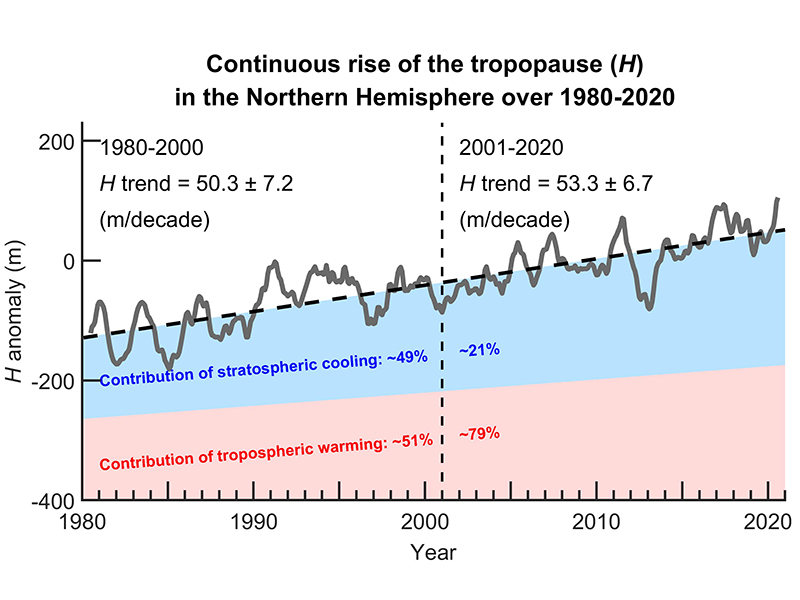

The rise of the tropopause over the Northern Hemisphere from 1980 to 2020 is caused by tropospheric warming and stratospheric cooling. Since the 2000s, it is primarily the increased warming of the troposphere that contributes to the continuous rise. Source: Meng and co-authors 2021
created by Gudrun Pichler

Related news

Will Austria win the World Cup? Mathematician reveals calculation method

Michael Fischer uses the football tournament as a practical example for highschool lessons.

Survival strategies: How plants respond to drought

According to Geosphere Austria, this spring was the driest in Austria since records began around 170 years ago. The low rainfall put particular pressure on the agricultural sector. And climate change is set to make the situation even worse in the coming decades. We asked Johannes Liesche, a professor at the Department of Biology at the University of Graz, how plants react to water shortages and how they survive periods of drought.

World literature from Austria: Anne-Kathrin Reulecke on Ingeborg Bachmann

On 25 June, Ingeborg Bachmann would have turned 100. To this day, she remains one of the most important German-language authors. Anne-Kathrin Reulecke, Professor of Modern German Literature at the Institute of German Studies, has conducted extensive research into the writer, who died in 1973. The academic explains why Bachmann continues to be influential and what makes her work so special. In addition to her literary analysis, Anne-Kathrin Reulecke shares some reading recommendations.

What matters in the end: moral theologian takes stock of assisted suicide

Since 1 January 2022, assisted suicide has been legal in Austria under certain conditions. This was made possible by a ruling of the Constitutional Court, which overturned the blanket ban on assisting in suicide. Four years on, it is clear that: “Although the legal framework is in place, many pressing questions remain unanswered when it comes to its practical implementation,” says Johann Platzer, a moral theologian at the University of Graz.

Begin of page section:
Additional information:

University of Graz
Universitaetsplatz 3
8010 Graz
Austria
  • Contact
  • Web Editors
  • Moodle
  • UNIGRAZonline
  • Imprint
  • Data Protection Declaration
  • Accessibility Declaration
Weatherstation
Uni Graz

End of this page section. Go to overview of page sections

End of this page section. Go to overview of page sections

Begin of page section:

End of this page section. Go to overview of page sections


