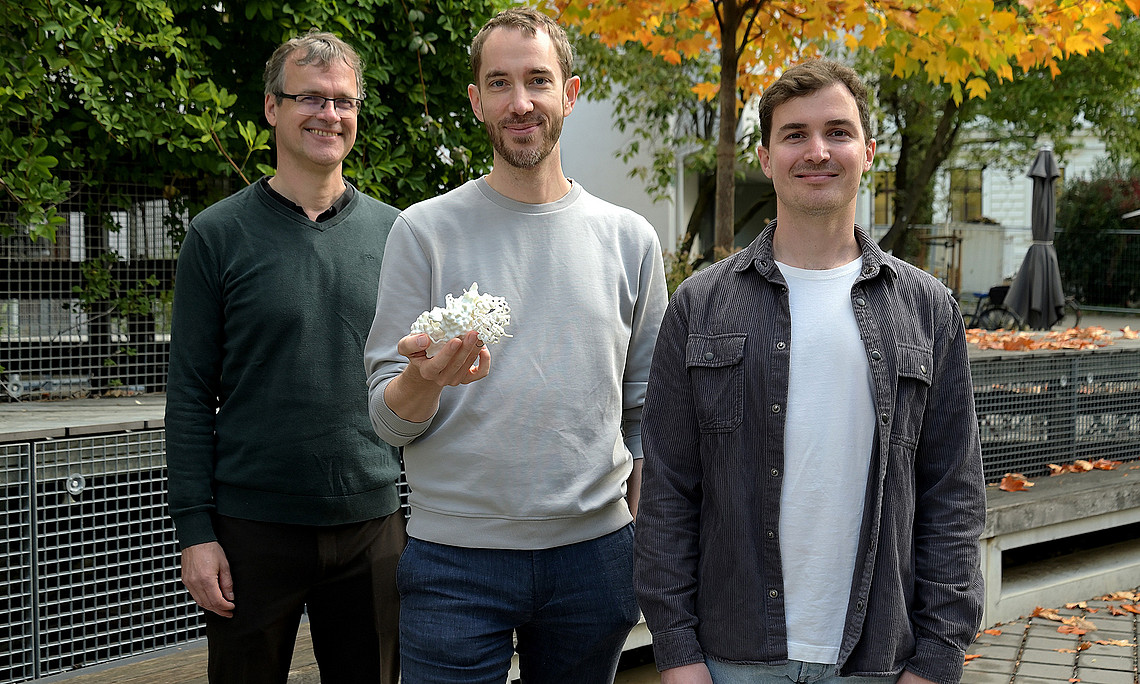
“We wanted to find out why embryonic tissues sometimes behave like a fluid and change shape rapidly during development, but later become firmer and stabilise into new forms. This determines the role the cell will later take on – for example, whether it becomes a liver cell or a skin cell,” explains Bernat Corominas Murtra from the Institute of Biology at the University of Graz. A key factor in this process is what is known as ‘adhesion’ – the force with which cells stick to one another.
If this cell adhesion exceeds a critical point, the tissue changes abruptly. It becomes stiffer, and the fine gaps close. This sets the course for the tissue’s further development. This process was particularly evident in the zebrafish embryos studied, as they are transparent in their early stages. Researchers can therefore observe, within the living embryo, how tissue building blocks move, adhere to one another and respond to developmental signals.
Coromina Murtra explains the role of mathematical biology in the studies: “Mathematics makes the causal chain visible. This enabled us to show how a change at the cellular level – namely the ‘adhesion effect’ – creates an abrupt transition at the tissue level and thereby influences how far a developmental signal reaches within the embryo.” His research is driven by curiosity and the joy of finding answers to the question of how complex life arises. “In doing so, we take a radically interdisciplinary approach, breaking down the boundaries between disciplines in order to seek answers from as unbiased a perspective as possible,” explains the researcher.
Graz as a hub for mathematical biology
Mathematics will soon take centre stage at a major event in Graz: from 13 to 17 July 2026, the “ECMTB 2026” congress will bring more than 1,000 researchers from the fields of mathematical and theoretical biology to the University of Graz. The conference will demonstrate how mathematics makes biological processes quantifiable. Topics will range from cell movement and embryonic development, through infection dynamics, to data-driven methods in medicine and the life sciences.
Publications:
Laura Rustarazo Calvo, Cristina Pallarès Cartes, Adrián Aguirre Tamaral et al.: “Adhesion-driven rigidity transition decoupled from density-driven jamming triggers epithelial organisation in embryonic tissues”. Cover story in *Nature Physics*, published on 2 June 2026, DOI: 10.1038/s41567-026-03276-6.
Camilla Autorino et al.: “Tissue rigidity phase transition shapes morphogen gradients”. Nature Cell Biology, published on 14 May 2026, DOI: 10.1038/s41556-026-01954-4.
>> Anyone wishing to specialise in mathematics and/or biology can do so by studying at the University of Graz: https://www.uni-graz.at/de/studium/