



Begin of page section:
Page sections:

  • Go to contents (Accesskey 1)
  • Go to position marker (Accesskey 2)
  • Go to main navigation (Accesskey 3)
  • Go to sub navigation (Accesskey 4)
  • Go to additional information (Accesskey 5)
  • Go to page settings (user/language) (Accesskey 8)
  • Go to search (Accesskey 9)

End of this page section. Go to overview of page sections

Begin of page section:
Page settings:

English en
Deutsch de
Search
Login

End of this page section. Go to overview of page sections

Begin of page section:
Search:

Search for details about Uni Graz
Close

End of this page section. Go to overview of page sections


Search

Begin of page section:
Main navigation:

Page navigation:

  • University

    University
    • About the University
    • Organisation
    • Faculties
    • Library
    • Working at University of Graz
    • Campus
    Developing solutions for the world of tomorrow - that is our mission. Our students and our researchers take on the great challenges of society and carry the knowledge out.
  • Research Profile

    Research Profile
    • Our Expertise
    • Research Questions
    • Research Portal
    • Promoting Research
    • Research Transfer
    • Ethics in Research
    • Commission for Scientific Integrity
    Scientific excellence and the courage to break new ground. Research at the University of Graz creates the foundations for making the future worth living.
  • Studies

    Studies
    • Prospective Students
    • Students
  • Community

    Community
    • International
    • Location
    • Research and Business
    • Alumni
    The University of Graz is a hub for international research and brings together scientists and business experts. Moreover, it fosters the exchange and cooperation in study and teaching.
  • Spotlight
Topics
  • Sustainable University
  • Researchers answer
  • Work for us
Close menu

End of this page section. Go to overview of page sections

Begin of page section:
You are here:

University of Graz News Junge Forschung

End of this page section. Go to overview of page sections

Friday, 30 May 2014

Junge Forschung

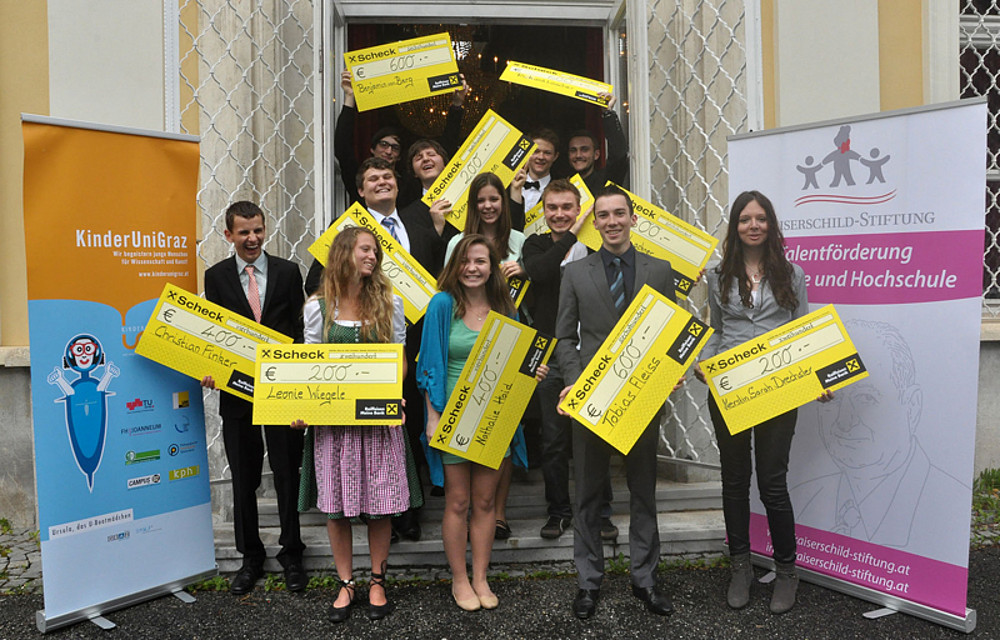
Glückliche GewinnerInnen: Die mit dem Hans-Riegel-Fachpreis ausgezeichneten MaturantInnen 2014.

Glückliche GewinnerInnen: Die mit dem Hans-Riegel-Fachpreis ausgezeichneten MaturantInnen 2014.

Verleihung der Dr. Hans Riegel-Fachpreise an ausgezeichnete vorwissenschaftliche Arbeiten

Noch drücken sie die Schulbank, aber bereits jetzt machen sie mit äußerst vielversprechenden vorwissenschaftlichen Leistungen auf sich aufmerksam, sodass eine Laufbahn als ForscherIn vorgezeichnet scheint: Jene 12 MaturantInnen, die heuer mit den Dr. Hans-Riegel-Fachpreisen ausgezeichnet wurden. Ihre exzellente Fachbereichsarbeiten in den Fächern Biologie, Chemie, Mathematik und Physik wurden mit dem Preis, der heuer mit einem Gesamtwert von 6000 Euro dotiert ist, honoriert. Verliehen wird er von der Gemeinnützigen Privatstiftung Kaiserschild, gegründet von Dr. Hans Riegel, dem Erben des Haribo-Süßwarenkonzerns. An vier österreichischen Universitäten wird der Preis bereits verliehen. 


Auch heuer zeichneten sich die aus insgesamt 42 Einreichungen gewählten Siegerarbeiten durch eine enorme inhaltliche Bandbreite aus: Pränatale Untersuchungen, Nanosilber im Abwasser oder das "Lebenselexier" Milch waren etwa Gegenstand der Untersuchungen. Davon beeindruckt zeigten sich die Ehrengäste der Veranstaltung, Uni-Graz-Vizerektorin Renate Dworczak, Bürgermeisterstellvertreterin Martina Schröck, Landtagsabgeordnete Alexandra Pichler-Jessenko, Stadtrat Kurt Hohensinner, Landesrat Michael Schickhofer sowie Marco Alfter, Vorstandsvorsitzender der Kaiserschild-Stiftung. 


Zum fünften Mal belohnten die Dr. Hans Riegel-Fachpreise in Österreich die drei besten Fachbereichsarbeiten den Naturwissenschaften mit 600, 400 und 200 Euro. Die Schulen der Erstplatzierten erhalten außerdem einen Sachpreis im Wert von je 250 Euro zur Förderung des naturwissenschaftlichen Unterrichts. Insgesamt wurde somit eine Summe von 6000 Euro als Preisgeld zur Verfügung gestellt. In der Steiermark organisiert den Wettbewerb die KinderUniGraz.


Die PreisträgerInnen 2014 sind:


Biologie:

1. Platz: Florian Lackner; „Genetischer Algorithmus“, Akad. Gym. Graz,
2. Platz: Nathalie Haid; „Begegnung mit Pollinosis“, BRG Kepler
3. Platz: Leonie Wiegele; „Blick in die Zukunft eines Menschen. Grundlagen und Methoden pränataler Untersuchungen“, privates Gym und ORG der Ursulinen


Chemie:

1. Platz: Tobias Fleiß; „Nanosilber und Metallströme im Abwasser“, BG/BRG Carneri
2. Platz: Jarom Korak; „Grundlagen des Drug Targeting“, BG/BRG Carneri
3. Platz: Kerstin Sarah Drechsler; „Lebenselixier Milch!? – Milch als Eiweiß- und Kalziumquelle“, BG/BRG Knittelfeld


Mathematik:

1. Platz: Richard Löscher; „Steinerkreis – ein Werkzeug der Projektiven Geometrie“, BRG Petersgasse
2. Platz: Christian Finker; „Entwicklung einer Smartphone-optimierten Webplattform für das BRG Kepler auf Basis von Datenbanken“, BRG Kepler
3. Platz: Corinna Mathwieser; „Gruppentheorie und ihre Anwendung in der Chemie“, BG/BRG Carneri


Physik:

1. Platz: Benjamin von Berg; „Die Möglichkeiten des 3D Drucks mit dem Verfahren des Fused Deposition Modeling anhand des RepRap Prusa Mendel 12“, BRG Kepler
2. Platz: Paul Worm; „Optimizing the strength of paper bridges”, BG/BRG Seebacher
3. Platz: Desmond Grossmann; “Das Kepler Weltraumteleskop”, BRG Kepler

created by Gerhld Kastrun

Related news

Higher Education Strategy 2040: Austria’s universities on course for the future

Austria has 77 higher education institutions, which is above the EU average – but does this really make sense? The new Higher Education Strategy 2040 focuses on cooperation rather than mergers. As one of the six largest universities in Austria, the University of Graz plays a central role in this.

Climate research in Greenland: Old data provides new insights

The polar explorer and University of Graz professor Alfred Wegener left behind a unique collection of climate data from Greenland. A research team from the University of Graz is now analysing this 100-year-old treasure trove of data and comparing it with current measurements.

Diversity in nature and science: How we talk about plants and each other

Ginkgo, kiwi, hemp: they exist as male and female plants. Anyone who paid attention in biology class will confirm this. But is this categorisation, established by Carl von Linné almost 300 years ago, still valid today? An interdisciplinary team at the University of Graz is questioning these attributions and using this as a starting point to provide food for thought for gender-sensitive interaction between students, scientific and teaching staff.

Around the world in eight stops: the Long Night of Research at the University of Graz

On 24 April from 5 pm, you can take a short trip around the globe at the University of Graz, discovering pecularities of foreign countries or new local features in the entrance hall of the University Library. The itinerary takes you through introduced animal species, political attitudes and the omnipotence of algorithms. There will also be a programme in the historic reading hall, as well as at the UniGraz@Museum and the University Archive.

Begin of page section:
Additional information:

University of Graz
Universitaetsplatz 3
8010 Graz
Austria
  • Contact
  • Web Editors
  • Moodle
  • UNIGRAZonline
  • Imprint
  • Data Protection Declaration
  • Accessibility Declaration
Weatherstation
Uni Graz

End of this page section. Go to overview of page sections

End of this page section. Go to overview of page sections

Begin of page section:

End of this page section. Go to overview of page sections

