Begin of page section:
Page sections:

  • Go to contents (Accesskey 1)
  • Go to position marker (Accesskey 2)
  • Go to main navigation (Accesskey 3)
  • Go to sub navigation (Accesskey 4)
  • Go to additional information (Accesskey 5)
  • Go to page settings (user/language) (Accesskey 8)
  • Go to search (Accesskey 9)

End of this page section. Go to overview of page sections

Begin of page section:
Page settings:

English en
Deutsch de
Search
Login

End of this page section. Go to overview of page sections

Begin of page section:
Search:

Search for details about Uni Graz
Close

End of this page section. Go to overview of page sections


Search

Begin of page section:
Main navigation:

Page navigation:

  • University

    University
    • About the University
    • Organisation
    • Faculties
    • Library
    • Working at University of Graz
    • Campus
    Developing solutions for the world of tomorrow - that is our mission. Our students and our researchers take on the great challenges of society and carry the knowledge out.
  • Research Profile

    Research Profile
    • Our Expertise
    • Research Questions
    • Research Portal
    • Promoting Research
    • Research Transfer
    • Ethics in Research
    Scientific excellence and the courage to break new ground. Research at the University of Graz creates the foundations for making the future worth living.
  • Studies

    Studies
    • Prospective Students
    • Students
  • Community

    Community
    • International
    • Location
    • Research and Business
    • Alumni
    The University of Graz is a hub for international research and brings together scientists and business experts. Moreover, it fosters the exchange and cooperation in study and teaching.
  • Spotlight
Topics
  • Our digital Advent calendar
  • Sustainable University
  • Researchers answer
  • Work for us
Close menu

End of this page section. Go to overview of page sections

Begin of page section:
You are here:

University of Graz News In the wheel of time: Graduates of the University of Graz from four centuries

End of this page section. Go to overview of page sections

Monday, 15 September 2025

In the wheel of time: Graduates of the University of Graz from four centuries

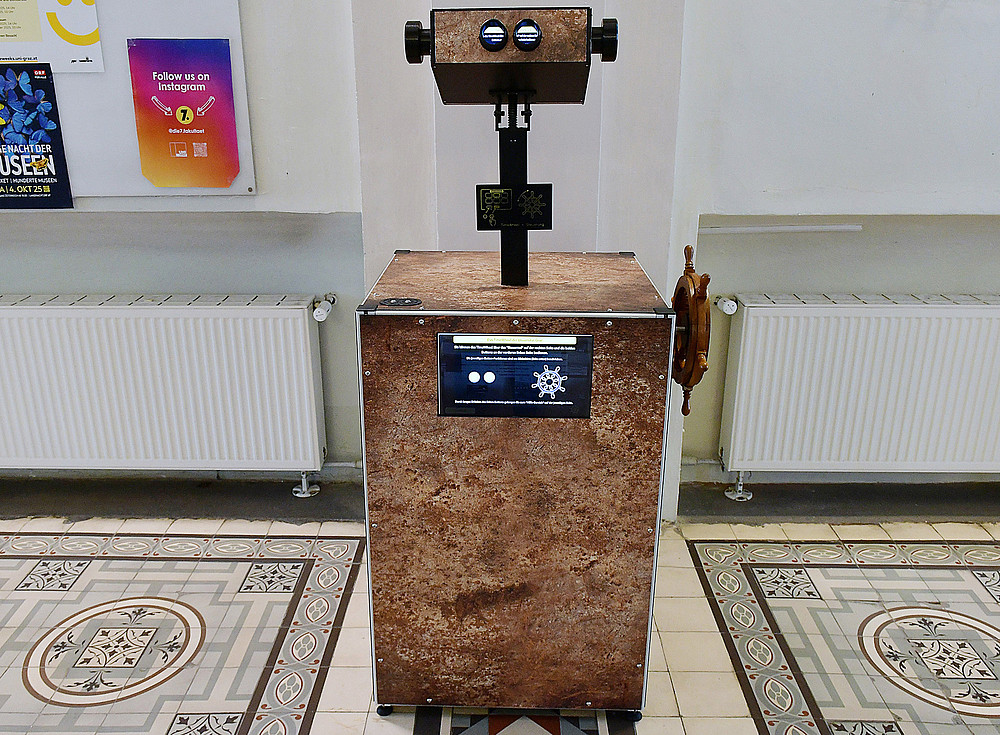
the Time Wheel, a metal box with an eyepiece, a wheel for turning on the side, two buttons and a display on the front ©University of Graz / Pichler

The Time Wheel contains the names of graduates of the University of Graz from four centuries, along with information about their origins. Photo: University of Graz / Pichler

What would the University of Graz be without the people who studied, worked and made their mark here? Some of them were famous or became famous later in life, while others were almost forgotten. Their names have survived the centuries in the university archives. Now they are being brought back into the light: in a "wheel of time" in the foyer of the main building of the University of Graz. Presented for the first time on 12 September 2025, the project is a tribute to the diversity and richness of human experience that has made the university a unique place of learning and inspiration for over 400 years.


A box with an eyepiece, a wheel to turn, two buttons and a computer inside – the “machine” that has recently been installed in the entrance area of the main building at Universitätsplatz 3 is a strange mixture of old and new. It has this in common with the university. If you take a look inside, turn and press, you will find the names of University of Graz graduates from four centuries, including information about their origins. Step by step, more will be added, including those of people who have researched and taught here or been employees with other tasks.

“From the early students and scientists to those who work at the University of Graz today and acquire new knowledge – people from different countries and cultures have always come together here. The Time Wheel is dedicated to them all and invites visitors to discover this diversity,” says Rector Peter Riedler about the idea behind the project.

The initiative came from Kurt-Martin Lugger, Head of Human Resources: “The Time Wheel Project aims to show that the true strength of the University of Graz lies above all in its community of people who are committed to knowledge, innovation and cooperation.”

The “hardware” for this unique machine was built in the precision engineering workshops at the University of Graz, equipped with software from the HR Applications team in the Human Resources Department and fed with data from the university archives.

empty picture
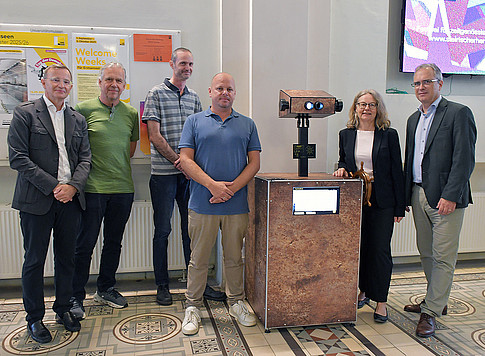
The Time Wheel and the team behind the project: Kurt-Martin Lugger, Robert Holzapfel, Andreas Golob, Franz-Thomas Stelzel and Christine Rigler (from left) with Rector Peter Riedler ©University of Graz / Pichler
©University of Graz / Pichler
The team behind the Time Wheel (from left) – Kurt-Martin Lugger (Human Resources), Robert Holzapfel (Precision Engineering Workshop), Andreas Golob (University Archives), Franz-Thomas Stelzel (HR Applications), Christine Rigler (University Archives) – with Rector Peter Riedler. Photo: University of Graz / Pichler
created by Gudrun Pichler

Related news

On the trail of the Big Bang: University of Graz receives 1.5 million euros for doctoral programmes

The Austrian Science Fund FWF has selected the Doctoral Programme in Theoretical Particle Physics at the University of Graz for funding from the Doc.funds. Six young scientists will be funded for 3.5 years. They will gain fundamentally new insights into the origins of the world.

From trans women and knee prostheses: sports science prizes awarded

Walking better with a prosthesis, successfully getting rid of excess weight, training more effectively, more fairness for trans people in sport: these were the topics addressed by the students at the University of Graz who were awarded the sports science prizes for their Master's theses on 3 December 2025.

Influential: Rupert Baumgartner and Holger Hoff among the highly cited researchers

The number of publications in scientific journals is considered to be a measure of a researcher's scientific achievement. How often these works are cited by colleagues provides information about the relevance of the publications. Sustainability researcher Rupert Baumgartner and transdisciplinarity expert Holger Hoff from the University of Graz are among the top 1 per cent of the most cited scientists in their fields of research.

Nobel Lecture 2025: How evolution enters chemistry

During the Nobel Lecture at BioTechMed-Graz, Nobel Prize winner in Chemistry Frances H. Arnold provided insight into her research on the directed evolution of enzymes.

Begin of page section:
Additional information:

University of Graz
Universitaetsplatz 3
8010 Graz
Austria
  • Contact
  • Web Editors
  • Moodle
  • UNIGRAZonline
  • Imprint
  • Data Protection Declaration
  • Accessibility Declaration
Weatherstation
Uni Graz

End of this page section. Go to overview of page sections

End of this page section. Go to overview of page sections

Begin of page section:

End of this page section. Go to overview of page sections