Begin of page section:
Page sections:

  • Go to contents (Accesskey 1)
  • Go to position marker (Accesskey 2)
  • Go to main navigation (Accesskey 3)
  • Go to sub navigation (Accesskey 4)
  • Go to additional information (Accesskey 5)
  • Go to page settings (user/language) (Accesskey 8)
  • Go to search (Accesskey 9)

End of this page section. Go to overview of page sections

Begin of page section:
Page settings:

English en
Deutsch de
Search
Login

End of this page section. Go to overview of page sections

Begin of page section:
Search:

Search for details about Uni Graz
Close

End of this page section. Go to overview of page sections


Search

Begin of page section:
Main navigation:

Page navigation:

  • University

    University
    • About the University
    • Organisation
    • Faculties
    • Library
    • Working at University of Graz
    • Campus
    Developing solutions for the world of tomorrow - that is our mission. Our students and our researchers take on the great challenges of society and carry the knowledge out.
  • Research Profile

    Research Profile
    • Our Expertise
    • Research Questions
    • Research Portal
    • Promoting Research
    • Research Transfer
    • Ethics in Research
    Scientific excellence and the courage to break new ground. Research at the University of Graz creates the foundations for making the future worth living.
  • Studies

    Studies
    • Prospective Students
    • Students
    • Welcome Weeks for First Year Students
  • Community

    Community
    • International
    • Location
    • Research and Business
    • Alumni
    The University of Graz is a hub for international research and brings together scientists and business experts. Moreover, it fosters the exchange and cooperation in study and teaching.
  • Spotlight
Topics
  • Sustainable University
  • Researchers answer
  • Work for us
Close menu

End of this page section. Go to overview of page sections

Begin of page section:
You are here:

University of Graz News Teamwork: 100 pupils take part in maths competition at the University of Graz

End of this page section. Go to overview of page sections

Monday, 24 November 2025

Teamwork: 100 pupils take part in maths competition at the University of Graz

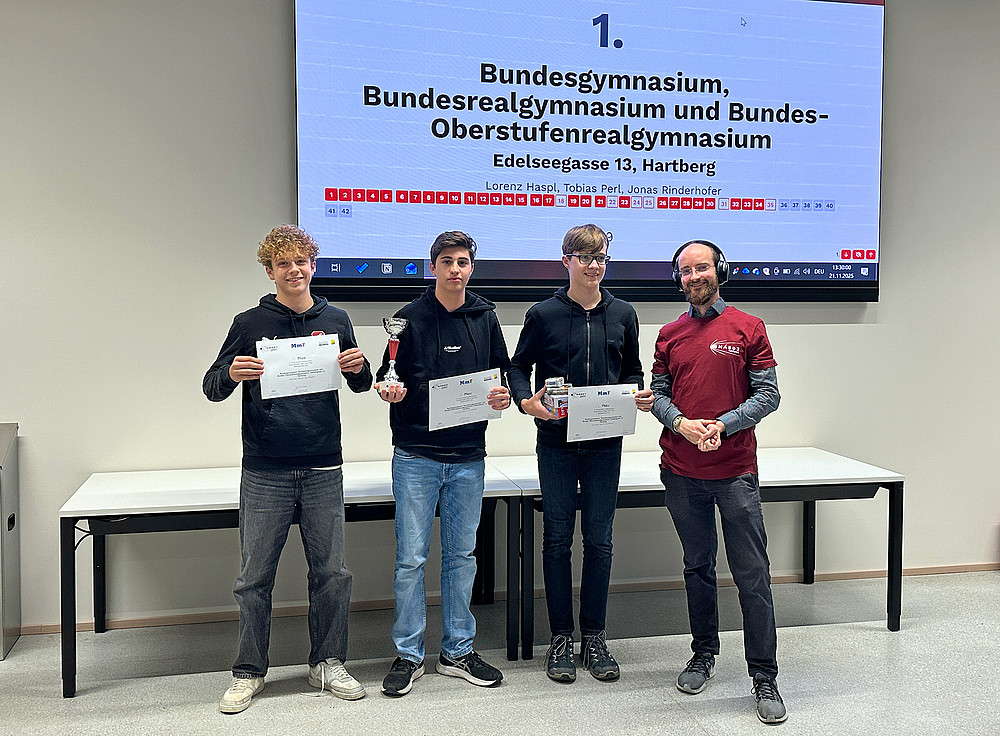
Group photo of the winners of the Naboj Junior Competition at the University of Graz

The fastest puzzlers at the University of Graz: Jonas Rinderhofer, Lorenz Haspl and Tobias Perl from BG/BRG/BORG Hartberg with co-organiser David Präsent. Photo: University of Graz

Four clever guts per group, increasingly tricky tasks, 120 minutes: these were the requirements for the international maths competition Náboj junior, which took place in Graz for the first time this year. The team from BG/BRG/BORG Hartberg was able to answer the most questions within the given limit - 29 - and thus won the competition.

The sum of six different positive integers is 22. What is their product? Or: It is so hot in the oven that the temperature in Fahrenheit would be exactly twice as high. How many degrees centigrade is it? The 25 Styrian teams from the 8th and 9th grades had to solve these and even more complex examples on 21 November at the University of Graz. They competed simultaneously with colleagues from numerous other European countries. "In the competition, we want to show possible applications of maths in everyday life. It's not about reproducing school material," explains Michael Fischer from the Department of Mathematics at the University of Graz, who brought the event to Austria. The participants need creativity and must be able to think outside the box. "Teamwork is very helpful for this. But there should also be at least one person who is quick at arithmetic," explains the researcher.

As soon as a group has solved an example, they are given the next one, with the level of difficulty constantly increasing. The thrill of competition and the desire to solve puzzles are a great motivation for many. "In some countries, there are even extra lessons in the afternoon, which the children attend voluntarily in order to be successful at Náboj," reports Fischer. Qualitative surveys have shown that such competitions increase the desire to do maths and give the subject a better image. "It's important to see in which areas you can apply maths. Many adults also enjoy solving Sudokus and didn't like the lessons."

>>Website of Náboj junior

created by Dagmar Eklaude

Related news

Survival yesterday and today: exhibition at the University of Graz makes poverty audible

What connects Anna from Styria, who lost her job two years ago due to illness, with the blacksmith Giulio, who worked in Bologna almost 500 years ago? Both are afraid of no longer being able to pay their rent. And what does the medieval Nuremberg begging ordinance have to do with current regulations in Graz? In both cases, the aim is to prevent too many people from begging for alms in the city. How do people cope with existential worries? To what extent are such experiences the same today as they were then? From 5 to 31 March 2026, an exhibition at the University of Graz will bring poverty in the present and the Middle Ages to life.

New AI Method Revolutionises the Design of Enzymes

Researchers at TU Graz and the University of Graz can use the technology to construct artificial biocatalysts. These new enzymes are significantly faster, more stable and more versatile than previous artificial biocatalysts.

The dark side of life: new method developed to identify soil organisms

A large number of soil animals are smaller than one millimetre and are therefore difficult to study scientifically. Biologists from the University of Graz have now developed a method to determine both the shape and the DNA of the organisms. The results have been published in the journal Geoderma.

How does peace succeed? Maximilian Lakitsch drives research forward

Donald Trump is rattling his proverbial sabre ever louder, unrest in the Middle East is escalating and the war in Ukraine continues to rage. Maximilian Lakitsch knows what political measures could contribute to reconciliation. He is the coordinator of an EU-wide initiative to strengthen peace research.

Begin of page section:
Additional information:

University of Graz
Universitaetsplatz 3
8010 Graz
Austria
  • Contact
  • Web Editors
  • Moodle
  • UNIGRAZonline
  • Imprint
  • Data Protection Declaration
  • Accessibility Declaration
Weatherstation
Uni Graz

End of this page section. Go to overview of page sections

End of this page section. Go to overview of page sections

Begin of page section:

End of this page section. Go to overview of page sections